SEAMO self-study edition 2027; not an official 2027 paper. Original source years are retained. 25 questions, 90 minutes; Q1–10: 3 points, Q11–20: 4 points, Q21–25: 6 points, total 100. Original response types and all subparts are preserved. Verified is an editorial convention; source defects, necessary assumptions and unresolved mathematical uncertainty are disclosed.
Given $S=\{1,2,\ldots,10\}$, a family $F$ of subsets of $S$ is intersecting if any two members $A,B$ have a nonempty intersection $A\cap B$. What is the maximum size of $F$?
Enter the exact number only; fractions are allowed.
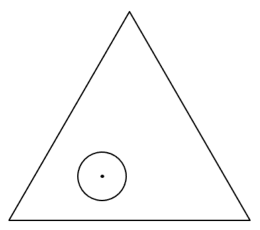
A circle of radius $r$ rolls freely inside an equilateral triangle of side $a$, where $a\ge2\sqrt3r$. Find the area inside the triangle that the circle does not cover.
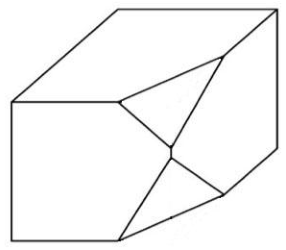
Each corner of a rectangular prism is cut off. The figure shows two of the eight cuts. How many edges does the new solid have? Assume the cutting planes do not intersect anywhere in or on the prism.
Find the smallest positive integer $k$ such that $\displaystyle\frac1{\log_{2^k}(2019!)}+\frac1{\log_{3^k}(2019!)}+\frac1{\log_{4^k}(2019!)}+\cdots+\frac1{\log_{2019^k}(2019!)}\gt \sqrt{2019}$.
Enter the exact number only; fractions are allowed.
Three red, four blue and two yellow flags are placed in order on nine numbered flagpoles, one flag on each pole. How many distinct flag patterns are possible?
For positive real numbers $a,b,c$, find the minimum value of $u=\left\lfloor\dfrac{a+b}{c}\right\rfloor+\left\lfloor\dfrac{b+c}{a}\right\rfloor+\left\lfloor\dfrac{c+a}{b}\right\rfloor$. Here $\lfloor t\rfloor$ denotes the greatest integer not exceeding $t$.
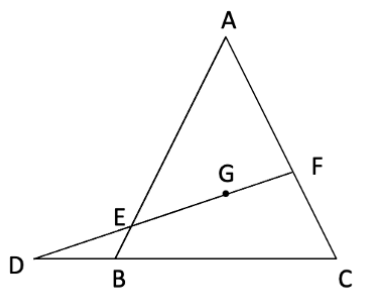
A line through the centroid $G$ of triangle $ABC$ meets $AB$ and $AC$ at $E$ and $F$, respectively, and meets the extension of $CB$ at $D$, as shown. Find $\dfrac{BE}{EA}+\dfrac{CF}{FA}$.
Enter the exact number only; fractions are allowed.
In a table-tennis tournament, each player is scheduled to play exactly one game against every other player. During the tournament three players withdraw, each having played exactly two matches. All matches among the remaining players are completed. If 50 matches are played in total, how many were played between the three withdrawn players?
Interpret the tournament as completed among all players who did not withdraw; this is the usual round-robin completion intended by the source.
Enter the exact number only; fractions are allowed.