SEAMO self-study edition 2027; not an official 2027 paper. Original source years are retained. 25 questions, 90 minutes; Q1–10: 3 points, Q11–20: 4 points, Q21–25: 6 points, total 100. Original response types and all subparts are preserved. Verified is an editorial convention; source defects, necessary assumptions and unresolved mathematical uncertainty are disclosed.
Suppose $a,b,c$ are positive real numbers such that $abc(a+b+c)=100$. Find the minimum value of $(a+b)(b+c)$.
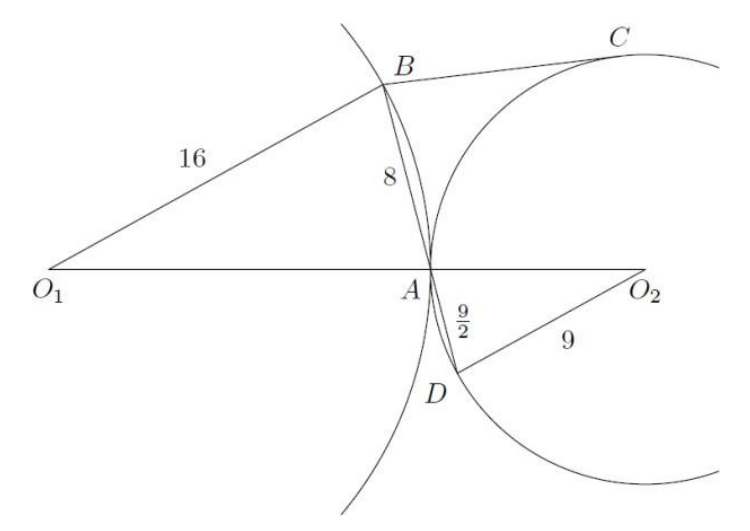
Circles $O_1$ and $O_2$ have radii $16$ and $9$, respectively, and are externally tangent at $A$. Point $B$ is chosen on circle $O_1$ such that $AB=8$, and $BC$ is tangent to circle $O_2$ at $C$. Compute $BC$.
It is given that $m$ is a real number not less than $-1$, such that the equation in $x$, $x^2+2(m-2)x+m^2-3m+3=0$, has two distinct real roots $x_1,x_2$. If $x_1^2+x_2^2=6$, find $m$.
Let $x,y,z$ be three positive real numbers such that $$x+|y|+\{z\}=13.2,\qquad |x|+\{y\}+z=14.3,\qquad \{x\}+y+|z|=15.1.$$ Here $[a]$ denotes the greatest integer $\le a$ and $\{b\}$ denotes the fractional part of $b$ (for example, $[5.4]=5$ and $\{4.3\}=0.3$). Find $x$.
Source notation conflict: the equations print absolute-value bars, but the accompanying definition uses floor brackets. Retain both as printed. For manual assessment, explain whether the literal system is consistent and, separately, what follows if the bars were intended as floor brackets.
The area of a rectangle remains unchanged when either its length is increased by $6$ units and its width decreased by $2$ units, or its length decreased by $12$ units and its width increased by $6$ units. If the perimeter of the original rectangle is $x$ units, find $x$.
An odometer displays the cumulative distance travelled by a vehicle in its lifetime. Leonard drove his car for an integral number of hours at an average speed of $55\text{ km/h}$. At the start, the odometer displayed $\overline{abc}\text{ km}$; at the end it displayed $\overline{cba}\text{ km}$. Given $a\ge1$ and $a+b+c\le7$, find $a^3+b^3+c^3$.
In a survey of coffee brands, $50\%$ drink brand $A$, $45\%$ brand $B$, $40\%$ brand $C$, $25\%$ both $A$ and $B$, $10\%$ both $B$ and $C$, $16\%$ both $A$ and $C$, and $8\%$ all three brands. What percentage of the consumers surveyed do not drink coffee?
For this exercise, every coffee drinker surveyed drinks at least one of A, B and C; pairwise overlaps include people who drink all three. This is the convention needed for the source question and key.
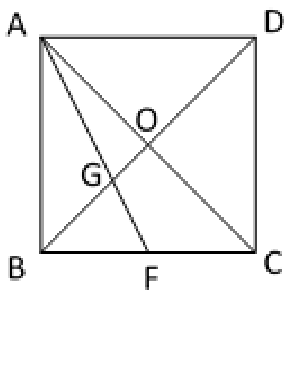
In square $ABCD$, the diagonals intersect at $O$. Ray $AF$ bisects $\angle BAC$, meeting $BD$ at $G$ and $BC$ at $F$. Given $OG:CF=m:n$, where $m,n$ are coprime positive integers, find $m+n$.
Find $\lceil a\rceil$, where $a$ is the maximum possible value of the shortest distance between two of ten points placed on a circle of diameter $5\text{ cm}$.
The source English says “in a circle”, while its Vietnamese says “on a circle”. Here the points lie on the circumference, following the printed Vietnamese. The ceiling is the smallest integer at least a.
Amos, Bryan and Catherine play a series of one-on-one chess games. At any time, two people play and one watches. The winner continues against the next competitor, while the loser switches out. Amos played $7$ games, Bryan $10$, and Catherine $13$. Who lost the second game?
A shopkeeper purchased a table originally costing $2000$ dollars at a discount of $10\%$ and an additional $15\%$ discount. He spent $70$ dollars on transportation and sold the table for $2080$ Singapore dollars. Find his profit margin.
Assume all stated dollar amounts are in the same currency. The source does not define “profit margin”, and its choices may use a different denominator. Keep all original choices as printed; explain both sales-based margin and cost-based markup for manual assessment.
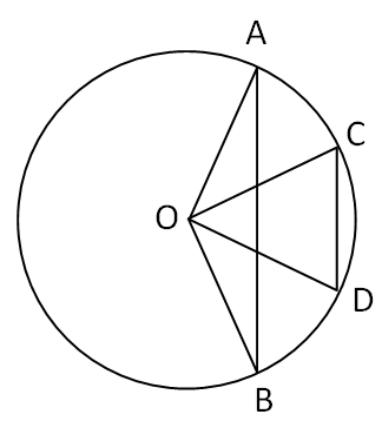
In the figure, $AB$ and $CD$ are parallel chords of a circle with centre $O$ and radius $r\text{ cm}$. Given $AB=46\text{ cm}$, $CD=18\text{ cm}$ and $\angle AOB=3\angle COD$, find $r$.