A model used to estimate the time it will take to hike to the top of a mountain on a trail is of the form $T=aL+bG,$ where $a$ and $b$ are constants, $T$ is the time in minutes, $L$ is the length of the trail in miles, and $G$ is the altitude gain in feet. The model estimates that it will take $69$ minutes to hike to the top if a trail is $1.5$ miles long and ascends $800$ feet, as well as if a trail is $1.2$ miles long and ascends $1100$ feet.
How many minutes does the model estimate it will take to hike to the top if the trail is $4.2$ miles long and ascends $4000$ feet?
The number $2024$ is written as the sum of not necessarily distinct two-digit numbers. What is the least number of two-digit numbers needed to write this sum?
A data set containing $20$ numbers, some of which are $6,$ has mean $45.$ When all the $6$s are removed, the data set has mean $66.$ How many $6$s were in the original data set?
In $\triangle ABC,$ $\angle ABC=90^\circ$ and $BA=BC=\sqrt2.$ Points $P_1,$ $P_2,$ $\ldots,$ $P_{2024}$ lie on hypotenuse $AC$ so that $AP_1=P_1P_2$ $=P_2P_3$ $=\cdots$ $=P_{2023}P_{2024}$ $=P_{2024}C.$
What is the length of the vector sum $$
\begin{aligned} &\vec{BP_1}+\vec{BP_2}+\vec{BP_3} \\ &\quad {}+\cdots+\vec{BP_{2024}}? \end{aligned}
$$
Let $\alpha$ be the radian measure of the smallest angle in a $3\text{-}4\text{-}5$ right triangle. Let $\beta$ be the radian measure of the smallest angle in a $7\text{-}24\text{-}25$ right triangle. In terms of $\alpha,$ what is $\beta?$
There are exactly $K$ positive integers $b$ with $5\le b\le2024$ such that the base-$b$ integer $2024_b$ is divisible by $16$ (where $16$ is in base ten). What is the sum of the digits of $K?$
The first three terms of a geometric sequence are the integers $a,$ $720,$ and $b,$ where $a\lt720\lt b.$ What is the sum of the digits of the least possible value of $b?$
The numbers, in order, of each row and the numbers, in order, of each column of a $5\times5$ array of integers form an arithmetic progression of length $5.$ The numbers in positions $(5,5),$ $(2,4),$ $(4,3),$ and $(3,1)$ are $0,$ $48,$ $16,$ and $12,$ respectively. What number is in position $(1,2)?$
A set of $12$ tokens — $3$ red, $2$ white, $1$ blue, and $6$ black — is to be distributed at random to $3$ game players, $4$ tokens per player. The probability that some player gets all the red tokens, another gets all the white tokens, and the remaining player gets the blue token can be written as $\dfrac{m}{n},$ where $m$ and $n$ are relatively prime positive integers. What is $m+n?$
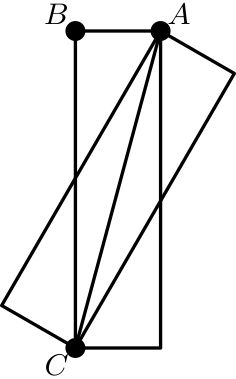
On top of a rectangular card with sides of length $1$ and $2+\sqrt3,$ an identical card is placed so that two of their diagonals line up, as shown ($AC,$ in this case).
Continue the process, adding a third card to the second, and so on, lining up successive diagonals after rotating clockwise. In total, how many cards must be used until a vertex of a new card lands exactly on the vertex labeled $B$ in the figure?
Points $P$ and $Q$ are chosen uniformly and independently at random on sides $\overline{AB}$ and $\overline{AC},$ respectively, of equilateral triangle $\triangle ABC.$ Which of the following intervals contains the probability that the area of $\triangle APQ$ is less than half the area of $\triangle ABC?$