The acute angles of a right triangle are $a^\circ$ and $b^\circ,$ where $a \gt b$ and both $a$ and $b$ are prime numbers. What is the least possible value of $b?$
Teams $A$ and $B$ are playing in a basketball league where each game results in a win for one team and a loss for the other team. Team $A$ has won $\tfrac23$ of its games and team $B$ has won $\tfrac58$ of its games. Also, team $B$ has won $7$ more games and lost $7$ more games than team $A.$ How many games has team $A$ played?
Two nonhorizontal, non-vertical lines in the $xy$-coordinate plane intersect to form a $45^\circ$ angle. One line has slope equal to $6$ times the slope of the other line. What is the greatest possible value of the product of the slopes of the two lines?
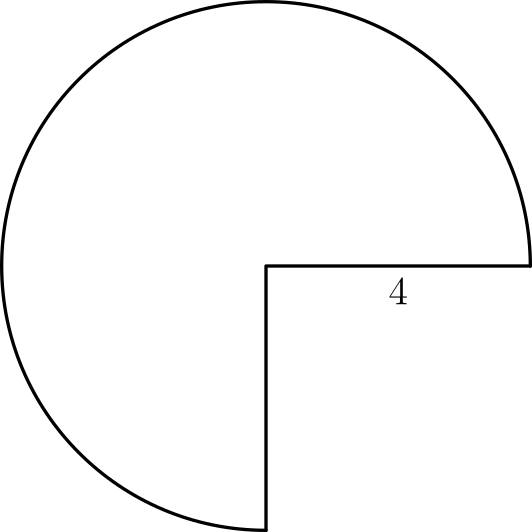
A three-quarter sector of a circle of radius $4$ inches together with its interior can be rolled up to form the lateral surface of a right circular cone by taping together along the two radii shown. What is the volume of the cone in cubic inches?
In unit square $ABCD,$ the inscribed circle $\omega$ intersects $\overline{CD}$ at $M,$ and $\overline{AM}$ intersects $\omega$ at a point $P$ different from $M.$ What is $AP?$
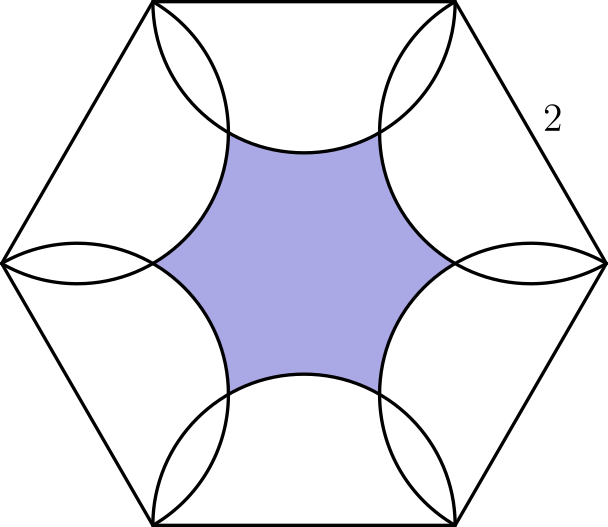
As shown in the figure below, six semicircles lie in the interior of a regular hexagon with side length $2$ so that the diameters of the semicircles coincide with the sides of the hexagon. What is the area of the shaded region—inside the hexagon but outside all of the semicircles?
Let $\overline{AB}$ be a diameter in a circle of radius $5\sqrt2.$ Let $\overline{CD}$ be a chord in the circle that intersects $\overline{AB}$ at a point $E$ such that $BE = 2\sqrt5$ and $\angle AEC = 45^\circ.$ What is $CE^2 + DE^2?$
Bela and Jenn play the following game on the closed interval $[0, n]$ of the real number line, where $n$ is a fixed integer greater than $4.$ They take turns playing, with Bela going first. At his first turn, Bela chooses any real number in the interval $[0, n].$ Thereafter, the player whose turn it is chooses a real number that is more than one unit away from all numbers previously chosen by either player. A player unable to choose such a number loses. Using optimal strategy, which player will win the game?
There are $10$ people standing equally spaced around a circle. Each person knows exactly $3$ of the other $9$ people: the $2$ people standing next to her or him, as well as the person directly across the circle. How many ways are there for the $10$ people to split up into $5$ pairs so that the members of each pair know each other?
An urn contains one red ball and one blue ball. A box of extra red and blue balls lies nearby. George performs the following operation four times: he draws a ball from the urn at random and then takes a ball of the same color from the box and returns those two matching balls to the urn. After the four iterations the urn contains six balls. What is the probability that the urn contains three balls of each color?
How many polynomials of the form $x^5 + ax^4 + bx^3 + cx^2 + dx$ $+ 2020,$ where $a,$ $b,$ $c,$ and $d$ are real numbers, have the property that whenever $r$ is a root, so is $\dfrac{-1 + i\sqrt3}{2}\cdot r?$ (Note that $i = \sqrt{-1}.$)
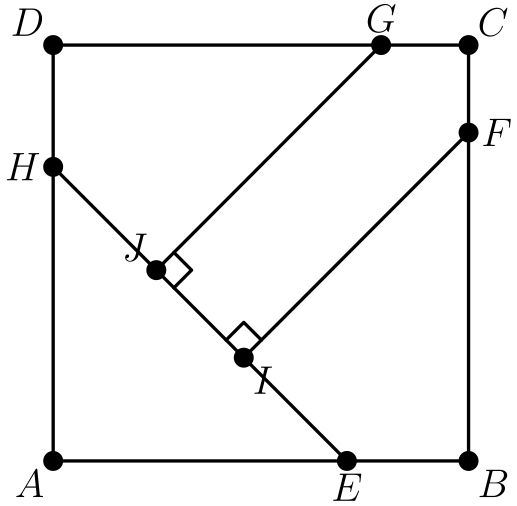
In square $ABCD,$ points $E$ and $H$ lie on $\overline{AB}$ and $\overline{DA},$ respectively, so that $AE = AH.$ Points $F$ and $G$ lie on $\overline{BC}$ and $\overline{CD},$ respectively, and points $I$ and $J$ lie on $\overline{EH}$ so that $\overline{FI} \perp \overline{EH}$ and $\overline{GJ} \perp \overline{EH}.$ See the figure below. Triangle $AEH,$ quadrilateral $BFIE,$ quadrilateral $DHJG,$ and pentagon $FCGJI$ each has area $1.$ What is $FI^2?$
Square $ABCD$ in the coordinate plane has vertices at the points $A(1, 1),$ $B(-1, 1),$ $C(-1, -1),$ and $D(1, -1).$ Consider the following four transformations:
$L,$ a rotation of $90^\circ$ counterclockwise around the origin;
$R,$ a rotation of $90^\circ$ clockwise around the origin;
$H,$ a reflection across the $x$-axis; and
$V,$ a reflection across the $y$-axis.
Each of these transformations maps the square onto itself, but the positions of the labeled vertices will change. For example, applying $R$ and then $V$ would send the vertex $A$ at $(1, 1)$ to $(-1, -1)$ and would send the vertex $B$ at $(-1, 1)$ to itself. How many sequences of $20$ transformations chosen from $\{L, R, H, V\}$ will send all of the labeled vertices back to their original positions? (For example, $R,$ $R,$ $V,$ $H$ is one sequence of $4$ transformations that will send the vertices back to their original positions.)
Two different cubes of the same size are to be painted, with the color of each face being chosen independently and at random to be either black or white. What is the probability that after they are painted, the cubes can be rotated to be identical in appearance?