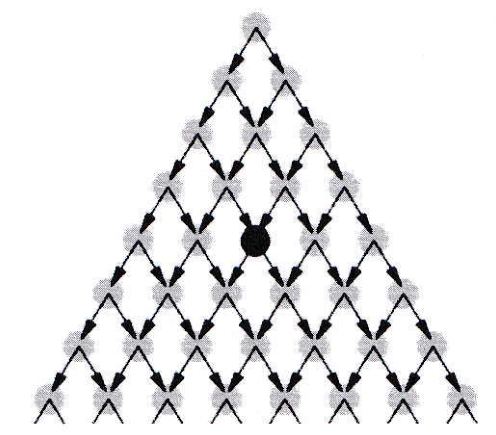
In how many ways can you reach any circle in the 10th row from the top circle if you can only move down-left or down-right and cannot pass through the black circle?
**Diagram convention:** The printed sketch shows only eight rows. Continue the same triangular pattern to row 10, counting the top circle as row 1. The forbidden circle is the middle circle of row 5. Different sequences of moves count as different paths, even if they end at the same circle. Enter the total number of paths as an integer.
**Domain convention:** Treat $x$ as an algebraic root, allowing complex numbers. The equation has no real root. You do not need to find the roots or perform calculations with complex numbers; use a polynomial identity. Enter the resulting number only.
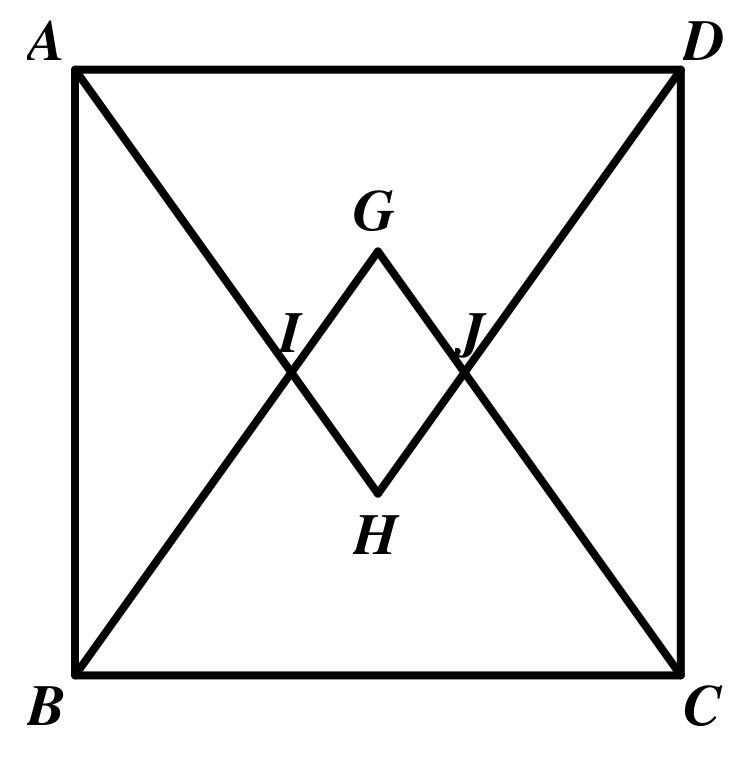
In the diagram, $ABCD$ is a square of side 6, and $AHD$ and $BCG$ are equilateral triangles inside it. Points $I$ and $J$ are the intersections shown: $I=AH\cap BG$ and $J=DH\cap CG$. Find the area of rhombus $IGJH$. Choose one option.
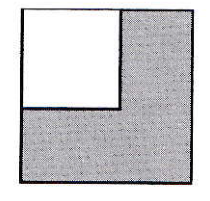
Two squares with positive integer side lengths overlap so that two sides of the smaller square lie along two sides of the larger square, as shown. The L-shaped shaded area is 27 square units. Find the sum of the two possible side lengths of the smaller square. Enter the integer only.
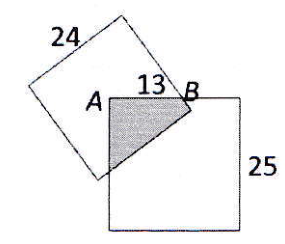
Two squares overlap so that a vertex $A$ of the larger square, whose side is 25 cm, is at the centre of the smaller square, whose side is 24 cm. In the diagram $AB=13$ cm. Find the perimeter, in centimetres, of the shaded overlap quadrilateral. Enter the number only.
A tangential quadrilateral $ABCD$ is a convex quadrilateral whose sides are tangent to a circle. Given $AD=16$, $BC=8$, and circle radius 4, find the area of the quadrilateral. Choose one option.
Define $n!=n\times(n-1)\times\cdots\times2\times1$. For example, $4!=4\times3\times2\times1=24$ and $3!=3\times2\times1=6$. Simplify
$$\frac{41!+40!}{3\times39!+2\times39!+39!}.$$
Choose one option.
A number has only the digit 1 when written in base 3, but its last digit is 0 when written in base 2. What is the largest four-digit number in base 10 with this property? Enter its ordinary base-10 value, without padding it with a leading zero.
Find $p+q+r$ for positive integers $p,q,r$ satisfying
$$\gcd(p,q)=45,\quad\gcd(q,r)=21,\quad\gcd(p,r)=3,$$
$$\operatorname{lcm}(p,q)=4725,\quad\operatorname{lcm}(q,r)=11025,$$
$$\operatorname{lcm}(p,r)=6615.$$
Here gcd means greatest common divisor and lcm means least common multiple. Enter the integer sum only.
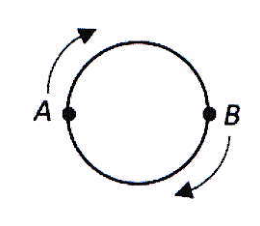
Andy and Brett start at opposite points on a circular track of circumference 600 feet and jog in the directions shown. Andy runs at 4.3 feet per second and Brett at 5.5 feet per second. How many seconds until they meet for the first time? The arrows indicate that both run clockwise. Choose one option.
The source asks: “Find the ordered set of 4-tuples of positive integers $[w,x,y,z]$ such that $w+x+y+z=21$.”
**Interpretation and response format:** In agreement with the source's numerical answer key, this version asks for the number of ordered quadruples, not a list of all of them. Every entry is at least 1, and changing the order may produce a different quadruple. Enter the integer count only.
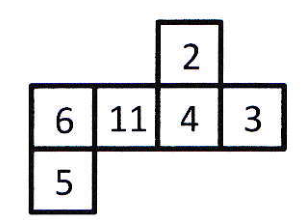
The cardboard pattern shown consists of six numbered squares and is folded into a cube. What is the greatest product of the numbers on three faces that meet at a common vertex? Enter the integer only.