Exercise 1. A number has a remainder of 2 when it is divided by 3. It has a remainder of 3 when divided by 4. Find the sum of two such numbers that are smaller than 30?
**Editorial input convention:** Interpret the candidates as positive integers smaller than 30.
Question 21. A train moves from Bangkok to Chiang Mai. After 1 hour 40 minutes, another train moves from Chiang Mai to Bangkok whose speed is 5 km/h more than the first train. The trains meet each other at a station that is 300 km away from Chiang Mai. Given that the distance between Bangkok and Chiang Mai is 645 km, find the velocity of the first train.
**Editorial input convention:** Assume constant speeds and no stops before meeting. Enter the first train’s speed in km/h.
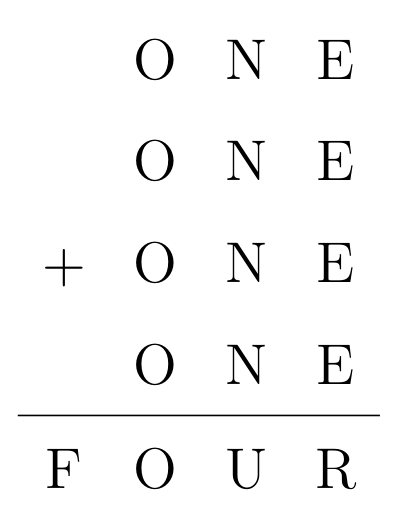
Question 50. Different letters stand for different digits, and no leading digit can equal 0, in the cryptarithm shown. Find the least possible value of “FOR”.
**Editorial input convention:** Read the figure as four ONE addends. Enter the three-digit FOR requested in the source, not the four-digit sum FOUR.
Exercise 6. 0.7 of the balls in a bag are black, 0.2 of the remainder are pink and the remainder are red. If there are 184 more black balls than red balls, how many balls are there in the bag together?
Exercise 3. One filling pipe $A$ is 5 times faster than second filling pipe $B$. If $B$ can fill a cistern in 36 minutes, find the time when the cistern will be full if both fill pipes are opened simultaneously.
**Editorial input convention:** Assume constant rates, an initially empty tank and no other flows. Both readings of “5 times faster” are accepted: A’s rate is 5 times B’s, or A is 500% faster so its rate is 6 times B’s. Enter the corresponding time in minutes.
Exercise 5. Consider the following pattern:
$$\begin{aligned}1&=1^2\\1+3&=2^2\\1+3+5&=3^2\\1+3+5+7&=4^2\\&\ldots\\1+3+5+\ldots+(2k-1)&=144\\&\ldots\end{aligned}$$
a) Write down the 8th line in the pattern.
b) Find the value of $k$.
**Editorial input convention:** Line n sums the first n positive odd integers. Enter the complete eighth-line equality, then k, separated by a semicolon; use ^ for exponents. A format example, not the answer: 1+3=2^2=4; 2.
**Editorial input note:** Use no spaces anywhere in your entry. Apply this rule to the format example above.
Question 3. Triangle $ABC$ is a right triangle with $AB=60$ units, $AC=80$ units and $BC=100$ units. $D$ is a point between $B$ and $C$ such that $\triangle ADB$ and $\triangle ADC$ have equal perimeters. Find the length of the side $BD$.
Example 17. Let $A$ be the area of the triangle with sides of length 25, 25 and 30. Let $B$ be the area of the triangle with sides of length 25, 25 and 40. Find $A/B$.
Exercise 20. A computer code generates all the different positive differences of two distinct numbers in the set $\{3^0,3^1,3^2,\ldots,3^8\}$. What is the remainder when the sum of all generated differences is divided by 1000?
Example 6. In how many minutes can a tank be filled by three pipes whose diameter are 1 cm, 2 cm and 3 cm? Given that the largest pipe alone can fill it in 21 minutes and the amount of water flowing through the pipe is directly proportional to the square of its diameter.
**Editorial input convention:** All three pipes operate simultaneously at constant rates into an initially empty tank, with no other flows. Use the given 21 minutes for the largest pipe. Enter minutes.
Exercise 7. Nine students, including four girls and five boys are arranged in a row. The teacher wants to arrange them such that no two consecutive students are of the same sex. How many ways can the teacher do that?
**Editorial input convention:** Treat all nine students as distinct and count left-to-right orders separately.