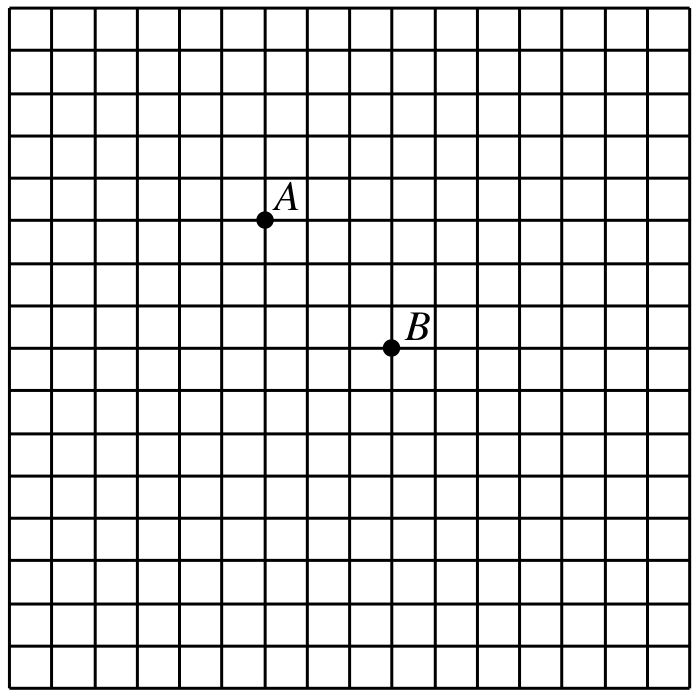
Suppose that we are living in a city where the streets are laid out on a square grid as shown below. In this city, you are only allowed to move along vertical lines (streets running north–south) or horizontal lines (streets running east–west). Suppose your home is at point $A$ and you want to go to your friend's house at point $B$. The distance travelled is not the straight-line distance measured with a ruler, but the distance walked along the streets. We define the TCG distance between $A$ and $B$ to be the length of a shortest such route. For example, from $A$ to $B$ you may move 3 right and 3 down, or 3 down and 3 right, so the TCG distance in the diagram is 6.
(a) How many grid points have TCG distance 6 from both $A$ and $B$? Draw the diagram. (2 marks)
(b) How many grid points have TCG distance 12 from both $A$ and $B$? Draw the diagram. (4 marks)
Answer-sheet instruction: no partial score for each subpart. The original answer sheet supplies a larger blank grid for drawing.
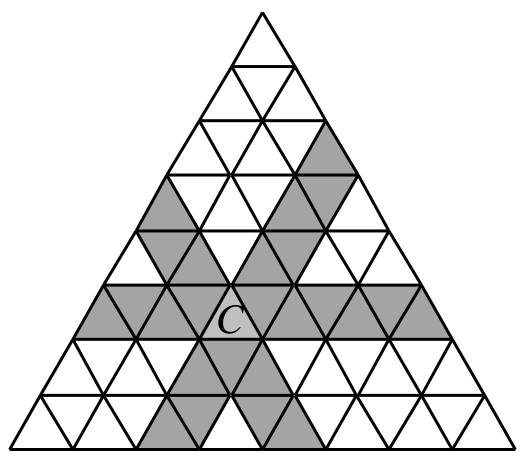
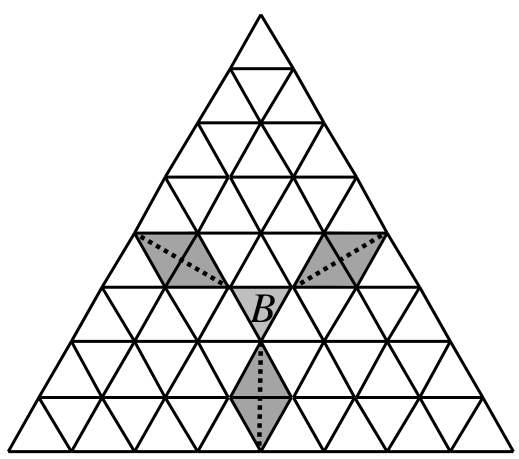
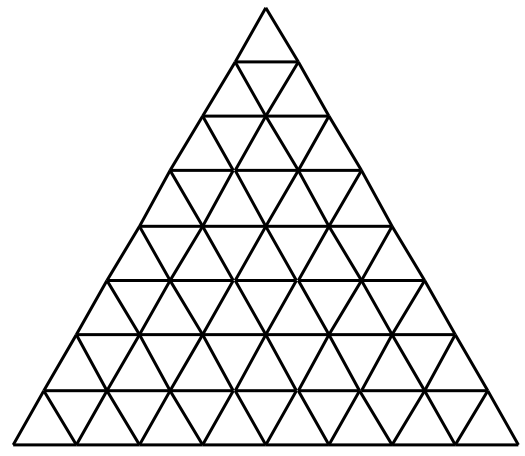
The diagram shows a triangular chessboard. A chess piece called a castle, indicated by $C$, may attack along any of the three directions highlighted below.
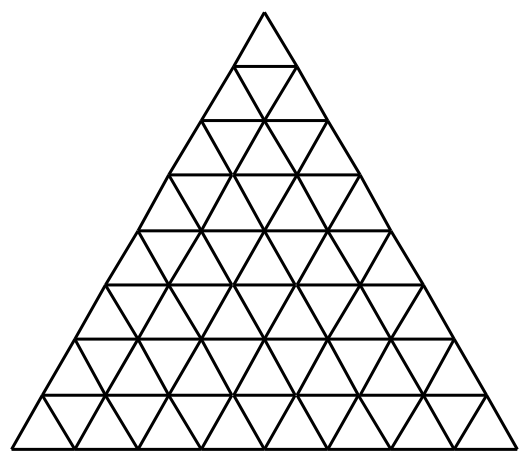
(a) Place as many castles as possible on the board so that no two castles can attack each other. (3 marks)
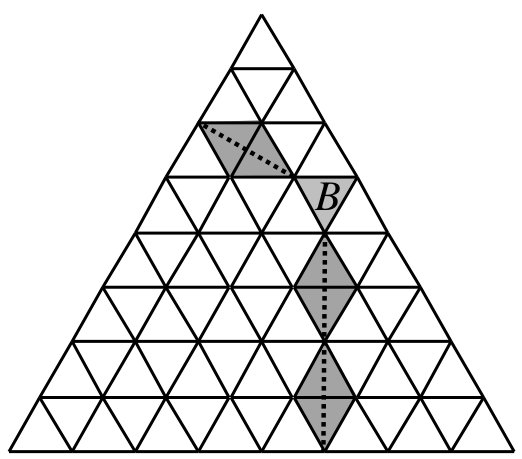
(b) A chess piece called a bishop, indicated by $B$, may attack along the direction of any of its angles. The two diagrams show examples of its attack ranges; the broken lines indicate the directions of the angles.
Place as many bishops as possible on the board so that no bishop attacks another. (3 marks)
The answer sheet asks for the number of pieces and a placement diagram for each part, with no partial score within each part.
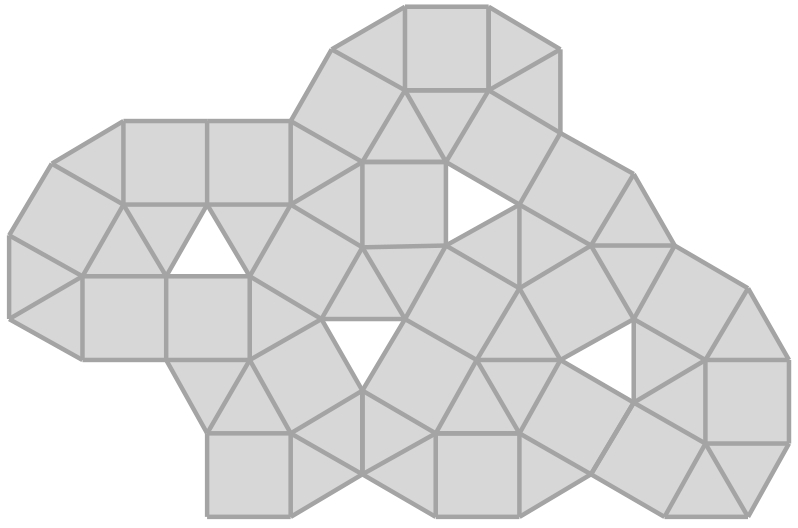
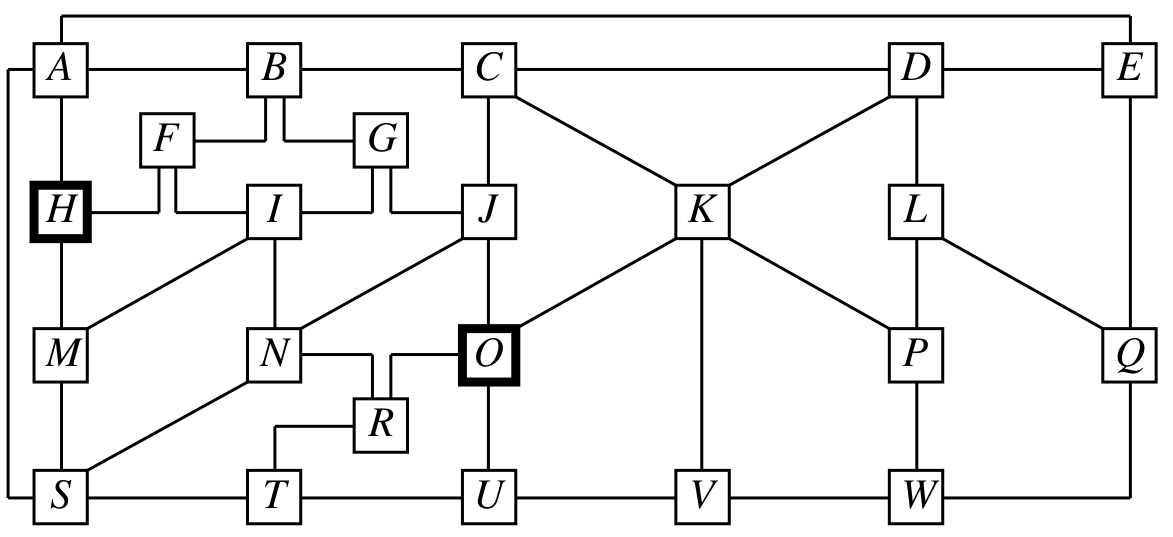
The diagram shows a map of 23 towns connected by roads, with a video arcade in each town. Andy, who loves playing video games, works in an office in town $O$. Every day after work, he visits all the towns exactly once to play before reaching his home in town $H$. He spends much of his free time at the arcades and is ignoring his girlfriend. One day she decides to meet him on his way home, but he varies his routes all the time. She has discovered that there is one road he must pass along in every possible route, so she plans to wait for him on it. Which road is it?
The answer sheet also asks you to draw one possible route and name the two towns at the ends of the road. No partial score.
Anna and Boris play a game using the integers $1,2,3,4,5,6,7,8$. Anna first selects a positive integer $k\le8$. Boris then chooses $k$ of these eight numbers, and Anna chooses three of the eight numbers. Anna wins if the sum of every pair of her chosen numbers is among the numbers chosen by Boris.
(a) What is the minimum value of $k$ for which Anna has a winning strategy? (2 marks)
(b) If Anna has a winning strategy for $k$, give a counterexample showing that for $k-1$ she cannot guarantee a win. (4 marks)
Answer-sheet instruction: no partial score for each subpart.
There are 100 positive integers whose sum is equal to their product. Find all possible products.
Answer-sheet scoring note: the number of correct answers minus the number of incorrect answers is the net number of correct answers. The paper assigns this question 6 marks, but does not specify how that net count is converted into 6 marks.