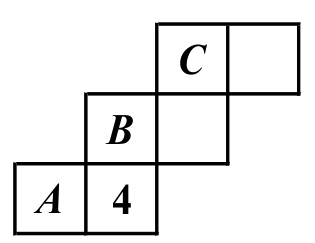
The diagram below is the expanded net of a cube. We label each of the faces of the cube by using the numbers 1, 2, 3, 4, 5, and 6 exactly once, so that the sum of any two opposite faces is always 7. What is the largest possible value of $A\times(B^2+C)$?
The average of 20 numbers is 18. If the first number is increased by 2, the second number is increased by 4, the third number is increased by 6, …, the twentieth number is increased by 40. What is the average of the 20 numbers now?
Twelve consecutive positive integers are written on a board. Maria erases one of the numbers. If the sum of the remaining numbers is 2023, what number did Maria erase?
The left-most digit of a six-digit number is 5. If you remove the left-most digit, the original number is 26 times the new number. What is the sum of the digits of the new number?
Mrs. Anne has two kinds of fruits: apples and oranges. The number of apples is 4 times the number of oranges. If some of the fruits were eaten by the children, then the number of remaining apples is 7 times the number of remaining oranges. What is the smallest possible total number of fruits that Mrs. Anne had at the beginning?
Given that $\frac{a+b+c+d-29}{6}=21$, where a, b, c, and d are positive integers. If $(a+c):(b+d)=2:3$, $a<c$ and $b<d$, then what is the largest possible value of $a+b$?
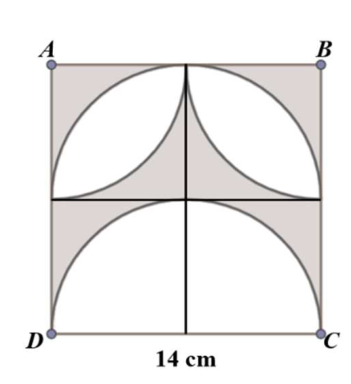
In the diagram, ABCD is a square. If all the arcs in the figure are the arcs of the circles with the same size, what is the area, in $\mathrm{cm}^2$, of the shaded region? (Use $\pi=\frac{22}{7}$.)
Sarah bought some number of roses. She gave half of it and another 13 roses to Patty. Then, she gave one–third of the remaining roses and another 8 roses to Sunny. Later on, she gave one–fourth of the remaining roses and another 11 roses to Nicky. After all of this, Sarah has 4 roses left for herself. What is the number of roses Sarah bought at the beginning?
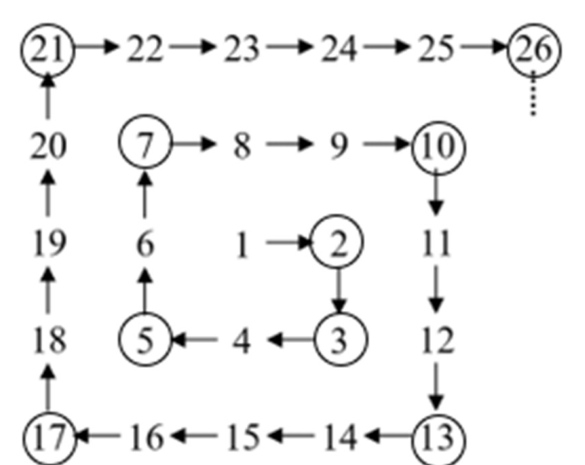
Arrange the positive integers 1, 2, 3, 4, .... in the order as shown in the diagram. The integers 2, 3, 5, 7, 10, .... are called the ‘turning integers’ as the arrow-in and arrow-out of these integers changed direction at the corner. How many ‘turning integers’ are there between 529 and 1000?
In a badminton tournament with 14 players, each player plays every other player exactly once. A win gets 2 points, a draw gets 1 point, and a loss get 0. A prize is given to each player whose total points is at least 18 points. What is the largest possible number of players who can get a prize?
There are 10 positive integers. Starting from the third integer, each integer is equal to the sum of the preceding two integers. If the tenth integer is less than or equal to 2022, what is the largest possible sum of the first two integers?
There are 80 cards in a box. Each card has a number on it from 1 to 80. What is the largest possible number of cards that we can take out from the box so that no two of them have the sum of 123?
A palindromic number is a number that remains the same when its digits are reversed. It is known that 1000001 is the smallest 7-digit palindromic number and 9999999 is the largest 7-digit palindromic number. What is the 2023rd 7-digit palindromic number?
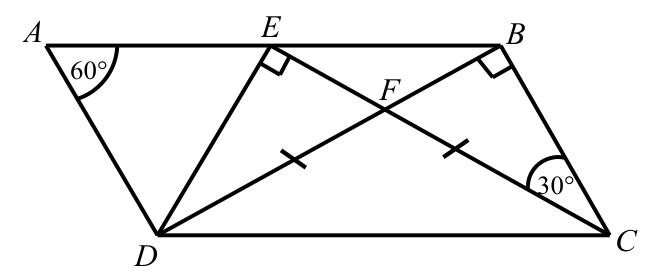
In the diagram below, ABCD is a parallelogram with perimeter 36 cm, $DF=CF$, $\angle DAB=60^\circ$, $\angle FCB=30^\circ$, $\angle DEC=90^\circ$ and $\angle DBC=90^\circ$. What is the length, in cm, of AB?
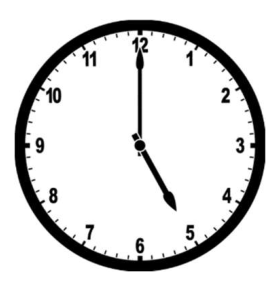
How many minutes does it take for both hands of an analogue clock to form an angle of $110^\circ$ for the first time and for the second time from 05:00 AM to 06:00 AM?
Let a and b be positive integers such that $\frac{1}{1\times9}+\frac{2}{9\times25}+\frac{3}{25\times49}+\cdots+\frac{15}{841\times961}=\frac ab$. If $\gcd(a,b)=1$, what is the sum of a and b?
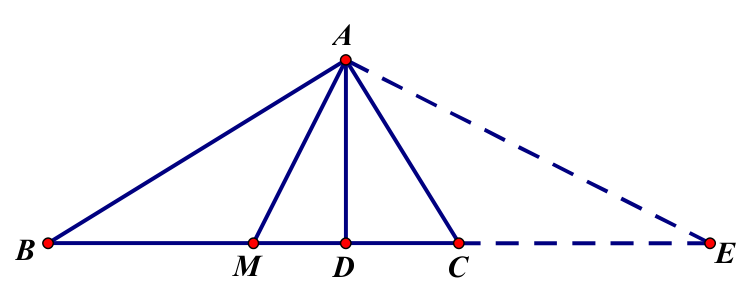
In the diagram below, ABC is a right-angled triangle where $\angle A=90^\circ$. M is the midpoint of BC, D is on BC such that AD is perpendicular to BC, and E is on the extension of BC such that AM is perpendicular to AE. If AM=22 and DM=10, what is the length of CE?
There are 20 passengers in the bus, where the fare for each passenger is 5 dollars. They have only 10-dollar, 15-dollar and 20-dollar bills. By trading among themselves, they come up with the correct combined fare, and each also receives the correct change. What is the smallest possible number of bills involved?