Skip to content / Đến nội dung
ThichHocToan.com

1981 AMC 12

Question 1

If $\sqrt{x+2}=2,$ then $(x+2)^2$ equals
  1. $\sqrt2$
  2. $2$
  3. $4$
  4. $8$
  5. $16$

Question 2

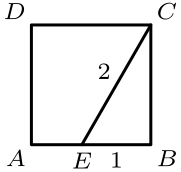
Point $E$ is on side $AB$ of square $ABCD.$ If $EB$ has length one and $EC$ has length two, then the area of the square is

Question illustration
  1. $\sqrt3$
  2. $\sqrt5$
  3. $3$
  4. $2\sqrt3$
  5. $5$

Question 3

For $x\ne0,$ $\frac1x+\frac1{2x}+\frac1{3x}$ equals
  1. $\frac1{2x}$
  2. $\frac1{6x}$
  3. $\frac5{6x}$
  4. $\frac{11}{6x}$
  5. $\frac1{6x^3}$

Question 4

If three times the larger of two numbers is four times the smaller and the difference between the numbers is $8,$ then the larger of the two numbers is
  1. $16$
  2. $24$
  3. $32$
  4. $44$
  5. $52$

Question 5

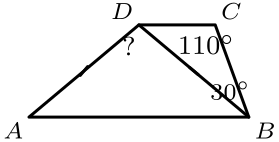
In trapezoid $ABCD,$ sides $AB$ and $CD$ are parallel, and diagonal $BD$ and side $AD$ have equal length. If $\angle DCB=110^\circ$ and $\angle CBD=30^\circ,$ then $\angle ADB=$

Question illustration
  1. $80^\circ$
  2. $90^\circ$
  3. $100^\circ$
  4. $110^\circ$
  5. $120^\circ$

Question 6

If $\frac{x}{x-1}=\frac{y^2+2y-1}{y^2+2y-2},$ then $x$ equals
  1. $y^2+2y-1$
  2. $y^2+2y-2$
  3. $y^2+2y+2$
  4. $y^2+2y+1$
  5. $-y^2-2y+1$

Question 7

How many of the first one hundred positive integers are divisible by all of the numbers $2,$ $3,$ $4,$ $5?$
  1. $0$
  2. $1$
  3. $2$
  4. $3$
  5. $4$

Question 8

For all positive numbers $x,$ $y,$ $z,$ the product $$
\begin{aligned} &(x+y+z)^{-1}\\ &\quad\cdot(x^{-1}+y^{-1}+z^{-1})\\ &\quad\cdot(xy+yz+zx)^{-1}\\ &\quad\cdot\big((xy)^{-1}+(yz)^{-1}+(zx)^{-1}\big) \end{aligned}
$$ equals
  1. $x^{-2}y^{-2}z^{-2}$
  2. $x^{-2}+y^{-2}+z^{-2}$
  3. $(x+y+z)^{-1}$
  4. $\frac1{xyz}$
  5. $\frac1{xy+yz+zx}$

Question 9

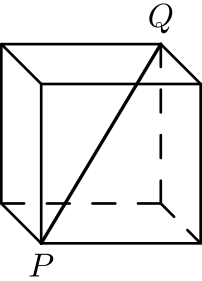
In the adjoining figure, $PQ$ is a diagonal of the cube. If $PQ$ has length $a,$ then the surface area of the cube is

Question illustration
  1. $2a^2$
  2. $2\sqrt2a^2$
  3. $2\sqrt3a^2$
  4. $3\sqrt3a^2$
  5. $6a^2$

Question 10

The lines $L$ and $K$ are symmetric to each other with respect to the line $y=x.$ If the equation of line $L$ is $y=ax+b$ with $a\ne0$ and $b\ne0,$ then the equation of $K$ is $y=$
  1. $\frac1a x+b$
  2. $-\frac1a x+b$
  3. $-\frac1a x-\frac ba$
  4. $\frac1a x+\frac ba$
  5. $\frac1a x-\frac ba$

Question 11

The three sides of a right triangle have integral lengths which form an arithmetic progression. One of the sides could have length
  1. $22$
  2. $58$
  3. $81$
  4. $91$
  5. $361$

Question 12

If $p,$ $q,$ and $M$ are positive numbers and $q\lt100,$ then the number obtained by increasing $M$ by $p\%$ and decreasing the result by $q\%$ exceeds $M$ if and only if
  1. $p\gt q$
  2. $p\gt\frac q{100-q}$
  3. $p\gt\frac q{1-q}$
  4. $p\gt\frac{100q}{100+q}$
  5. $p\gt\frac{100q}{100-q}$

Question 13

Suppose that at the end of any year, a unit of money has lost $10\%$ of the value it had at the beginning of that year. Find the smallest integer $n$ such that after $n$ years the unit of money will have lost at least $90\%$ of its value. (To the nearest thousandth $\log_{10}3$ is $0.477.$)
  1. $14$
  2. $16$
  3. $18$
  4. $20$
  5. $22$

Question 14

In a geometric sequence of real numbers, the sum of the first two terms is $7,$ and the sum of the first six terms is $91.$ The sum of the first four terms is
  1. $28$
  2. $32$
  3. $35$
  4. $49$
  5. $84$

Question 15

If $b\gt1,$ $x\gt0,$ and $(2x)^{\log_b2}-(3x)^{\log_b3}=0,$ then $x$ is
  1. $\frac1{216}$
  2. $\frac16$
  3. $1$
  4. $6$
  5. not uniquely determined

Question 16

The base three representation of $x$ is $$
12112211122211112222.
$$ The first digit (on the left) of the base nine representation of $x$ is
  1. $1$
  2. $2$
  3. $3$
  4. $4$
  5. $5$

Question 17

The function $f$ is not defined for $x=0,$ but, for all nonzero real numbers $x,$ $$
f(x)+2f\left(\frac1x\right)=3x.
$$ The equation $f(x)=f(-x)$ is satisfied by
  1. exactly one real number
  2. exactly two real numbers
  3. no real numbers
  4. infinitely many, but not all, nonzero real numbers
  5. all nonzero real numbers

Question 18

The number of real solutions to the equation $$
\frac{x}{100}=\sin x
$$ is
  1. $61$
  2. $62$
  3. $63$
  4. $64$
  5. $65$

Question 19

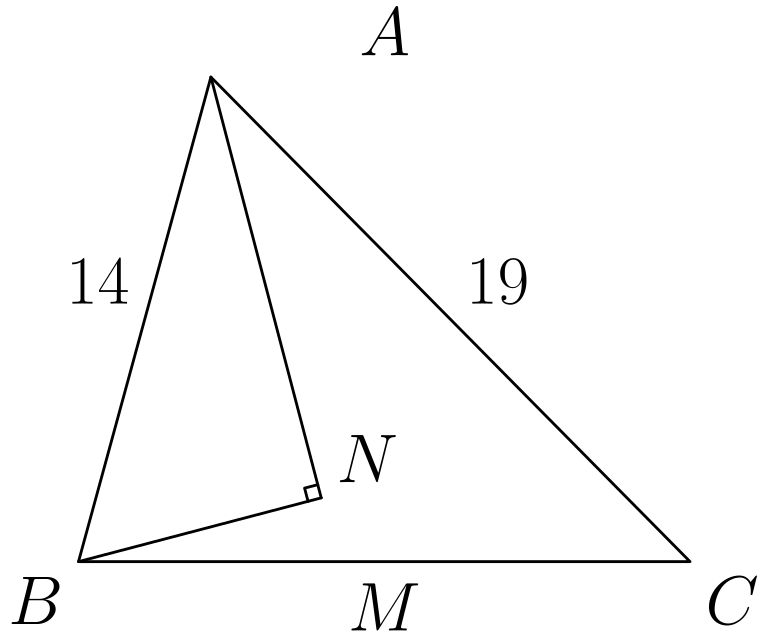
In $\triangle ABC,$ $M$ is the midpoint of side $BC,$ $AN$ bisects $\angle BAC,$ $BN\perp AN,$ and $\theta$ is the measure of $\angle BAC.$ If sides $AB$ and $AC$ have lengths $14$ and $19,$ respectively, then length $MN$ equals

Question illustration
  1. $2$
  2. $\frac52$
  3. $\frac52-\sin\theta$
  4. $\frac52-\frac12\sin\theta$
  5. $\frac52-\frac12\sin\left(\frac\theta2\right)$

Question 20

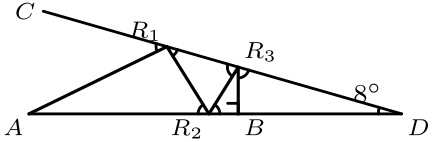
A ray of light originates from point $A$ and travels in a plane, being reflected $n$ times between lines $AD$ and $CD,$ before striking a point $B$ (which may be on $AD$ or $CD$) perpendicularly and retracing its path to $A.$ (At each point of reflection the light makes two equal angles as indicated in the adjoining figure. The figure shows the light path for $n=3.$) If $\angle CDA=8^\circ,$ what is the largest value $n$ can have?
Question illustration
  1. $6$
  2. $10$
  3. $38$
  4. $98$
  5. There is no largest value.