Skip to content / Đến nội dung
ThichHocToan.com

1976 AMC 12

Question 1

If one minus the reciprocal of $(1-x)$ equals the reciprocal of $(1-x),$ then $x$ equals
  1. $-2$
  2. $-1$
  3. $\frac12$
  4. $2$
  5. $3$

Question 2

For how many real numbers $x$ is $\sqrt{-(x+1)^2}$ a real number?
  1. none
  2. one
  3. two
  4. a finite number greater than two
  5. infinitely many

Question 3

The sum of the distances from one vertex of a square with sides of length two to the midpoints of each of the sides of the square is
  1. $2\sqrt5$
  2. $2+\sqrt3$
  3. $2+2\sqrt3$
  4. $2+\sqrt5$
  5. $2+2\sqrt5$

Question 4

Let a geometric progression with $n$ terms have first term one, common ratio $r$ and sum $s,$ where $r$ and $s$ are not zero. The sum of the geometric progression formed by replacing each term of the original progression by its reciprocal is
  1. $\frac1s$
  2. $\frac1{r^ns}$
  3. $\frac{s}{r^{n-1}}$
  4. $\frac{r^n}{s}$
  5. $\frac{r^{n-1}}s$

Question 5

How many integers greater than ten and less than one hundred, written in base ten notation, are increased by nine when their digits are reversed?
  1. $0$
  2. $1$
  3. $8$
  4. $9$
  5. $10$

Question 6

If $c$ is a real number and the negative of one of the solutions of $x^2-3x+c=0$ is a solution of $x^2+3x-c=0,$ then the solutions of $x^2-3x+c=0$ are
  1. $1,$ $2$
  2. $-1,$ $-2$
  3. $0,$ $3$
  4. $0,$ $-3$
  5. $\frac32,$ $\frac32$

Question 7

If $x$ is a real number, then the quantity $(1-|x|)(1+x)$ is positive if and only if
  1. $|x|\lt1$
  2. $x\lt1$
  3. $|x|\gt1$
  4. $x\lt-1$
  5. $x\lt-1$ or $-1\lt x\lt1$

Question 8

A point in the plane, both of whose rectangular coordinates are integers with absolute value less than or equal to four, is chosen at random, with all such points having an equal probability of being chosen. What is the probability that the distance from the point to the origin is at most two units?
  1. $\frac{13}{81}$
  2. $\frac{15}{81}$
  3. $\frac{13}{64}$
  4. $\frac{\pi}{16}$
  5. the square of a rational number

Question 9

In triangle $ABC,$ $D$ is the midpoint of $AB;$ $E$ is the midpoint of $DB;$ and $F$ is the midpoint of $BC.$ If the area of $\triangle ABC$ is $96,$ then the area of $\triangle AEF$ is
  1. $16$
  2. $24$
  3. $32$
  4. $36$
  5. $48$

Question 10

If $m,$ $n,$ $p$ and $q$ are real numbers and $f(x)=mx+n$ and $g(x)=px+q,$ then the equation $f(g(x))=g(f(x))$ has a solution
  1. for all choices of $m,$ $n,$ $p$ and $q$
  2. if and only if $m=p$ and $n=q$
  3. if and only if $mq-np=0$
  4. if and only if $n(1-p)-q(1-m)=0$
  5. if and only if $(1-n)(1-p)$ ${}-(1-q)(1-m)=0$

Question 11

Which of the following statements is (are) equivalent to the statement “If the pink elephant on planet alpha has purple eyes, then the wild pig on planet beta does not have a long nose”?

$\mathrm{I}.$ “If the wild pig on planet beta has a long nose, then the pink elephant on planet alpha has purple eyes.”

$\mathrm{II}.$ “If the pink elephant on planet alpha does not have purple eyes, then the wild pig on planet beta does not have a long nose.”

$\mathrm{III}.$ “If the wild pig on planet beta has a long nose, then the pink elephant on planet alpha does not have purple eyes.”

$\mathrm{IV}.$ “The pink elephant on planet alpha does not have purple eyes, or the wild pig on planet beta does not have a long nose.”

*The word “or” is used here in the inclusive sense (as is customary in mathematical writing).*
  1. $\mathrm{I}$ and $\mathrm{III}$ only
  2. $\mathrm{III}$ and $\mathrm{IV}$ only
  3. $\mathrm{II}$ and $\mathrm{IV}$ only
  4. $\mathrm{II}$ and $\mathrm{III}$ only
  5. $\mathrm{III}$ only

Question 12

A supermarket has $128$ crates of apples. Each crate contains at least $120$ apples and at most $144$ apples. What is the largest integer $n$ such that there must be at least $n$ crates containing the same number of apples?
  1. $4$
  2. $5$
  3. $6$
  4. $24$
  5. $25$

Question 13

If $x$ cows give $x+1$ cans of milk in $x+2$ days, how many days will it take $x+3$ cows to give $x+5$ cans of milk?
  1. $\frac{x(x+2)(x+5)}{(x+1)(x+3)}$
  2. $\frac{x(x+1)(x+5)}{(x+2)(x+3)}$
  3. $\frac{(x+1)(x+3)(x+5)}{x(x+2)}$
  4. $\frac{(x+1)(x+3)}{x(x+2)(x+5)}$
  5. none of these

Question 14

The measures of the interior angles of a convex polygon are in arithmetic progression. If the smallest angle is $100^\circ$ and the largest angle is $140^\circ,$ then the number of sides the polygon has is
  1. $6$
  2. $8$
  3. $10$
  4. $11$
  5. $12$

Question 15

If $r$ is the remainder when each of the numbers $1059,$ $1417$ and $2312$ is divided by $d,$ where $d$ is an integer greater than one, then $d-r$ equals
  1. $1$
  2. $15$
  3. $179$
  4. $d-15$
  5. $d-1$

Question 16

In triangles $ABC$ and $DEF,$ lengths $AC,$ $BC,$ $DF$ and $EF$ are all equal. Length $AB$ is twice the length of the altitude of $\triangle DEF$ from $F$ to $DE.$ Which of the following statements is (are) true?

$\mathrm{I}.$ $\angle ACB$ and $\angle DFE$ must be complementary.

$\mathrm{II}.$ $\angle ACB$ and $\angle DFE$ must be supplementary.

$\mathrm{III}.$ The area of $\triangle ABC$ must equal the area of $\triangle DEF.$

$\mathrm{IV}.$ The area of $\triangle ABC$ must equal twice the area of $\triangle DEF.$
  1. $\mathrm{II}$ only
  2. $\mathrm{III}$ only
  3. $\mathrm{IV}$ only
  4. $\mathrm{I}$ and $\mathrm{III}$ only
  5. $\mathrm{II}$ and $\mathrm{III}$ only

Question 17

If $\theta$ is an acute angle and $\sin2\theta=a,$ then $\sin\theta+\cos\theta$ equals
  1. $\sqrt{a+1}$
  2. $(\sqrt2-1)a+1$
  3. $\sqrt{a+1}-\sqrt{a^2-a}$
  4. $\sqrt{a+1}+\sqrt{a^2-a}$
  5. $\sqrt{a+1}+a^2-a$

Question 18

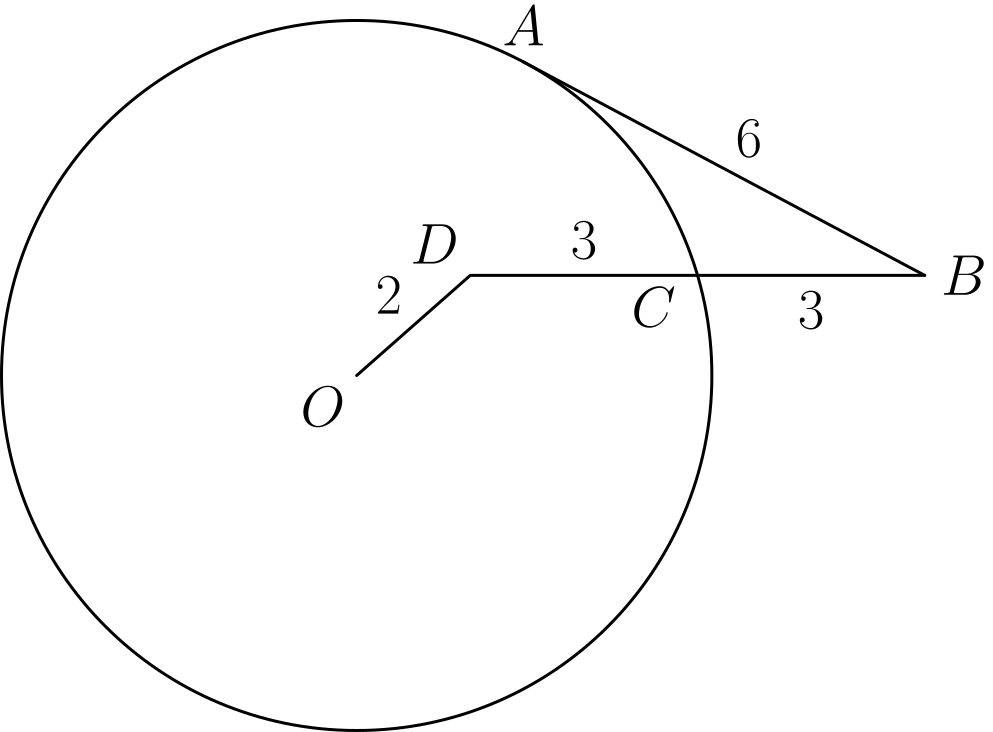
In the adjoining figure, $AB$ is tangent at $A$ to the circle with center $O;$ point $D$ is interior to the circle; and $DB$ intersects the circle at $C.$ If $BC=DC=3,$ $OD=2$ and $AB=6,$ then the radius of the circle is

Question illustration
  1. $3+\sqrt3$
  2. $\frac{15}{\pi}$
  3. $\frac92$
  4. $2\sqrt6$
  5. $\sqrt{22}$

Question 19

A polynomial $p(x)$ has remainder three when divided by $x-1$ and remainder five when divided by $x-3.$ The remainder when $p(x)$ is divided by $(x-1)(x-3)$ is
  1. $x-2$
  2. $x+2$
  3. $2$
  4. $8$
  5. $15$

Question 20

Let $a,$ $b$ and $x$ be positive real numbers distinct from one. Then $$
\begin{aligned} 4(\log_a x)^2&+3(\log_b x)^2\\ &=8(\log_a x)(\log_b x) \end{aligned}
$$
  1. for all values of $a,$ $b$ and $x$
  2. if and only if $a=b^2$
  3. if and only if $b=a^2$
  4. if and only if $x=ab$
  5. none of these