One thousand unit cubes are fastened together to form a large cube with edge length $10$ units; this is painted and then separated into the original cubes. The number of these unit cubes which have at least one face painted is
The stronger Goldbach conjecture states that any even integer greater than $7$ can be written as the sum of two different prime numbers. For such representations of the even number $126,$ the largest possible difference between the two primes is
*Note:* The regular Goldbach conjecture states that any even integer greater than $3$ is expressible as a sum of two primes. Neither this conjecture nor the stronger version has been settled.
Two congruent $30^\circ$-$60^\circ$-$90^\circ$ triangles are placed so that they overlap partly and their hypotenuses coincide. If the hypotenuse of each triangle is $12,$ the area common to both triangles is
If $1$ pint of paint is needed to paint a statue $6$ ft. high, then the number of pints it will take to paint (to the same thickness) $540$ statues similar to the original but only $1$ ft. high is
In $\triangle ABC$ with right angle at $C,$ altitude $CH$ and median $CM$ trisect the right angle. If the area of $\triangle CHM$ is $K,$ then the area of $\triangle ABC$ is
If $n$ is a real number, then the simultaneous system $$
\begin{cases} nx+y=1,\\ ny+z=1,\\ x+nz=1 \end{cases}
$$ has no solution if and only if $n$ is equal to
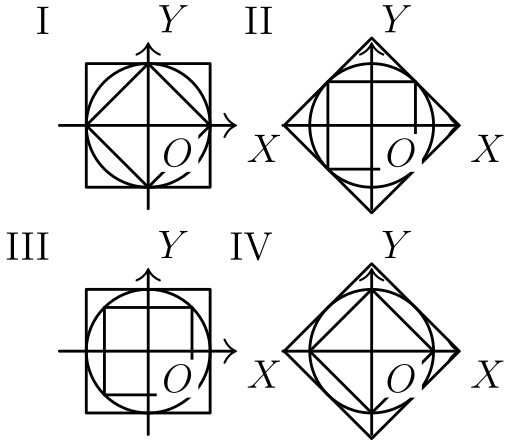
A circle with a circumscribed and an inscribed square centered at the origin $O$ of a rectangular coordinate system with positive $x$- and $y$-axes $OX$ and $OY$ is shown in each figure $\mathrm{I}$ to $\mathrm{IV}$ below.
The inequalities $$
\begin{aligned} |x|+|y| &\le \sqrt{2(x^2+y^2)}\\ &\le 2\operatorname{Max}(|x|,|y|). \end{aligned}
$$ are represented geometrically by the figure numbered
*Geometric representation:* An inequality $f(x,y)\le g(x,y)$ for all $x,$ $y$ is represented by a figure showing, for a typical real number $a,$ the containment $$
\begin{aligned} &\{(x,y):g(x,y)\le a\}\\ &\quad\subset \{(x,y):f(x,y)\le a\}. \end{aligned}
$$
The average (arithmetic mean) age of a group consisting of doctors and lawyers is $40.$ If the doctors average $35$ and the lawyers $50$ years old, then the ratio of the number of doctors to the number of lawyers is
Each valve $A,$ $B,$ and $C,$ when open, releases water into a tank at its own constant rate. With all three valves open, the tank fills in $1$ hour, with only valves $A$ and $C$ open it takes $1.5$ hours, and with only valves $B$ and $C$ open it takes $2$ hours. The number of hours required with only valves $A$ and $B$ open is
Define $n_a!$ for positive $n$ and $a$ to be $$
\begin{aligned} n_a!={}&n(n-a)(n-2a)\\ &\cdot(n-3a)\cdots(n-ka), \end{aligned}
$$ where $k$ is the greatest integer for which $n\gt ka.$ Then the quotient $$
\frac{72_8!}{18_2!}
$$ is equal to
A cowboy is $4$ miles south of a stream which flows due east. He is also $8$ miles west and $7$ miles north of his cabin. He wishes to water his horse at the stream and return home. The shortest distance (in miles) he can travel and accomplish this is