A circle is inscribed in a hexagon $ABCDEF$ so that each side of the hexagon is tangent to the circle. Find the perimeter of the hexagon if $AB=6$, $CD=7$, and $EF=8$.
Numerical answer only; a non-negative integer less than 1000.
A selection of 3 whatsits, 7 doovers and 1 thingy cost a total of \$329. A selection of 4 whatsits, 10 doovers and 1 thingy cost a total of \$441. What is the total cost, in dollars, of 1 whatsit, 1 doover and 1 thingy?
Numerical answer only; a non-negative integer less than 1000.
A fraction, expressed in its lowest terms $\frac ab$, can also be written in the form $\frac2n+\frac1{n^2}$, where $n$ is a positive integer. If $a+b=1024$, what is the value of $a$?
Numerical answer only; a non-negative integer less than 1000.
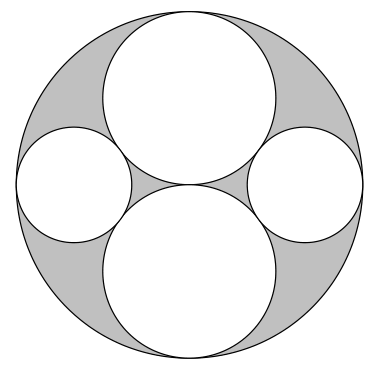
The large circle has radius $30/\sqrt\pi$. Two circles with diameter $30/\sqrt\pi$ lie inside the large circle. Two more circles lie inside the large circle so that the five circles touch each other as shown. Find the shaded area.
Numerical answer only; a non-negative integer less than 1000.
Consider a shortest path along the edges of a $7\times7$ square grid from its bottom-left vertex to its top-right vertex. How many such paths have no edge above the grid diagonal that joins these vertices?
Numerical answer only; a non-negative integer less than 1000.
Determine the number of non-negative integers $x$ that satisfy the equation $\left\lfloor\frac{x}{44}\right\rfloor=\left\lfloor\frac{x}{45}\right\rfloor$. (Note: if $r$ is any real number, then $\lfloor r\rfloor$ denotes the largest integer less than or equal to $r$.)
Numerical answer only; a non-negative integer less than 1000.
A sequence is formed by the following rules: $s_1=a$, $s_2=b$ and $s_{n+2}=s_{n+1}+(-1)^ns_n$ for all $n\ge1$. If $a=3$ and $b$ is an integer less than $1000$, what is the largest value of $b$ for which $2015$ is a member of the sequence? Justify your answer.
Written reasoning is required. The reference answer is not an automatic assessment of a student proof.
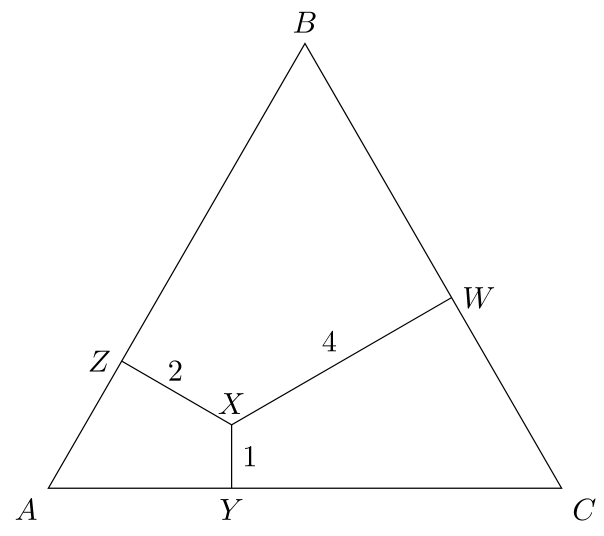
$X$ is a point inside an equilateral triangle $ABC$. $Y$ is the foot of the perpendicular from $X$ to $AC$, $Z$ is the foot of the perpendicular from $X$ to $AB$, and $W$ is the foot of the perpendicular from $X$ to $BC$.
The ratio of the distances of $X$ from the three sides of the triangle is $1:2:4$ as shown in the diagram.
If the area of $AZXY$ is $13\text{ cm}^2$, find the area of $ABC$. Justify your answer. [5 marks]
Investigation (source; 2 bonus marks): If $XY:XZ:XW=a:b:c$, find the ratio of the areas of $AZXY$ and $ABC$.
Written reasoning is required. The reference answer is not an automatic assessment of a student proof.