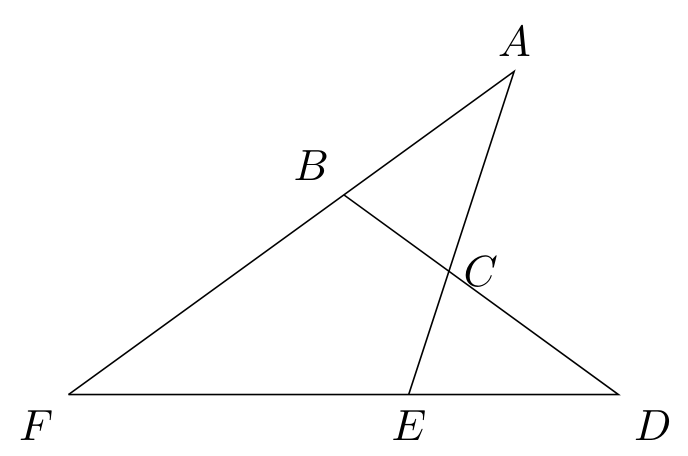
In the diagram below, the points $B$ and $E$ lie on $AF$ and $DF$ respectively, and $AE$ and $BD$ intersect at $C$. If $AB=AC$, $BD=BF$ and $EA=EF$, find $\angle BAC$.
Let $N$ be a 2-digit whole number. When $2692$ is divided by $N$, the remainder is $13$, and when $2978$ is divided by $N$, the remainder is $14$. Find the sum of all the possible values of $N$.
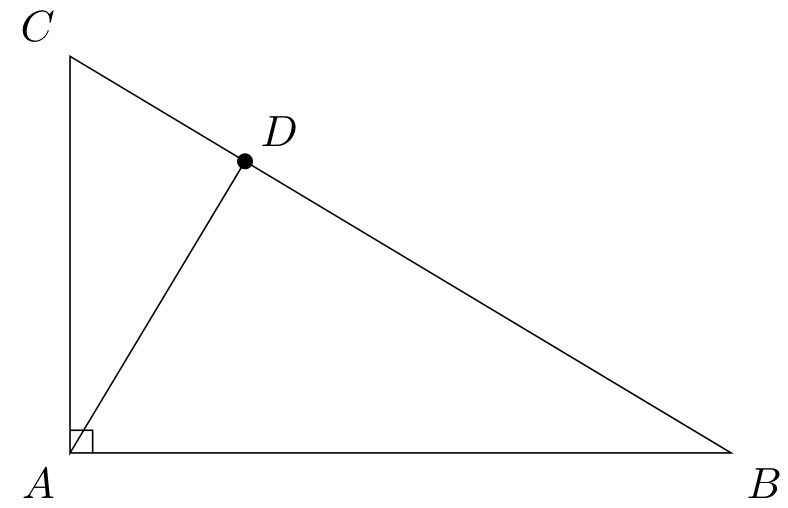
The diagram shows a right-angled triangle $ABC$. The sides $AC$ and $AB$ are in the ratio $3:5$. The point $D$ lies on $BC$ such that $AD$ is perpendicular to $BC$. Furthermore, $DB$ is $8$ cm longer than $CD$. What is the length of $BC$ in cm?
Let $n$ be a positive integer. Suppose that $a_1,a_2,a_3,\ldots$ is a sequence of numbers defined by
$$a_1=\sqrt{(n+3)(n-1)+4},\qquad a_k=\sqrt{(n+2k+1)a_{k-1}+4}\quad\text{for }k\ge2.$$
If $a_{100}=2024$, find the value of $n$.
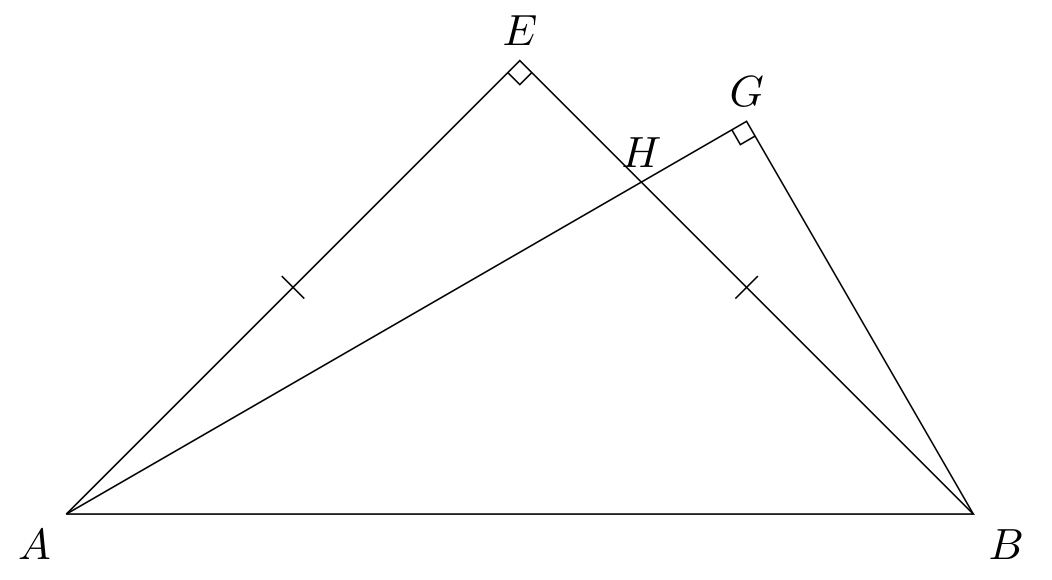
In the diagram below, $AEB$ is an isosceles right-angled triangle and $ABG$ is a $30^\circ$-$60^\circ$-$90^\circ$ right-angled triangle with $\angle GAB=30^\circ$. The sides $AG$ and $BE$ intersect at $H$. If the area of triangle $AHE$ is $50$ cm$^2$, find the area of triangle $BGH$ in cm$^2$.
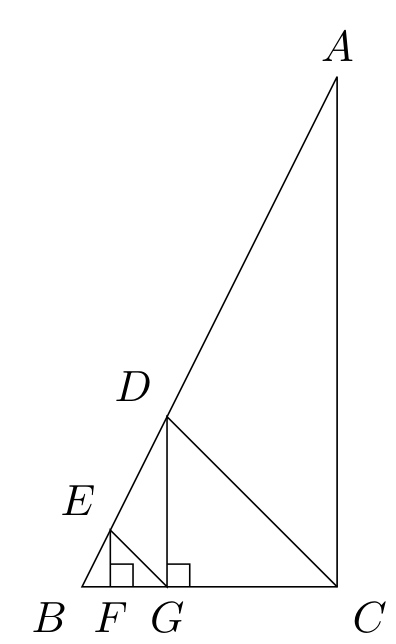
In the diagram below, $ABC$ is a right-angled triangle. Points $D,E$ lie on $AB$ while points $F,G$ lie on $BC$ such that $\triangle EFG$ and $\triangle DGC$ are right-angled isosceles triangles. It is given that $DC=3EG$ and the area of $\triangle DGC$ is $1$ cm$^2$. What is the area of $\triangle ADC$ in cm$^2$?