The incircle of $\triangle ABC$ touches the sides $BC,CA,AB$, at $D,E,F$ respectively. A circle through $A$ and $B$ encloses $\triangle ABC$ and intersects the line $DE$ at $P$ and $Q$. Prove that the midpoint of $AB$ lies on the circumcircle of $\triangle PQF$.
Let $a_1,a_2,\ldots,a_n,b_1,b_2,\ldots,b_n,p$ be real numbers with $p>-1$. Prove that $$\sum_{i=1}^n(a_i-b_i)\left(a_i(a_1^2+a_2^2+\cdots+a_n^2)^{p/2}-b_i(b_1^2+b_2^2+\cdots+b_n^2)^{p/2}\right)\ge0.$$
Let $n\ge3$ be an integer. Prove that there exist positive integers $x_1,\ldots,x_n$ in geometric progression and positive integers $y_1,\ldots,y_n$ in arithmetic progression such that $x_1\lt y_1\lt x_2\lt y_2\lt\cdots\lt x_n\lt y_n$.
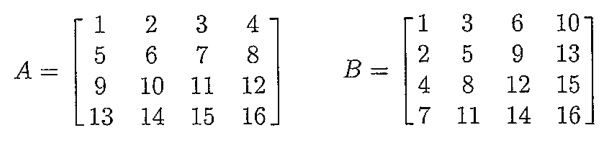
Let $A$ and $B$ be two $n\times n$ square arrays. The cells of $A$ are labelled by the numbers from $1$ to $n^2$ from left to right starting from the top row; whereas the cells of $B$ are labelled by the numbers from $1$ to $n^2$ along rising north-easterly diagonals starting with the upper-left-hand corner. Stack the array $B$ on top of the array $A$. If two overlapping cells have the same number, they are coloured red. Determine those $n$ for which there is at least one red cell other than the cells at top left corner, bottom right corner and at the centre (when $n$ is odd). Below shows the arrays for $n = 4$.