Determine all finite nonempty sets $S$ of positive integers satisfying
$$\frac{i+j}{\gcd(i,j)}\in S\qquad\text{for all }i,j\in S,$$
where $\gcd(i,j)$ is the greatest common divisor of $i$ and $j$.
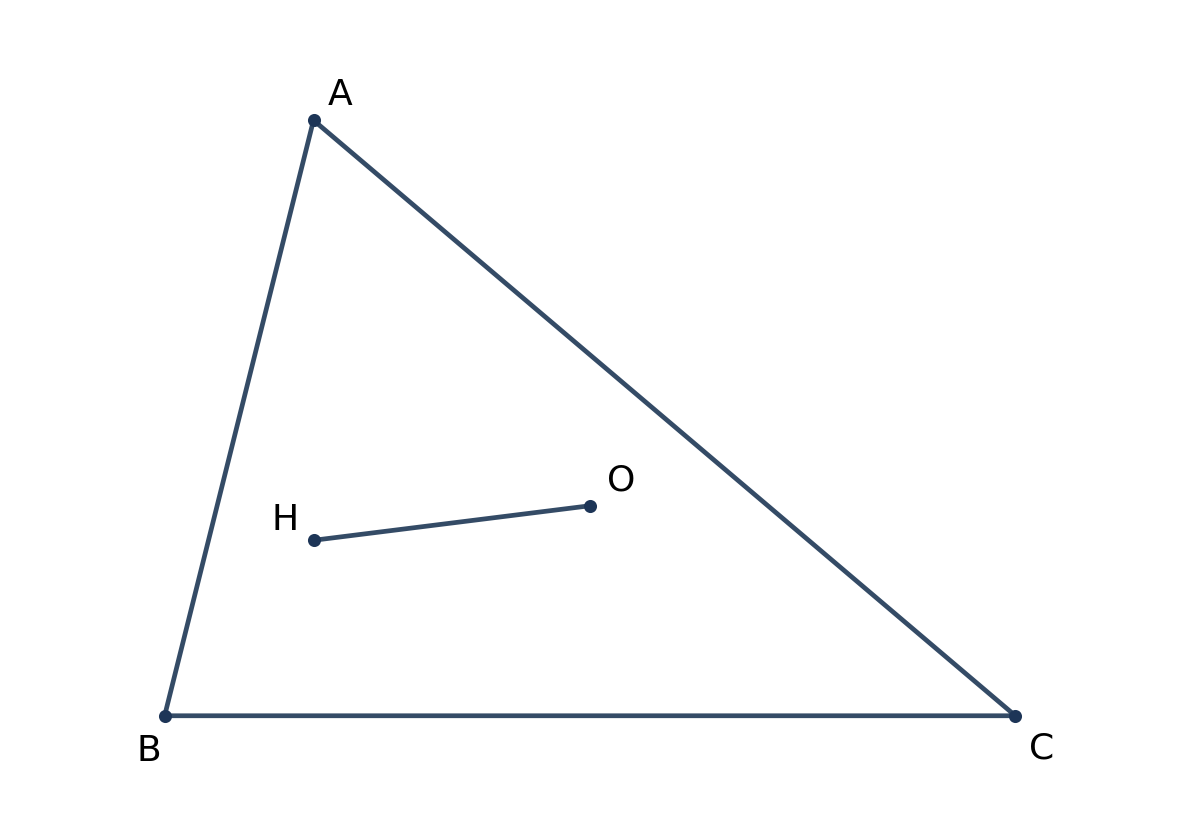
Let $O$ be the circumcentre and $H$ the orthocentre of an acute triangle $ABC$. Prove that the area of one of the triangles $AOH,BOH,COH$ is equal to the sum of the areas of the other two.
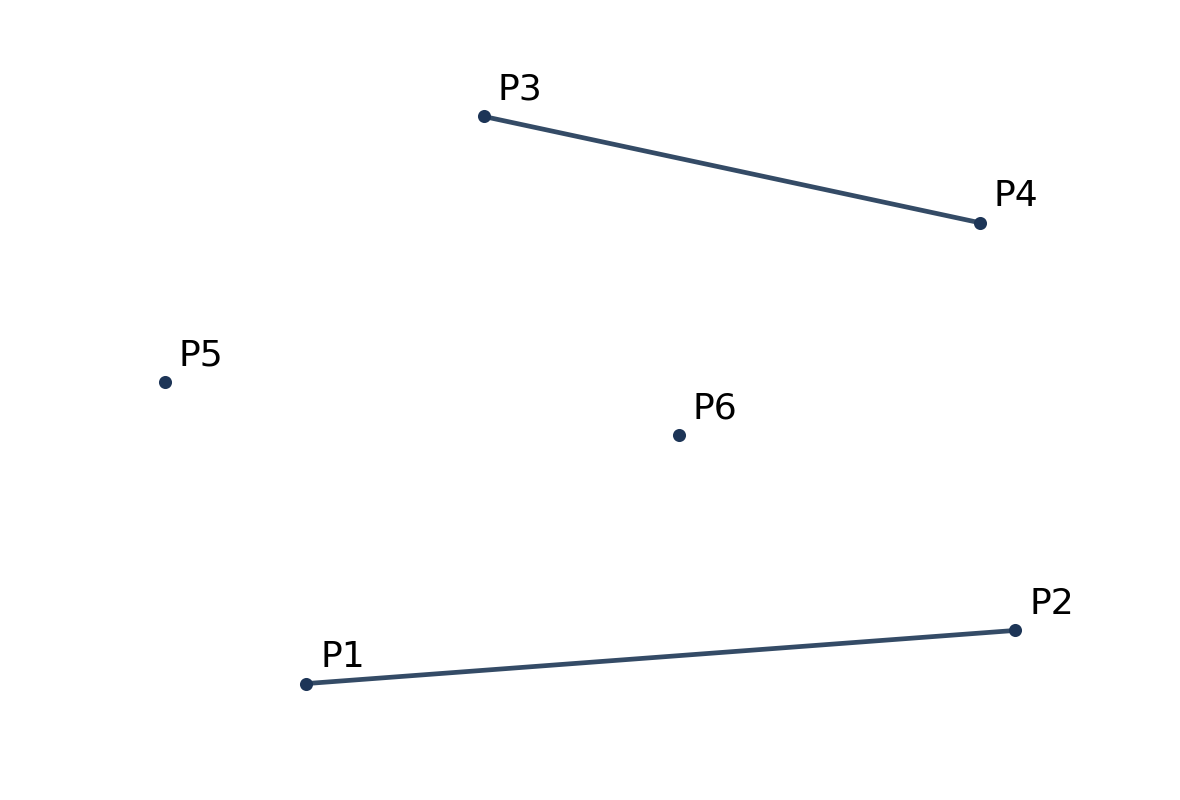
Let a set $S$ of 2004 points in the plane be given, no three of which are collinear. Let $L$ denote the set of all lines (extended indefinitely in both directions) determined by pairs of points from the set. Show that it is possible to colour the points of $S$ with at most two colours, such that for any points $p,q$ of $S$, the number of lines in $L$ which separate $p$ from $q$ is odd if and only if $p$ and $q$ have the same colour.
Note: A line $\ell$ separates two points $p,q$ if they lie on opposite sides of $\ell$, with neither point on $\ell$.
Editorial clarification: the two points $p,q$ are distinct. The source says “any points”; comparing a point with itself would make that literal wording false.
Schematic illustration: only a few sample points and two of the determining lines are shown, rather than all 2004 points and all lines in $L$.
For a real number $x$, let $\lfloor x\rfloor$ stand for the largest integer that is less than or equal to $x$. Prove that
$$\left\lfloor\frac{(n-1)!}{n(n+1)}\right\rfloor$$
is even for every positive integer $n$.