Find the smallest positive integer $n$ with the following property: there does not exist an arithmetic progression of 1999 real numbers containing exactly $n$ integers.
Let $a_1,a_2,\ldots$ be real numbers satisfying $a_{i+j}\le a_i+a_j$ for all positive integers $i,j$. Prove that
$$a_1+\frac{a_2}{2}+\frac{a_3}{3}+\cdots+\frac{a_n}{n}\ge a_n$$
for every positive integer $n$.
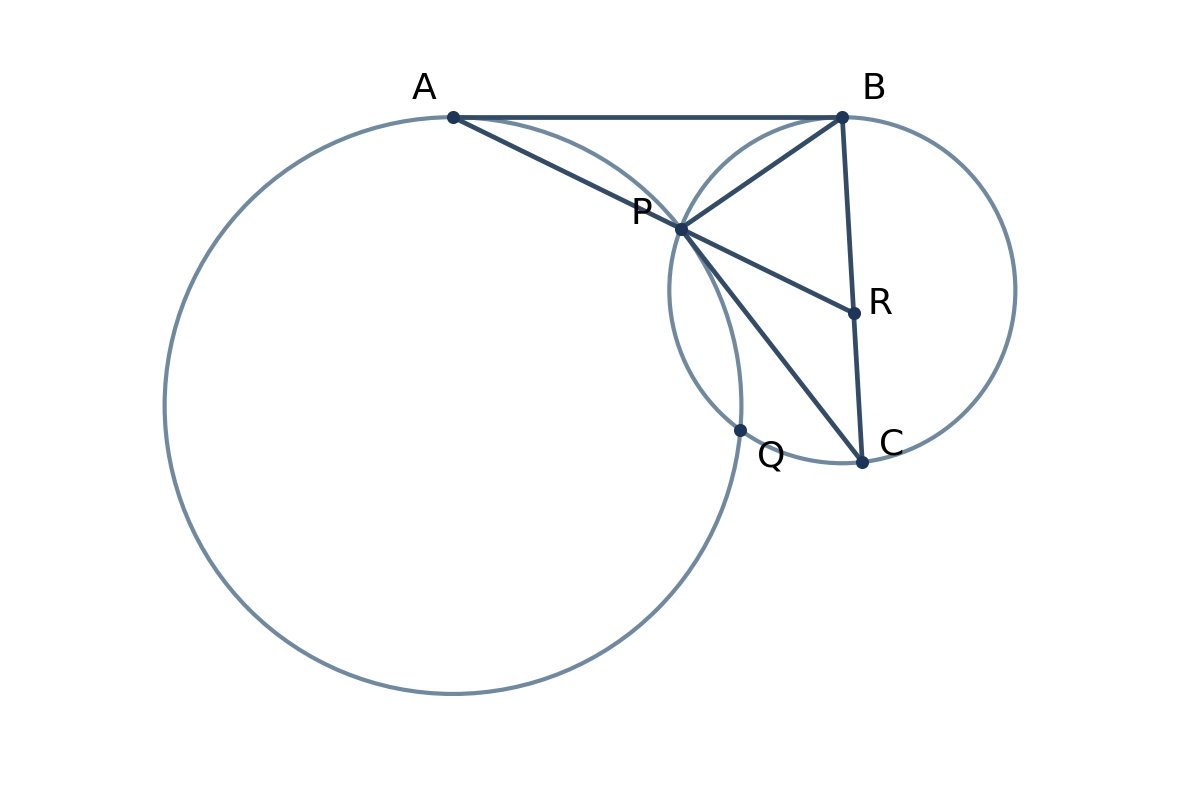
Let $\Gamma_1,\Gamma_2$ be two circles intersecting at $P,Q$. Their common tangent closer to $P$ touches $\Gamma_1$ at $A$ and $\Gamma_2$ at $B$. The tangent to $\Gamma_1$ at $P$ meets $\Gamma_2$ again at $C\ne P$, and the extension of $AP$ meets $BC$ at $R$. Prove that the circumcircle of $PQR$ is tangent to $BP$ and $BR$.
Let $S$ be a set of $2n+1$ points in the plane such that no three are collinear and no four concyclic. A circle is called good if it has 3 points of $S$ on its circumference, $n-1$ in its interior and $n-1$ in its exterior. Prove that the number of good circles has the same parity as $n$.