Let $x,$ $y,$ and $z$ all exceed $1$ and let $w$ be a positive number such that $$
\begin{aligned} \log_x w &= 24,\\ \log_y w &= 40,\\ \log_{xyz} w &= 12. \end{aligned}
$$ Find $\log_z w.$
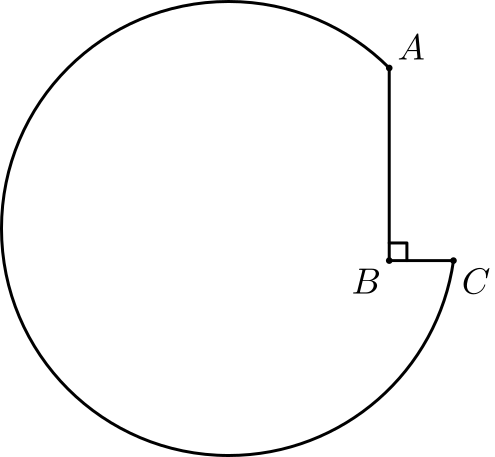
A machine-shop cutting tool has the shape of a notched circle, as shown. The radius of the circle is $\sqrt{50}$ cm, the length of $AB$ is $6$ cm, and that of $BC$ is $2$ cm. The angle $ABC$ is a right angle. Find the square of the distance (in centimeters) from $B$ to the center of the circle.
Suppose that the sum of the squares of two complex numbers $x$ and $y$ is $7$ and the sum of the cubes is $10.$ What is the largest real value that $x+y$ can have?
Twenty-five of King Arthur’s knights are seated at their customary round table. Three of them are chosen, with all choices of three equally likely, and are sent off to slay a troublesome dragon. Let $P$ be the probability that at least two of the three had been sitting next to each other. If $P$ is written as a fraction in lowest terms, what is the sum of the numerator and denominator?
The numbers $1447,$ $1005,$ and $1231$ have something in common: each is a four-digit number beginning with $1$ that has exactly two identical digits. How many such numbers are there?
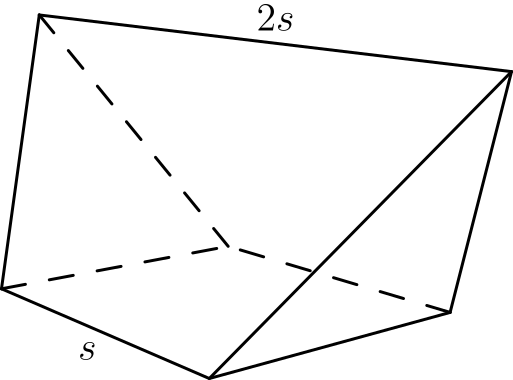
The solid shown has a square base of side length $s.$ The upper edge is parallel to the base and has length $2s.$ All other edges have length $s.$ Given that $s=6\sqrt2,$ what is the volume of the solid?
Diameter $AB$ of a circle has length a $2$-digit integer (base ten). Reversing the digits gives the length of the perpendicular chord $CD.$ The distance from their intersection point $H$ to the center $O$ is a positive rational number. Determine the length of $AB.$
For $\{1,2,3,\ldots,n\}$ and each of its nonempty subsets a unique **alternating sum** is defined as follows: Arrange the numbers in the subset in decreasing order and then, beginning with the largest, alternately add and subtract successive numbers. (For example, the alternating sum for $\{1,2,4,6,9\}$ is $9-6+4-2+1=6$ and for $\{5\}$ it is simply $5.$) Find the sum of all such alternating sums for $n=7.$
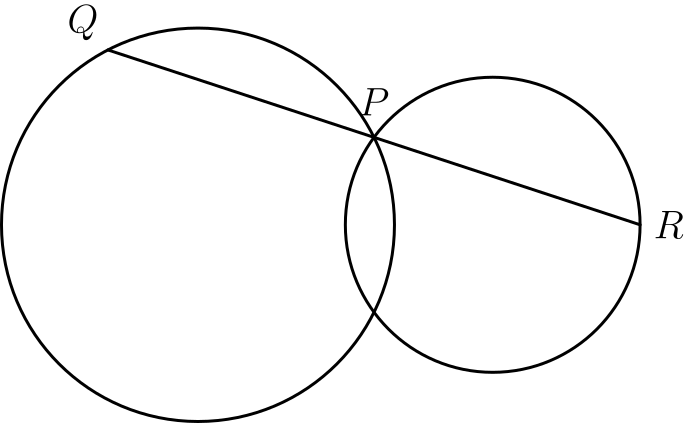
In the adjoining figure, two circles of radii $6$ and $8$ are drawn with their centers $12$ units apart. At $P,$ one of the points of intersection, a line is drawn in such a way that the chords $QP$ and $PR$ have equal length. Find the square of the length of $QP.$
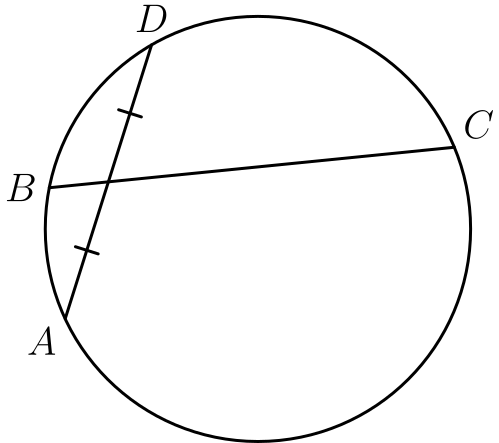
The adjoining figure shows two intersecting chords in a circle, with $B$ on minor arc $AD.$ Suppose that the radius of the circle is $5,$ that $BC=6,$ and that $AD$ is bisected by $BC.$ Suppose further that $AD$ is the only chord starting at $A$ which is bisected by $BC.$ It follows that the sine of the minor arc $AB$ is a rational number. If this fraction is expressed as a fraction $\frac{m}{n}$ in lowest terms, what is the product $mn?$