An ordered triple of positive integers $(a,b,c)$ is called a V-triple if $a\lt b\lt c$ and it satisfies all the following conditions:
- $a$ is a factor of $b+c$;
- $b$ is a factor of $c+a$;
- $c$ is a factor of $a+b$;
- The sum of $a$, $b$ and $c$ is less than or equal to $2025$.
Let $x$, $y$ and $z$ be positive integers such that
$$\begin{cases}z^3-x^3-y^3=3xyz,\\x^2+y^2+z^2\le150.\end{cases}$$
What is the maximum possible value of $x+y+z$?
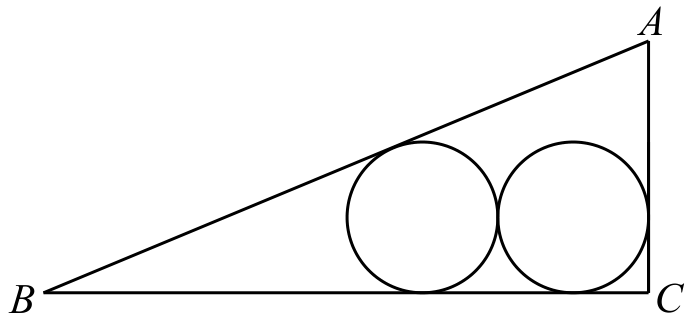
In the diagram below, $ABC$ is a triangle with $AB=13$ cm, $BC=12$ cm and $AC=5$ cm. Inside this triangle, we consider two equal circles, that are externally tangent to each other, such that one of them is tangent to sides $AB$ and $BC$, and the other one is tangent to sides $BC$ and $AC$. What is the length, in cm, of the radius of each circle?
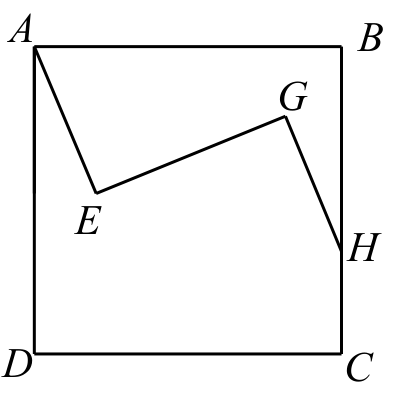
In the diagram below, $ABCD$ is a square. Let $E$ and $G$ be two points inside square $ABCD$ and $H$ be a point on $BC$ such that $\angle AEG=\angle EGH=90^\circ$ and $EG=BH$. If $AE=13$ cm and $GH=12$ cm, what is the side length, in cm, of square $ABCD$?
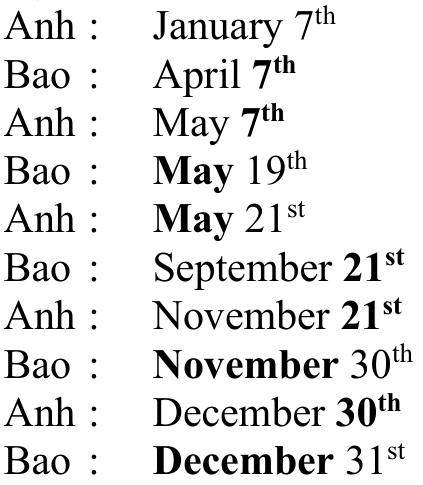
Anh and Bao are playing a game using the 2025 calendar. First, Anh chooses a date in January. Next, Bao chooses a date later in the calendar year, but he must keep either the month or the day from Anh’s previous move. The game continues in a similar way where they take turns and whoever chooses December 31st is the winner. One example of a played game is shared below, with Bao winning:
| Player | Chosen date |
| --- | --- |
| Anh | January 7th |
| Bao | April 7th |
| Anh | May 7th |
| Bao | May 19th |
| Anh | May 21st |
| Bao | September 21st |
| Anh | November 21st |
| Bao | November 30th |
| Anh | December 30th |
| Bao | December 31st |
If Anh has a winning strategy, which date in January should he choose on the first move?
Consider a convex $2025$-gon. We draw a subset of its diagonals such that each drawn diagonal (excluding the two endpoints) intersects exactly one of the other drawn diagonals. What is the maximum possible number of such diagonals that can be drawn?
Let $n$ be any integer where $n\ge2$. Now, consider all the fractions in the form $\frac1{pq}$, where $\gcd(p,q)=1$, $0\lt p\lt q\le n$ and $p+q>n$. Prove that the sum of all such fractions is $\frac12$.
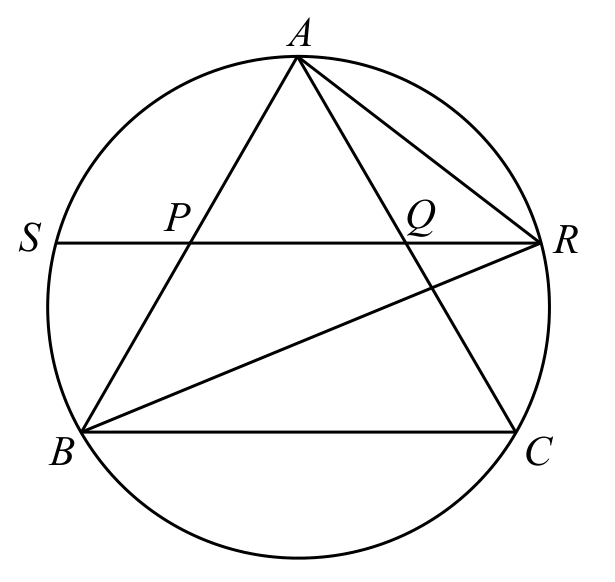
In the diagram below, circle $O$ is the circumcircle of the equilateral triangle $ABC$. Points $P$ and $Q$ are the midpoints of $AB$ and $AC$, respectively. Line $PQ$ intersects circle $O$ at points $S$ and $R$. If $AR=10$ cm, what is the length, in cm, of $BR$?
Alex has a fair six-faced die with the fractions $\frac12$, $\frac32$, $\frac52$, $\frac72$, $\frac92$ and $\frac{11}2$ on its faces. Ben, on the other hand, has a spinning wheel, that is divided into $n$ equal parts. An integer from $0$ to $n-1$ is written on each part, with each number appearing exactly once.
Alex rolls his die, and Ben spins his wheel at the same time. Let $p$ be the probability that Ben obtains a greater number than the one Alex obtains. What is the smallest value of $n$ for which $p$ is at least $\frac12$?