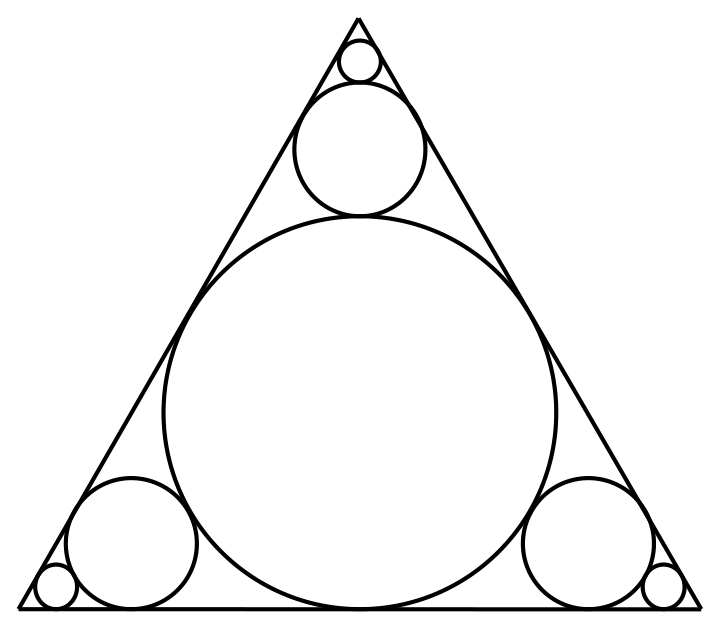
A circle of radius 1 cm is drawn touching the three edges of an equilateral triangle. Starting from this circle, three infinite sequences of smaller circles are then drawn, one at each corner, such that each circle touches tangentially the previous circle and two of the edges of the triangle, as shown in the diagram below. What is the sum of the circumferences, in cm, of all the circles? (Take $\pi=3.14$)
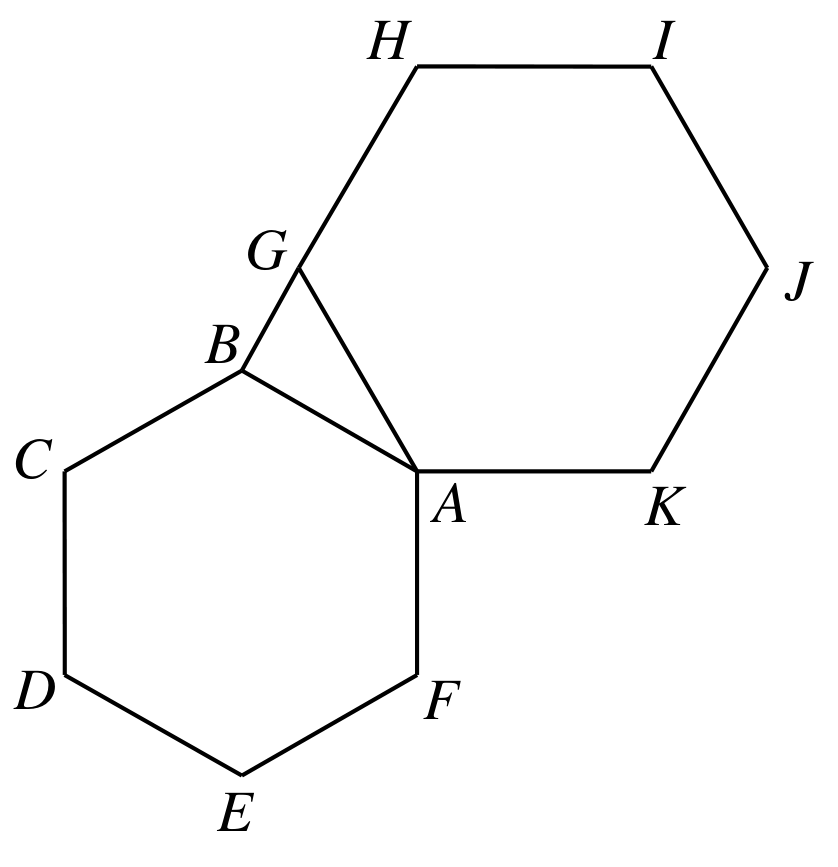
Let $ABCDEF$ and $AGHIJK$ be two regular hexagons that do not overlap, as shown in the diagram below. Assume that $\angle FAK=90^\circ$ and that the areas satisfy $3\times[AGHIJK]=4\times[ABCDEF]$. What is the ratio of $[ABG]:[AGHIJK]$?
Consider the equation $10y^2-9x^{2022}=y^4$, where $x$ and $y$ are integers. If $m$ is the greatest possible value of $x+y$ and $n$ is the number of solutions $(x,y)$, what is $m+n$?
Let $a,b$ and $c$ be three non-zero real numbers that satisfy $a+b+c=0$. What is the value of
$$S=\frac{a^4}{a^4-(b^2-c^2)^2}+\frac{b^4}{b^4-(c^2-a^2)^2}+\frac{c^4}{c^4-(a^2-b^2)^2}?$$
If a number can be expressed as $2^a+2^b$, where $a,b$ are non-negative integers and $a\ne b$, then this number is called a “Lucky number.” Suppose all lucky numbers are listed in increasing order. What is the 64th lucky number?
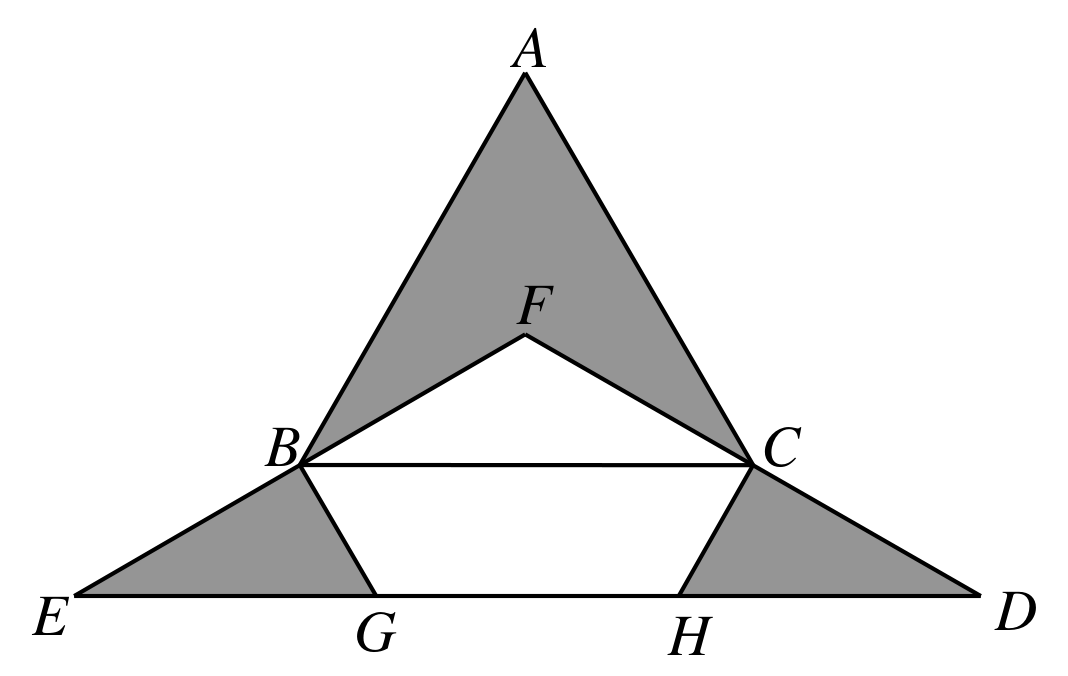
Let $ABC$ be an equilateral triangle whose area is 36 cm$^2$, and $EFD$ be an isosceles triangle with $EF=FD$. The point $F$ is the centre of triangle $ABC$, and the points $B$ and $C$ are the midpoints of $EF$ and $FD$, respectively, as shown in the diagram below. If $BG\perp EF$ and $CH\perp DF$, what is the area, in cm$^2$, of the shaded region?
A very secret company develops a hi-tech machine. There are 20 different blueprints needed to construct it. Every employee has access to exactly 5 different blueprints and every combination of 5 different blueprints is accessible by at least one employee. The CEO wants to distribute employees into departments so that no department could make the machine by itself. That is, there should not be any department where every blueprint is accessible by at least one of its members. What is the smallest number of departments the CEO needs to create?
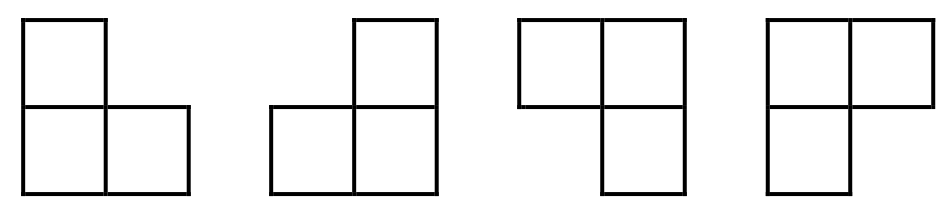
A V-Tromino is made up of three $1\times1$ squares, as diagrams shown below:
All the V-Trominos must be aligned with the board cells. What is the minimum number of the V-Trominos needed to be placed on an $8\times8$ board so that one cannot fit a $2\times2$ square in the remaining space?
There are 17 empty boxes and an infinite supply of balls. In each step, we choose some number of boxes, then put in each chosen box a different number of balls, where each number must be a power of 2 (including 2 to the power of 0). After $k$ steps, it's possible that all boxes have the same non-zero number of balls inside. What is the smallest positive integer $k$ to achieve this?
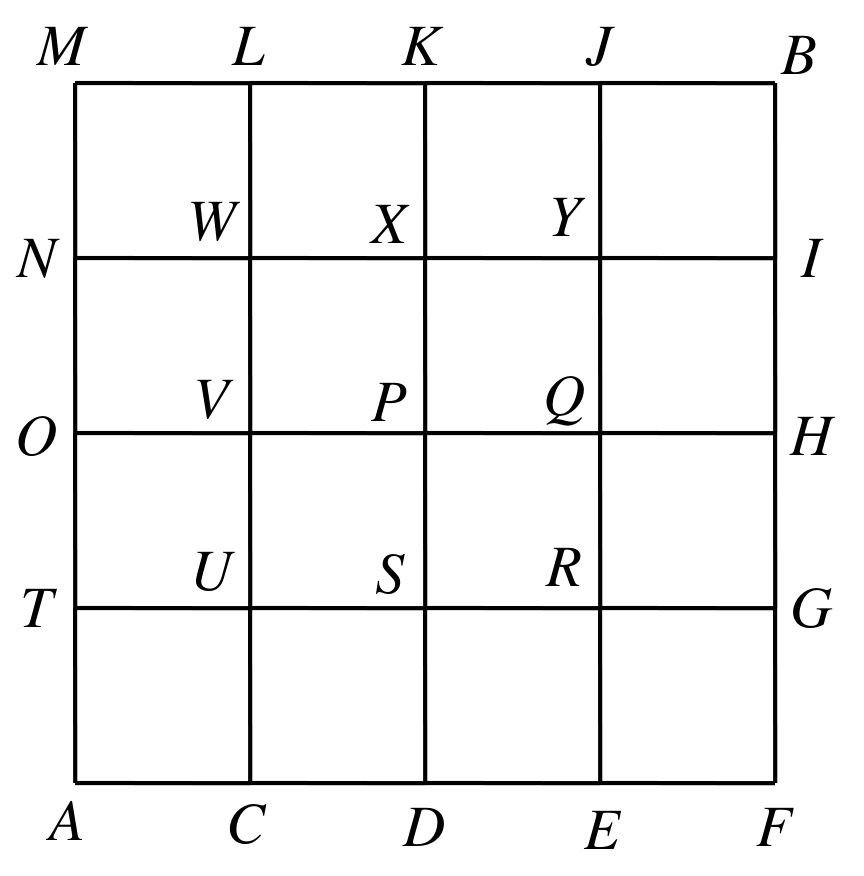
The diagram given below shows an underground maze in the form of a $4\times4$ square. A snake, initially at position $P$, starts crawling along the path P-Q-R-S in a loop. A mouse, initially at position $A$, has to reach position $B$, moving across the maze. The mouse can only move vertically up or horizontally right. If the snake and the mouse reach the same position at the same time, the snake will eat the mouse; also if the two cross each other along a path, the snake will eat the mouse (the snake and the mouse move at the same speed). Given that the mouse and the snake start moving at the same time, what is the number of safe paths for the mouse to move from $A$ to $B$?
(For example, A-C-D-E-R-G-H-I-B is a safe path for the mouse, since when the mouse reaches $R$, the crawling snake will be at point $P$)
Consider a regular hexagon. Paul wishes to colour each of the vertices of the hexagon in green, red or blue, in such a way that there are no neighbouring vertices coloured in the same colour. What is the total number of ways Paul can do such a colouring?
Section B instruction: Show your detailed solution. Each question is worth 20 points.
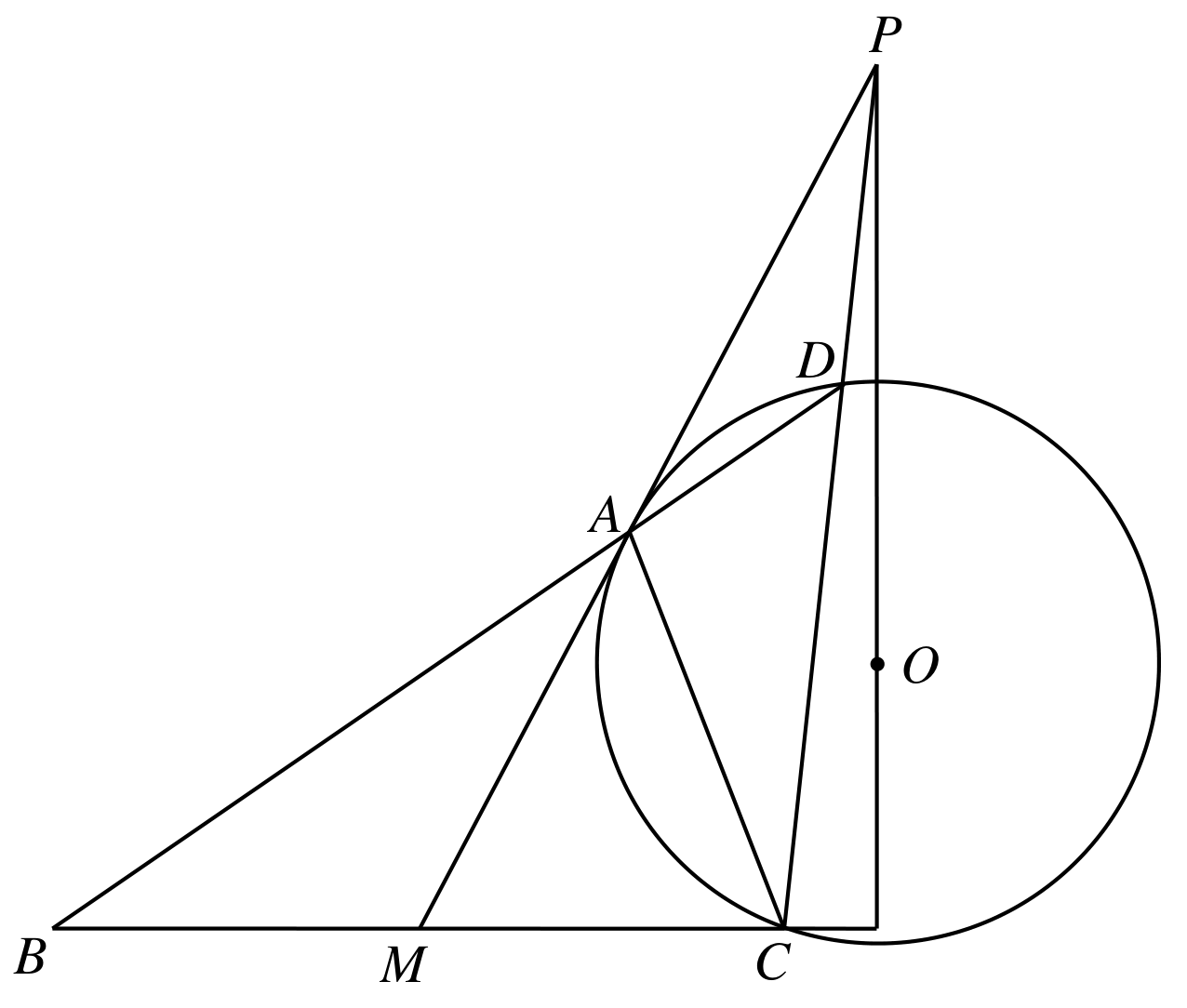
In triangle $ABC$, $M$ is the midpoint of $BC$. We draw the circle with centre $O$ that passes through the points $A$ and $C$ and is tangent to the line $AM$. The extension of $BA$ intersects the circle at $D$ and the extension of $CD$ intersects the extension of $MA$ at $P$, as shown in the diagram below. Prove that $OP\perp BC$.
Section B instruction: Show your detailed solution. Each question is worth 20 points.