There are $81$ dots which are arranged in a $9\times9$ array as shown below. If the distance between any two adjacent dots on the same row or column is $1$ cm, determine the number of rectangles that can be formed having an area of $12$ cm$^2$, where all four vertices are among these $81$ dots.
There are $99$ numbers that are placed around a circle, each one is either $1$ or $-1$. The product of each block of $10$ adjacent numbers along the circle is then computed. Let $S$ denote the sum of these $99$ products. If there is at least one instance of $1$ and at least one instance of $-1$ around the circle, what is the difference between the maximum value and the minimum value of $S$?
Let $P(x)$ and $Q(x)$ be two quadratic polynomials with integer coefficients and their leading coefficients are both $1$. It is known that $P(Q(0))=Q(P(0))=1$ and $P(0)+Q(0)=2$. Find the value of $P(3)+Q(3)$.
Let $a_1,a_2,a_3,\ldots,a_9$ be a random arrangement of the numbers $1,2,3,\ldots,9$. What is the greatest possible value of
$$|a_1-\sqrt3a_2|+|a_2-\sqrt3a_3|+|a_3-\sqrt3a_4|+\cdots+|a_8-\sqrt3a_9|+|a_9-\sqrt3a_1|?$$
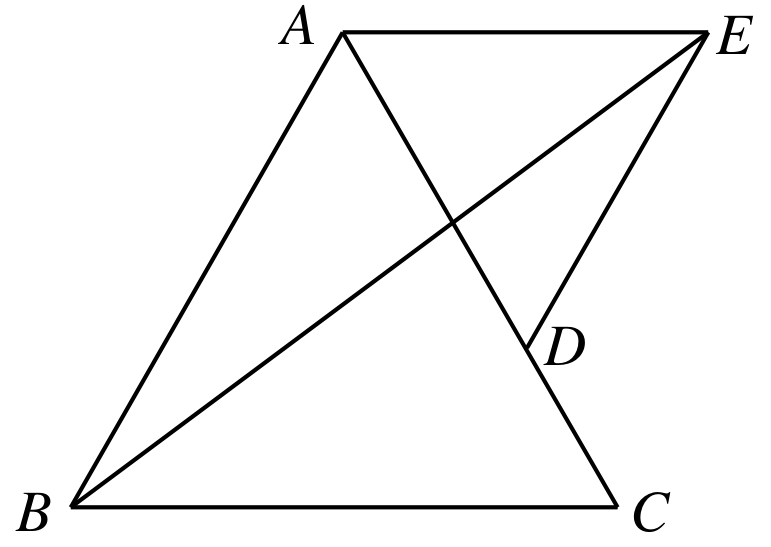
In the diagram below, $ABC$ and $ADE$ are both equilateral triangles having side length of $6$ cm and $4$ cm, respectively. Find the length, in cm, of $BE$.
If a prime number can be written in the form $k^k+1$, where $k$ is a positive integer, then such a prime number is called an IMC prime number. Find the largest IMC prime number not exceeding $20212021$.
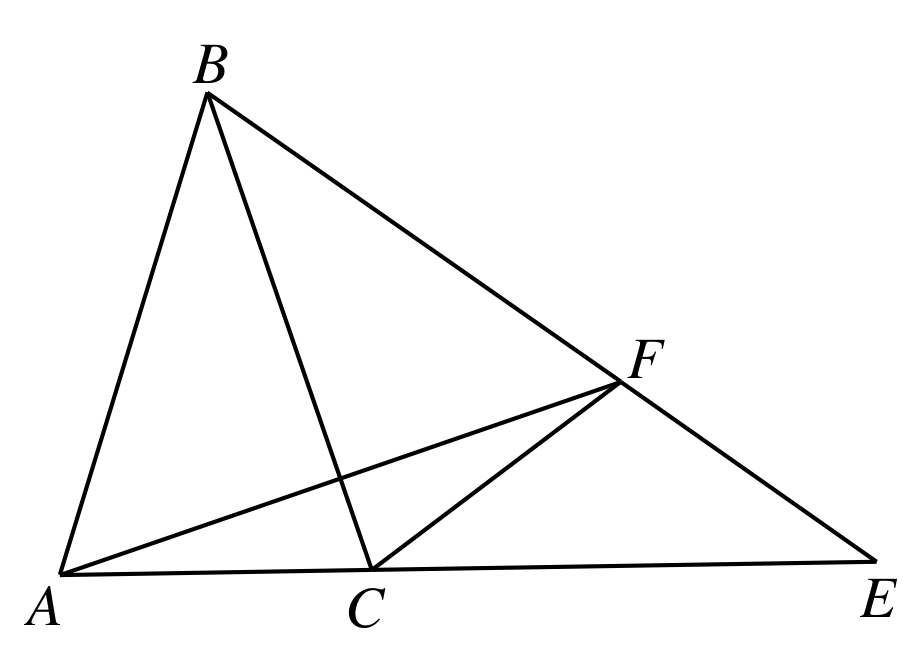
In an isosceles triangle $ABC$, where $AB=BC$, point $E$ is on the extension of side $AC$, where $C$ is between $A$ and $E$ and point $F$ is on the segment $BE$ such that $AC=CF=FE$ and $\angle BAF=3\angle FAE$, as shown in the diagram below. Find the measure, in degrees, of $\angle FAE$.
The nation of IMC-land consists of $8$ islands, none of which are connected to each other. Since each citizen wants to visit each of the other islands, the government plans to build bridges between the islands. However, each island has a volcano that could erupt at any time, destroying that island and any bridges that are connected to it. The government wants to guarantee that after any eruption, a citizen from any of the remaining $7$ islands can go on a tour, visiting each of the remaining islands exactly once and returning to their home island (only at the end of the tour). What is the minimum number of bridges needed to be built?
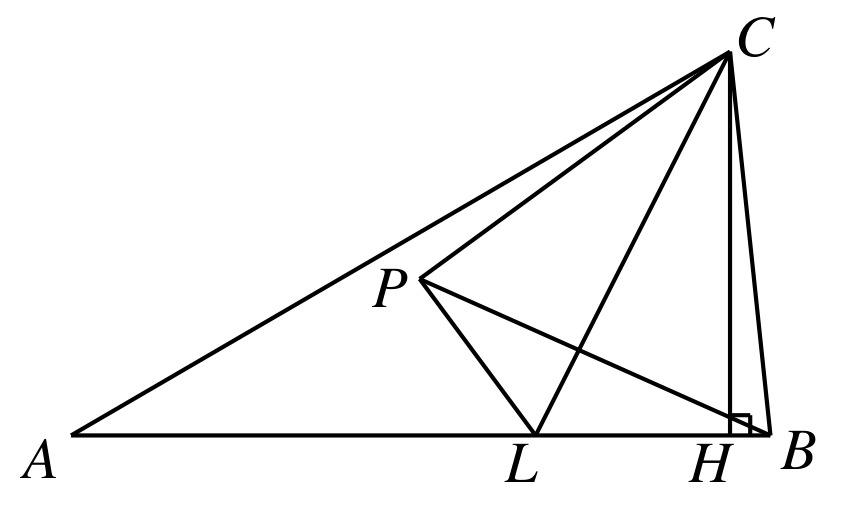
Let $P$ be an interior point of acute triangle $ABC$ such that $CP=BP$ and $\angle BPC=2\angle BAC$. Let the angle bisector of $\angle ACB$ and $AB$ intersect at $L$ and point $H$ be on $AB$ such that $CH\perp AB$, where $L$ is between points $A$ and $H$, as shown in the diagram below. If $CP=CH=28$ cm and the area of triangle $CPL$ is $196$ cm$^2$, then find the length, in cm, of $LH$.
In a class of $14$ boys and $17$ girls, some candies are to be distributed. Every boy receives an equal number of candies as each other, while every girl also receives an equal number of candies as each other. Each person receives at least one candy, but the number of candies received by each boy may be different from that received by each girl. If the total number of candies cannot be redistributed in any other way to satisfy our conditions, determine the maximum number of candies that we can have. Show your detailed solution.
Let $M$ and $N$ be non-negative integers such that $C_{1010}^{2021}$ is divisible by $2^M\times3^N$. Find the sum of all the possible values of $M+N$. (Note: $C_{1010}^{2021}$ refers to the combination of $2021$ things taken $1010$ at a time without repetition.) Show your detailed solution.