Function $F$, when applied to any four-digit positive integer $\overline{abcd}$, produces another positive integer, according to the rule: $F(\overline{abcd})=a^4+b^3+c^2+d^1$. For example, $F(2019)=2^4+0^3+1^2+9^1=26$.
Find the value of $F(2019)-F(2018)+F(2017)-F(2016)+\cdots-F(2000)$.
Three boxes $A$, $B$ and $C$, contain $100$, $50$ and $80$ marbles of the same size respectively, some of which are black. In box $A$ there are $15$ black marbles. We select a box at random and then take a marble from that box, again at random. The probability to obtain a black marble this way is $\frac{101}{600}$. What is the greatest possible number of black marbles in box $C$?
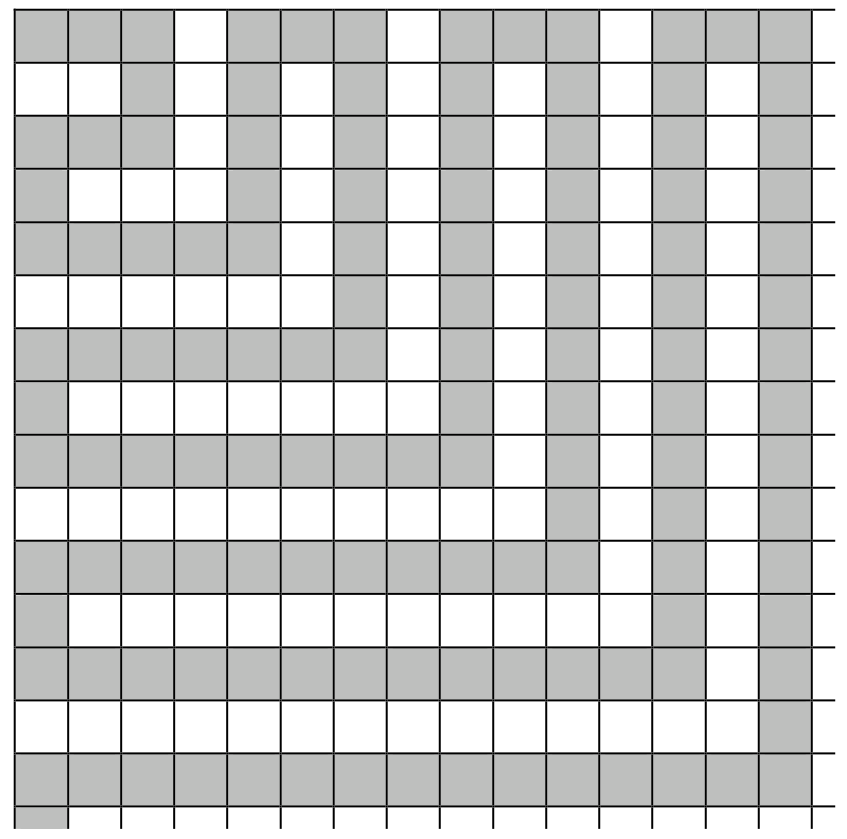
The top-left portion of a grid of $101\times101$ white squares is shown below. A chain is formed by coloring squares grey as shown. The chain starts at the upper left-hand corner and goes on until it cannot go on any further. In total, how many squares are colored grey in the entire grid of $101\times101$ squares?
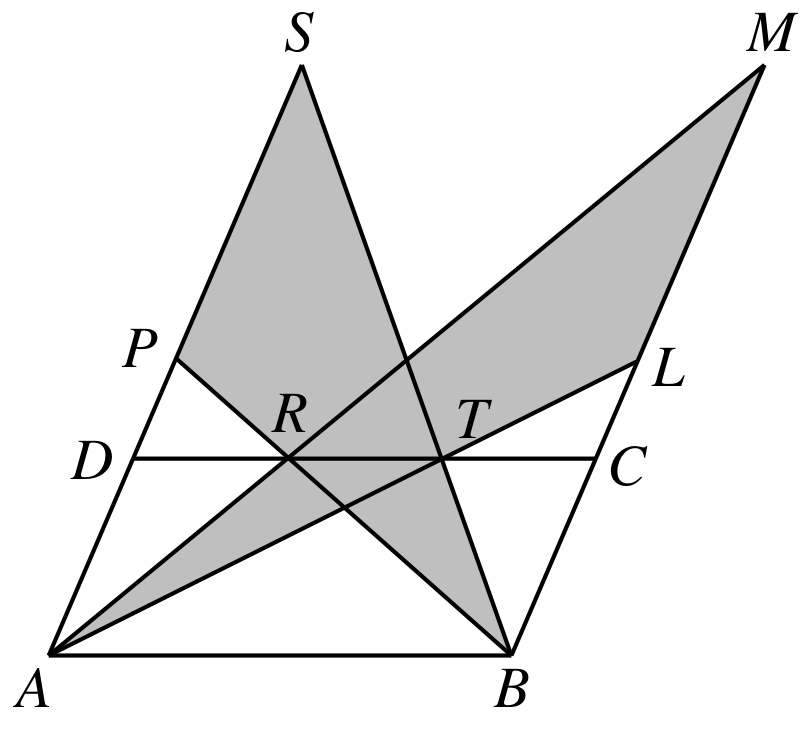
In the figure below, points $R$ and $T$ lie on the side $CD$ of the parallelogram $ABCD$ such that $DR=RT=TC$. Lines $AR$ and $AT$ intersect the extension of $BC$ at points $M$ and $L$ respectively, and the lines $BT$ and $BR$ intersect the extension of $AD$ at points $S$ and $P$ respectively. If the area of the parallelogram $ABCD$ is $48$ cm², then what is the area, in cm², of the shaded region?
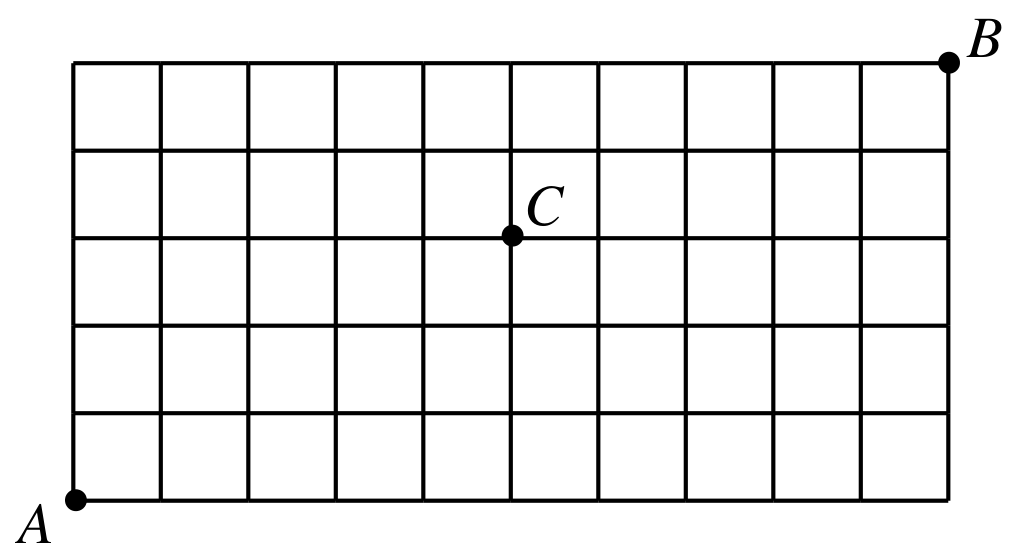
In the figure below, an ant starting at point $A$ is travelling along the grid lines of the $10\times5$ grid. It is only allowed to go up and to the right and is not allowed to go through point $C$. How many ways are there for the ant to go from point $A$ to point $B$?
In the figure below, $ABC$ is a triangle such that $\angle BAC=150^\circ$, $BC=74$ cm and point $D$ is on $BC$ such that $BD=14$ cm. If $\angle ADB=60^\circ$, then what is the area, in cm², of triangle $ABC$?
Answer entry: give the exact value; use sqrt(...) for a square root.
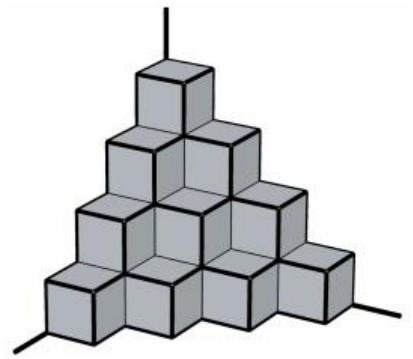
In the figure below, there is a certain number of cubes that are piled on top of each other to form a triangular tower that fits one corner of a room. If we use exactly $1330$ identical cubes, then how many levels does the tower have?
Note that not all cubes can be seen from this view.
The increasing sequence $1,3,4,9,10,12,13,\ldots$ consists of all the positive integers which can be expressed as powers of $3$ or sums of distinct powers of $3$. Find the $100$th term of this sequence.
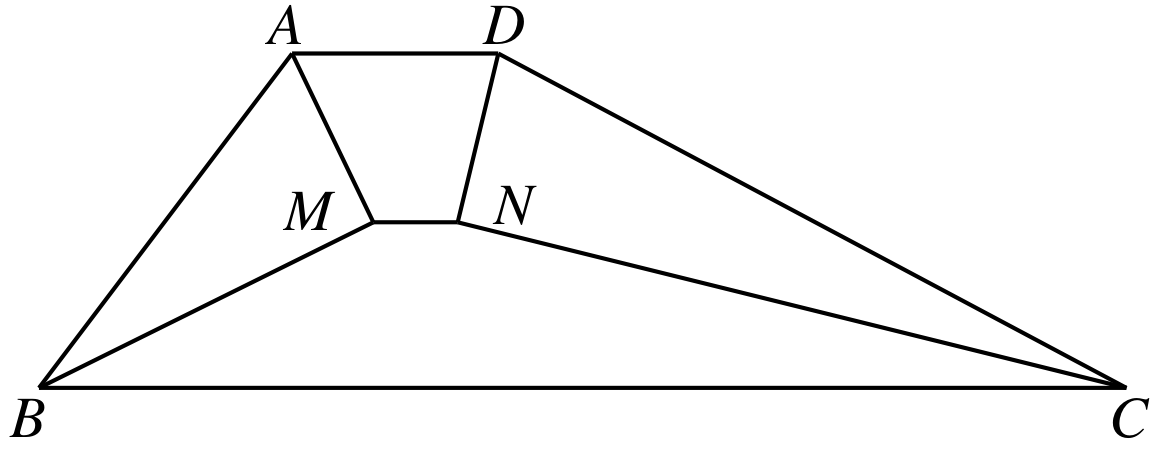
In a quadrilateral $ABCD$, $BC\parallel AD$, $BC=26$ cm, $AD=5$ cm, $AB=10$ cm and $CD=17$ cm. The bisectors of $\angle A$ and $\angle B$ intersect at $M$ while the bisectors of $\angle C$ and $\angle D$ intersect at $N$. Find the length, in cm, of $MN$.