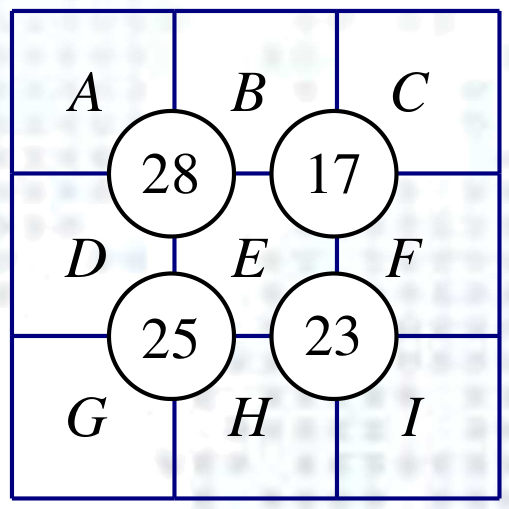
In the diagram below, replace each letter by a different number from of $1,2,3,4,5,6,7,8$ and $9$, so that the sum of the four numbers around each circle is equal to the number inside the circle.
Find the sum of all four-digit perfect squares such that if each of its digits is reduced by the same amount, the resulting four-digit number is still a perfect square. (Different reduction amounts may be used for different perfect squares.)
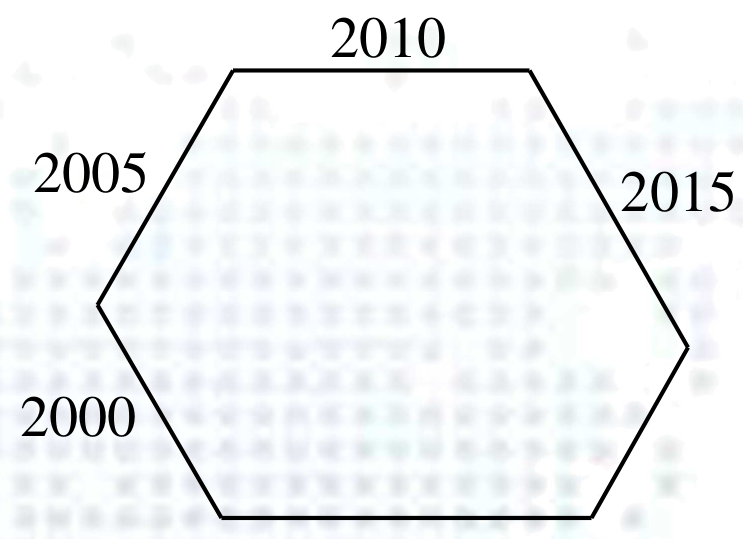
A hexagon has six angles of $120^\circ$. The lengths of four consecutive sides are $2000$ cm, $2005$ cm, $2010$ cm and $2015$ cm. Calculate the circumference, in cm, of this hexagon.
There is a $4\times4$ grid posted on the wall. Find the number of ways of placing two identical red counters and two identical blue counters on four different squares of the grid such that no column or row has two counters of the same color.
What is the minimum size of a collection of perfect squares, with repetitions allowed, such that every positive integer up to $100$ can be expressed as a sum of the numbers in the collection? A sum may consist of one number from the collection as well.
Kelly is younger than $100$ and Kerry is older than $9$. Kelly’s age becomes Kerry’s age when it is multiplied by a fraction whose denominator is $999$ and whose numerator is a three-digit number with $5$ as the tens digit. How many possible values of Kerry’s age are there?
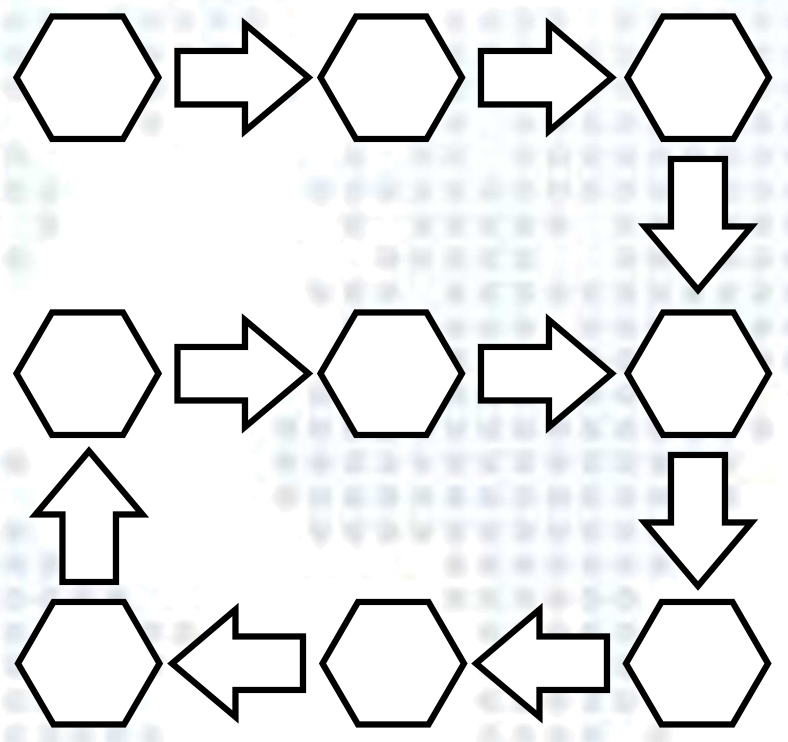
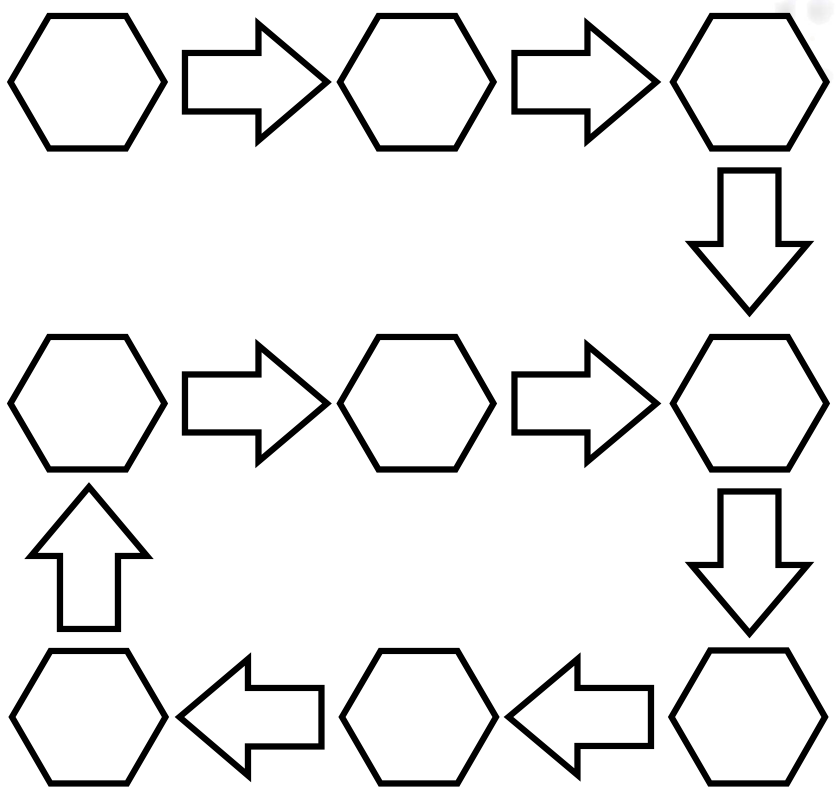
In the diagram below, each hexagon contains one of the numbers $2,4,5,6,7,18,20$ and $36$. Each number appears once except that $6$ appears twice. Each arrow contains one of the operations $-1$, $\div2$, $+3$, $\times3$, $+4$, $\times4$, $\div9$ and $+16$. Each operation appears once except that $-1$ appears twice. Complete the diagram so that each operation applied to the number in the preceding hexagon yields the number in the succeeding hexagon. Note that one of the hexagon succeeds no arrows while another one succeeds two arrows.
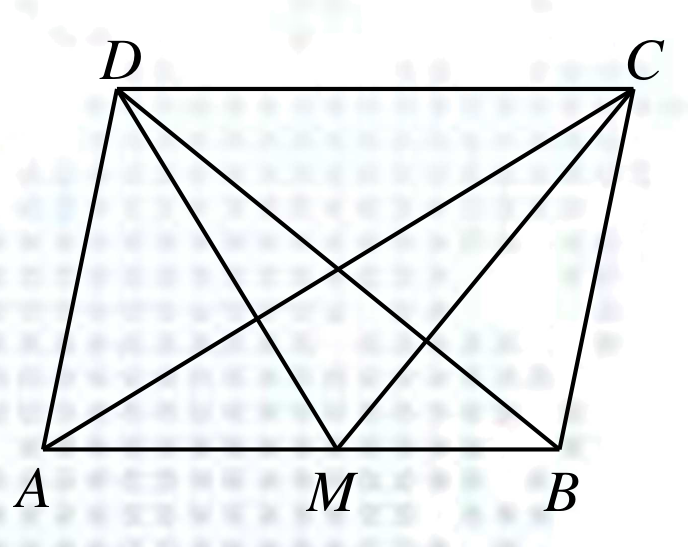
$M$ is a point on the side $AB$ of a parallelogram $ABCD$ such that $AM:MB=4:3$. $DM$ and $CM$ are perpendicular respectively to $AC$ and $BD$. If $BC=5$ cm, find the area, in cm$^2$, of $ABCD$.
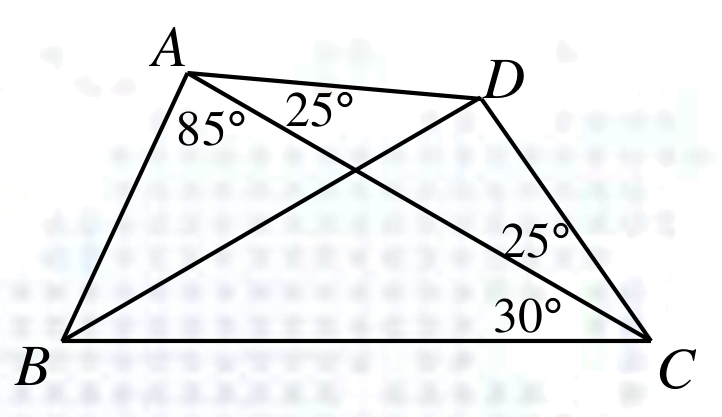
In a convex quadrangle $ABCD$, $\angle DAC=\angle DCA=25^\circ$, $\angle BAC=85^\circ$ and $\angle ACB=30^\circ$. Find the measure, in degrees, of $\angle BDC$.