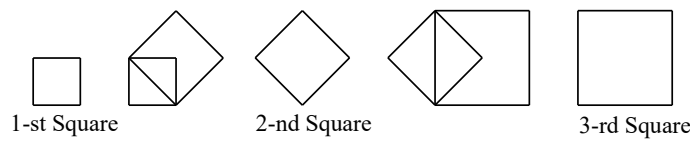
In a sequence of squares, the first one has side length $1$ cm. The side length of each subsequent square equals the length of a diagonal of the preceding square. The diagram illustrates the second and third squares. What is the side length, in cm, of the eleventh square?
Twenty girls stood in a row facing right. Four boys joined the row facing left. Each boy counted the girls in front of him, obtaining $3,6,15,18$. Each girl counted the boys in front of her. What was the sum of the girls\' counts?
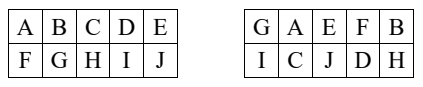
Ten advertisements $A$–$J$ occupy a $2\times5$ billboard as shown. Every day they move between boxes by the same fixed rule. The next-day arrangement is also shown. After how many days do all advertisements first return to their original boxes together?
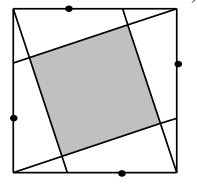
Each side of a square of side length $10$ cm is divided into three equal parts. Some division points are joined to vertices as shown. What is the area, in cm$^2$, of the shaded region?
Two opposite corner dots are removed from a $4\times4$ array, leaving the fourteen dots shown. How many different squares have four of these dots as vertices?
How many positive integers below $1000$, with units digit $9$, are the sum of a power of $2$ and a power of $3$? Note that $1$ is a power of both $2$ and $3$.
Alice replaces each number $6,7,\ldots,2012,2013$ by its digit sum. Brian replaces every resulting number by its digit sum, and Colin does so again. Which number does Colin obtain most frequently?
Every positive integer is a sum of distinct powers of $2$; $1$ and $2$ are powers of $2$. How many three-digit numbers are sums of exactly nine distinct powers of $2$?
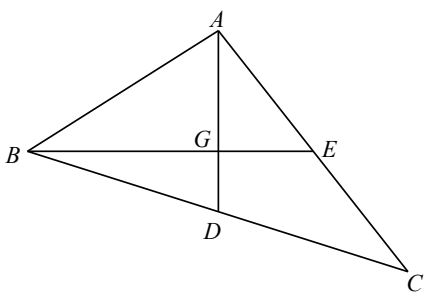
In triangle $ABC$, $D$ and $E$ are midpoints of $BC$ and $CA$. The medians $AD,BE$ are perpendicular and meet at centroid $G$, where $AG=2DG$, $BG=2EG$. Find $(BC^2+AC^2)/AB^2$.
Point $O$ is inside quadrilateral $ABCD$. Its distances from the vertices are $1,2,4,7$ cm in some order. What is the maximum quadrilateral area, in cm$^2$?
A positive integer is strange if all exponents in its prime factorization are odd. For example $22=2^1\times11^1$, $23=23^1$, $24=2^3\times3^1$ give three consecutive strange numbers. What is the greatest possible length of a block of consecutive strange numbers?
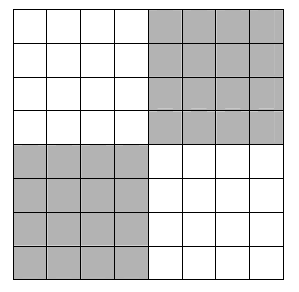
Half the squares of an $8\times8$ board are shaded as shown. How many $2\times2$, $4\times4$ and $6\times6$ subboards each have exactly half their squares shaded?
A positive integer with at most nine digits is good if its units digit is $0$ or $1$, tens digit $0,1,2$, hundreds digit $0,1,2,3$, thousands digit $0,1,2,3,4$, and so on. The first ten are $1,10,11,20,21,100,101,110,111,120$. What is the hundredth good number?