A positive real number is given. Each move adds three, subtracts three, multiplies by three or divides by three. Determine every starting number which can return to itself after exactly three moves.
Eight people have average age fifteen; every age is prime. Nineteen occurs more often than any other age. In sorted order the two middle ages average eleven. Find the oldest person’s maximum age.
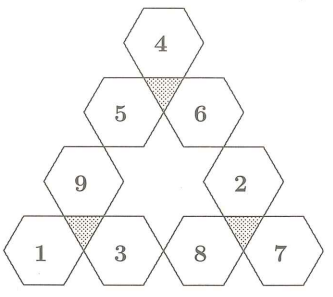
The digits one through nine occupy the nine hexagons on the sides of a triangle, initially summing to nineteen on each side. Rearrange them so the three side sums remain equal. Find the minimum and maximum common sum.
Two thousand twelve equally spaced collinear points are painted orange or green. If three points $A,B,C$ satisfy $AB=BC$, all three must have the same colour. Count all colourings.
The three splits $2|012$, $20|12$, $201|2$ of the four-digit number two thousand twelve give product sum $2\cdot012+20\cdot12+201\cdot2=666$. Find all other four-digit numbers with this property.
Using straight and circular cuts, dissect a circle into congruent pieces so at least one piece has the circle centre neither inside nor on its boundary.
A machine has three boxes, each initially with its red light off. After objects are inserted, a box lights only when its total weight is strictly less than both others; otherwise all lights remain off. Among seven balls, six have equal weight and one fake is lighter. Find the fake using the machine twice.
Five tetrominoes I, L, N, O and T are shown, each formed from four edge-connected unit squares. (a) Use three different pieces to make a reflection-symmetric figure; give five solutions with different piece combinations. (b) Use three different pieces to make a rotation-symmetric figure; give one solution.
The ten decimal digits are replaced bijectively by $A,B,C,D,E,F,G,H,I,J$. Given $$10A+B=A^2C,\quad10D+E=CF,\quad10B+G=H+I+FG,\quad ABDJ\ne0,$$ find $J$.