The height of a building is $60$ m. At a certain moment during daytime, it casts a shadow of length $40$ m. If a vertical pole of length $2$ m is erected on the roof of the building, find the length, in m, of the shadow of the pole at the same moment.
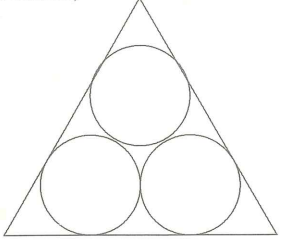
The diagram below shows an equilateral triangle of side $1$ cm. The three circles touch each other and the sides of the triangle. Find the common radius, in cm, of the circles.
Let $a,b,c$ be positive integers. The sum of $160$ and the square of $a$ is equal to the sum of $5$ and the square of $b$. The sum of $320$ and the square of $a$ is equal to the sum of $5$ and the square of $c$. Find $a$.
Let $x$ be a two-digit number. Denote by $f(x)$ the sum of $x$ and its digits minus the product of its digits. Find the value of $x$ which gives the largest possible value for $f(x)$.
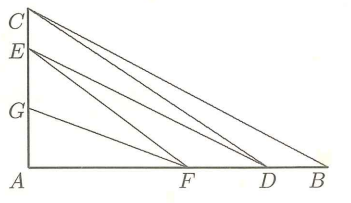
The diagram below shows a right triangle $ABC$. The perpendicular sides $AB$ and $AC$ have lengths $15$ cm and $8$ cm respectively. $D,F$ are points on $AB$, and $E,G$ are points on $AC$. The segments $CD,DE,EF,FG$ divide triangle $ABC$ into five triangles of equal area. The length, in cm, of only one of these segments is integral. What is that length?
There are two committees A and B. Committee A had $13$ members while committee B had $6$ members. Each member is paid $6000$ dollars per day for attending the first $30$ days of meetings, and $9000$ dollars per day thereafter. Committee B met twice as many days as committee A, and the expenditure on attendance were the same for the two committees. If the total expenditure on attendance for these two committees was over $3000000$ dollars, how much was it?
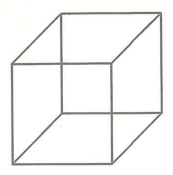
The diagram below shows a cubical wire framework of side $1$ cm. An ant starts from a vertex and crawls along the sides of the framework. If it does not repeat any part of its path and finally returns to the starting vertex, what is the longest possible length, in cm, of the path it has travelled?
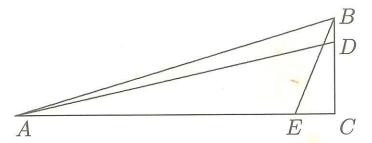
In the diagram below, $BC\perp AC$. A point $D$ on $BC$ satisfies $BC=4BD$, and a point $E$ on $AC$ satisfies $AC=8CE$. If $AD=164$ cm and $BE=52$ cm, determine the length, in cm, of $AB$.
When a particular six-digit number is multiplied by $2,3,4,5,6$ respectively, each product is still a six-digit number with the same digits as the original number but in a different order. Find the original number.