Question 162
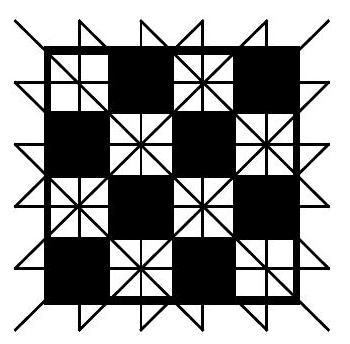
The 16 squares of a $4 \times 4$ chessboard can be arranged into 18 lines as follows: the four rows, the four columns, five diagonals from northwest to southeast and five diagonals from northeast to southwest. Here these diagonals consist of 2, 3 or 4 diagonally adjacent squares of the same color each; the corner squares of the board alone thus do not form a diagonal.
Now a stone is placed on each of 10 of the 16 squares. Each of the 18 lines that then contains an even number of stones scores one
point.
What is the largest score that can be achieved by placing the 10 stones? The answer is to be justified.
Now a stone is placed on each of 10 of the 16 squares. Each of the 18 lines that then contains an even number of stones scores one
point.
What is the largest score that can be achieved by placing the 10 stones? The answer is to be justified.