Question 97
In each vertex of a regular $n$-gon $A_1, A_2, \ldots, A_n$ there is a unique pawn. In each step it is allowed:
1\. to move all pawns one step in the clockwise direction or
2\. to swap the pawns at vertices $A_1$ and $A_2$.
Prove that by a finite series of such steps it is possible to swap the pawns at vertices:
a) $A_i$ and $A_{i+1}$ for any $1 \le i \lt n$ while leaving all other pawns in their initial place
b) $A_i$ and $A_j$ for any $1 \le i \lt j \le n$ leaving all other pawns in their initial place.
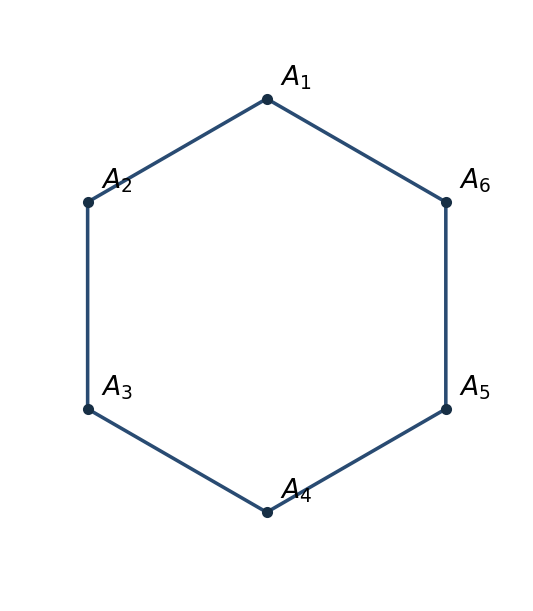
1\. to move all pawns one step in the clockwise direction or
2\. to swap the pawns at vertices $A_1$ and $A_2$.
Prove that by a finite series of such steps it is possible to swap the pawns at vertices:
a) $A_i$ and $A_{i+1}$ for any $1 \le i \lt n$ while leaving all other pawns in their initial place
b) $A_i$ and $A_j$ for any $1 \le i \lt j \le n$ leaving all other pawns in their initial place.