Question 79
The numbers $1,2,3,\ldots,25$ are placed on a $5\times5$ board, one number per cell, so that consecutive numbers always occupy neighboring cells. The table shows an example.
| 3 | 4 | 5 | 24 | 23 |
| :---: | :---: | :---: | :---: | :---: |
| 2 | 1 | 6 | 25 | 22 |
| 9 | 8 | 7 | 20 | 21 |
| 10 | 13 | 14 | 19 | 18 |
| 11 | 12 | 15 | 16 | 17 |
(a) Show that in every arrangement satisfying the condition, all numbers on the two diagonals are odd.
Call the diagonal painted white in the following figure the main diagonal.
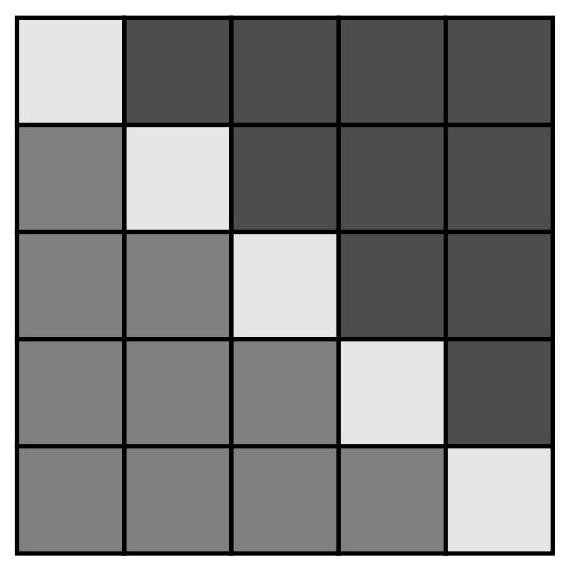
The main diagonal divides the board into an upper and a lower region.
(b) Let $x,y\in\{1,2,\ldots,25\}$ with $x\lt y$. Show that if $x,y$ lie in different regions, there is a number $z$ on the main diagonal with $x\le z\le y$.
(c) Determine the smallest possible sum of the numbers on the main diagonal among arrangements satisfying the condition.
| 3 | 4 | 5 | 24 | 23 |
| :---: | :---: | :---: | :---: | :---: |
| 2 | 1 | 6 | 25 | 22 |
| 9 | 8 | 7 | 20 | 21 |
| 10 | 13 | 14 | 19 | 18 |
| 11 | 12 | 15 | 16 | 17 |
(a) Show that in every arrangement satisfying the condition, all numbers on the two diagonals are odd.
Call the diagonal painted white in the following figure the main diagonal.
The main diagonal divides the board into an upper and a lower region.
(b) Let $x,y\in\{1,2,\ldots,25\}$ with $x\lt y$. Show that if $x,y$ lie in different regions, there is a number $z$ on the main diagonal with $x\le z\le y$.
(c) Determine the smallest possible sum of the numbers on the main diagonal among arrangements satisfying the condition.