Question 36
Suppose $m$ and $n$ are two nonnegative integers. In the Philosopher's Chess, the chessboard is an infinite array of same regular hexagon cells. The Phoenix piece, which is a special piece in this kind of chess, moves as follows:
At first, the Phoenix selects one of the six directions and moves $m$ cells in that direction. Then it turns 60 degrees clockwise and moves $n$ cells in that new direction to get to the final point.
At most how many cells of the Philosopher's Chess' chessboard exist in such a way that one cannot start from one of them and reach another one with a finite number of movements of the Phoenix piece?
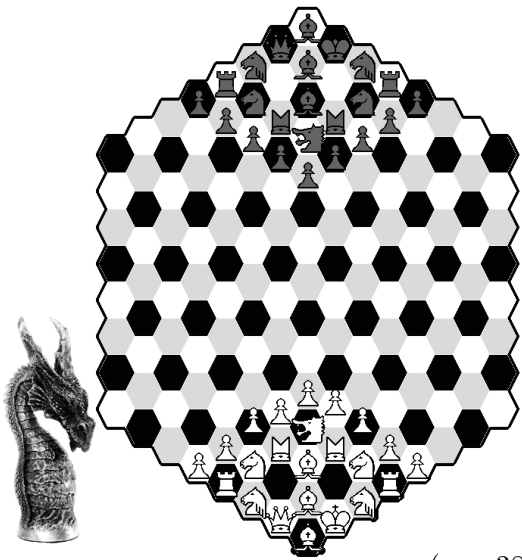
At first, the Phoenix selects one of the six directions and moves $m$ cells in that direction. Then it turns 60 degrees clockwise and moves $n$ cells in that new direction to get to the final point.
At most how many cells of the Philosopher's Chess' chessboard exist in such a way that one cannot start from one of them and reach another one with a finite number of movements of the Phoenix piece?