Question 3
Mercury in fish and other marine organisms is a source of great health concern for people who eat them, particularly expecting mothers and young children who are at risk of having damages in the central nervous system. Figure 4 shows that once in a lake or river, mercury from mines, volcanoes, and factories is converted to a highly toxic substance called methylmercury by bacteria and other chemical reactions. Fish absorb methylmercury from their food and from water as it passes over their gills. Mercury is tightly bound to proteins in all fish tissue, including muscle.
When an animal consumes food having methylmercury residue, the methylmercury accumulates in the tissue of the animal by a process called bioaccumulation. The higher an animal is on the food chain, the greater the concentration of methylmercury in their body as a result of a process called biomagnification. Unfortunately, there is no method of cooking or cleaning fish that will reduce the amount of mercury in a meal.
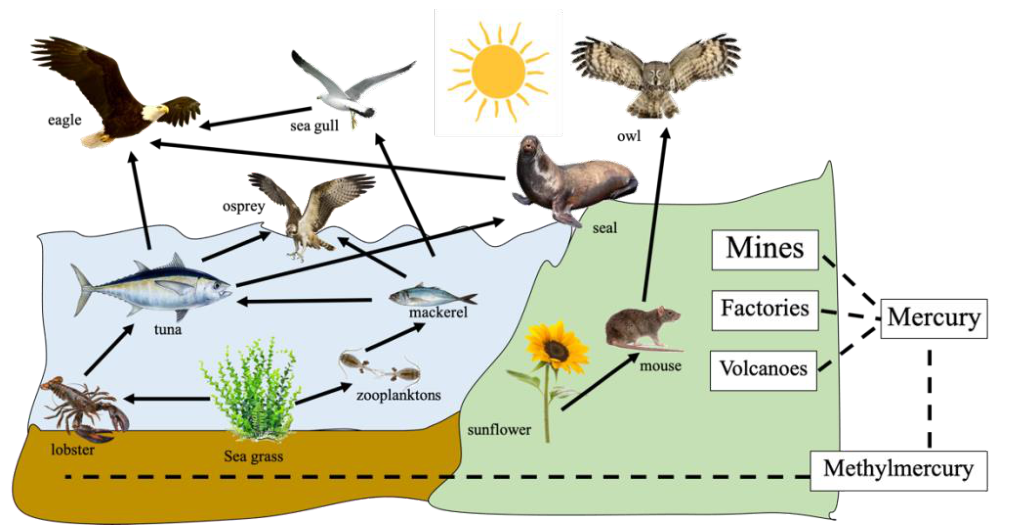
Figure 4
a. Plants/animals from which of the trophic groups are most susceptible to problems from methylmercury. Describe and explain by citing examples from the figure above. [1.5 points]
b. What are some differences between the food chain of ospreys and the food chain of owls? How might these differences in the diet of osprey and owls result in exposure to different amounts of methylmercury? [2 points]
c. Taking all factors into account, rank the following for likelihood of bioaccumulation: eagle, osprey, seals, and owls. [1.5 points]
When an animal consumes food having methylmercury residue, the methylmercury accumulates in the tissue of the animal by a process called bioaccumulation. The higher an animal is on the food chain, the greater the concentration of methylmercury in their body as a result of a process called biomagnification. Unfortunately, there is no method of cooking or cleaning fish that will reduce the amount of mercury in a meal.
Figure 4
a. Plants/animals from which of the trophic groups are most susceptible to problems from methylmercury. Describe and explain by citing examples from the figure above. [1.5 points]
b. What are some differences between the food chain of ospreys and the food chain of owls? How might these differences in the diet of osprey and owls result in exposure to different amounts of methylmercury? [2 points]
c. Taking all factors into account, rank the following for likelihood of bioaccumulation: eagle, osprey, seals, and owls. [1.5 points]