Question 4
Section C: science experiment. The supplied key prints 40 marks and a 50-minute limit. Ten points per parent task and its subpart rubric are editorial allocations; no per-task scores are printed.
## IV. A taxonomic key for mammals
**Objective:** discover how familiar mammals are classified. **Problem:** how does a taxonomic key help classify living things? **Skills:** observing, inferring, classifying. **Materials:** pencil and paper.
**Procedure**
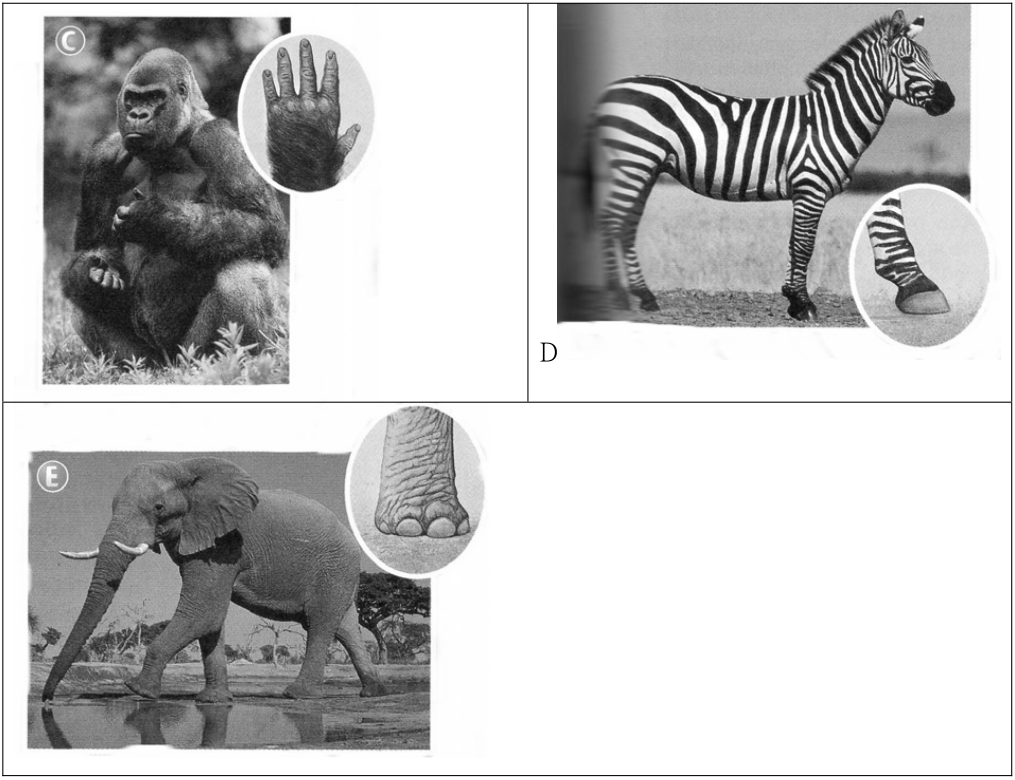
1. Observe organisms A–E. All are mammals; each belongs to a different mammalian order.
2. Use the paired statements in Table 1, beginning at Step 1 for photograph A. The source directs A to Step 2 because it lacks the specified five-digit/flexible-thumb combination. Continue until an order is identified.
3. Repeat for B–E.
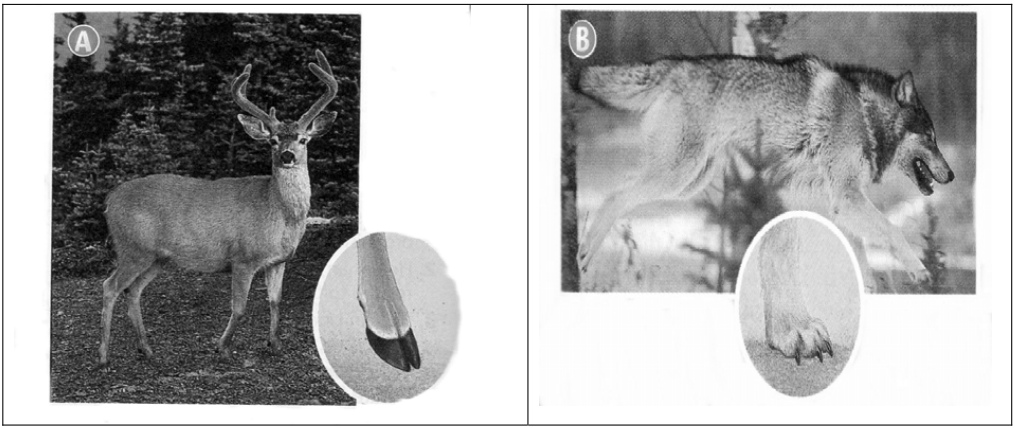
| Step | Statement | Result |
|---|---|---|
| 1a | Five digits on all limbs, and hands with flexible thumbs | Primates |
| 1b | Do not have five digits on all limbs, and hands with flexible thumbs [source wording] | Go to Step 2 |
| 2a | Limbs with claws or nails, not hooves | Go to Step 3 |
| 2b | Limbs with hooves, not claws or nails | Go to Step 4 |
| 3a | Long muscular trunks | Proboscidea |
| 3b | Sharp teeth for biting and tearing flesh | Carnivora |
| 4a | Even number of hoofed toes | Artiodactyla |
| 4b | Odd number of hoofed toes | Perissodactyla |
**Questions**
1. Name the mammalian order of each photographed organism.
2. Why must the paired statements at Step 1 be opposites?
3. Could this key classify non-mammals? Explain.
4. Could it classify different carnivores, such as foxes, skunks and walruses? Explain.
## IV. A taxonomic key for mammals
**Objective:** discover how familiar mammals are classified. **Problem:** how does a taxonomic key help classify living things? **Skills:** observing, inferring, classifying. **Materials:** pencil and paper.
**Procedure**
1. Observe organisms A–E. All are mammals; each belongs to a different mammalian order.
2. Use the paired statements in Table 1, beginning at Step 1 for photograph A. The source directs A to Step 2 because it lacks the specified five-digit/flexible-thumb combination. Continue until an order is identified.
3. Repeat for B–E.
| Step | Statement | Result |
|---|---|---|
| 1a | Five digits on all limbs, and hands with flexible thumbs | Primates |
| 1b | Do not have five digits on all limbs, and hands with flexible thumbs [source wording] | Go to Step 2 |
| 2a | Limbs with claws or nails, not hooves | Go to Step 3 |
| 2b | Limbs with hooves, not claws or nails | Go to Step 4 |
| 3a | Long muscular trunks | Proboscidea |
| 3b | Sharp teeth for biting and tearing flesh | Carnivora |
| 4a | Even number of hoofed toes | Artiodactyla |
| 4b | Odd number of hoofed toes | Perissodactyla |
**Questions**
1. Name the mammalian order of each photographed organism.
2. Why must the paired statements at Step 1 be opposites?
3. Could this key classify non-mammals? Explain.
4. Could it classify different carnivores, such as foxes, skunks and walruses? Explain.