Question 74
Consider a convex $n$-gon $A_{1} A_{2} \cdots A_{n}$. (Note: In a convex polygon, all interior angles are less than $180^{\circ}$.) Let $h$ be a positive number. Using the sides of the polygon as bases, we draw $n$ rectangles, each of height $h$, so that each rectangle is either entirely inside the $n$-gon or partially overlaps the inside of the $n$-gon.
As an example, the left figure below shows a pentagon with a correct configuration of rectangles, while the right figure shows an incorrect configuration of rectangles (since some of the rectangles do not overlap with the pentagon):
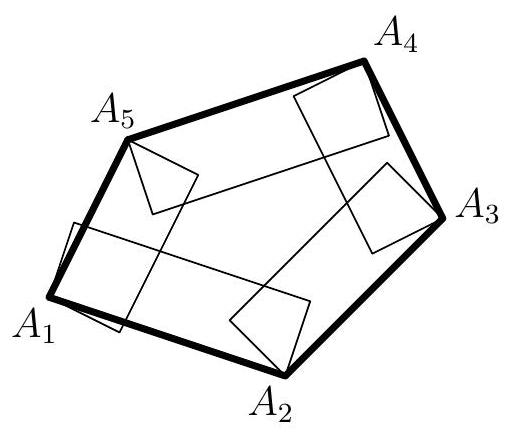
(a) Correct
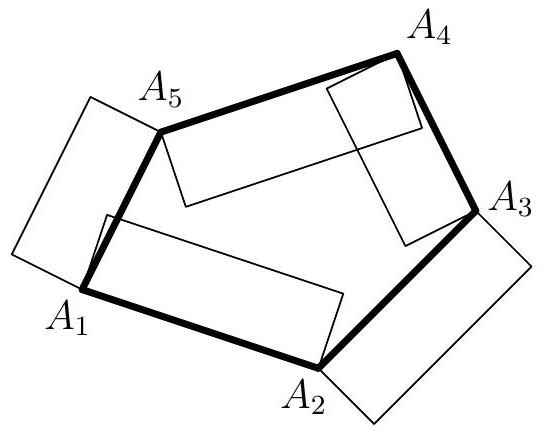
(b) Incorrect
Prove that it is always possible to choose the number $h$ so that the rectangles completely cover the interior of the $n$-gon and the total area of the rectangles is no more than twice the area of the $n$-gon.
As an example, the left figure below shows a pentagon with a correct configuration of rectangles, while the right figure shows an incorrect configuration of rectangles (since some of the rectangles do not overlap with the pentagon):
(a) Correct
(b) Incorrect
Prove that it is always possible to choose the number $h$ so that the rectangles completely cover the interior of the $n$-gon and the total area of the rectangles is no more than twice the area of the $n$-gon.