Question 100
We want to cover a grid board with certain small pieces, without overlapping and so that no part of them lies outside the board. We will use pieces made of unit squares, called L-triominoes and I-triominoes, which can be rotated into the positions shown in the following figure.

To prove that a covering is possible, it suffices to show a way of placing the pieces. On the other hand, to prove that some covering is not possible, it is not always convenient to test all possible configurations of pieces, and we often need to devise clever arguments. For example, we will prove that it is not possible to cover a $3 \times 3$ board using only L-triominoes.
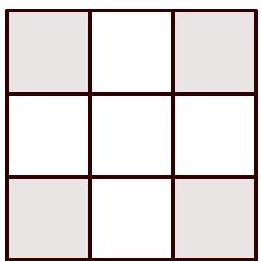
Look at the shaded squares in the figure. There are 4 squares and it is not possible to cover two of them with the same L-triomino. Thus, to cover the 4 squares we would have to use at least $4$ L-triominoes, but this would result in $4 \cdot 3=12$ covered squares, which clearly exceeds the total of 9 squares of the whole board. Therefore, it is not possible to cover the $3 \times 3$ board with L-triominoes.
a) Show a way of covering a $3 \times 4$ board using only L-triominoes.
b) Prove that it is not possible to cover a $3 \times 5$ board using only L-triominoes.
c) It is possible to cover the $3 \times 5$ board using exactly one I-triomino and some L-triominoes. Determine the positions that the I-triomino can occupy so that the rest of the board can be covered with L-triominoes.
To prove that a covering is possible, it suffices to show a way of placing the pieces. On the other hand, to prove that some covering is not possible, it is not always convenient to test all possible configurations of pieces, and we often need to devise clever arguments. For example, we will prove that it is not possible to cover a $3 \times 3$ board using only L-triominoes.
Look at the shaded squares in the figure. There are 4 squares and it is not possible to cover two of them with the same L-triomino. Thus, to cover the 4 squares we would have to use at least $4$ L-triominoes, but this would result in $4 \cdot 3=12$ covered squares, which clearly exceeds the total of 9 squares of the whole board. Therefore, it is not possible to cover the $3 \times 3$ board with L-triominoes.
a) Show a way of covering a $3 \times 4$ board using only L-triominoes.
b) Prove that it is not possible to cover a $3 \times 5$ board using only L-triominoes.
c) It is possible to cover the $3 \times 5$ board using exactly one I-triomino and some L-triominoes. Determine the positions that the I-triomino can occupy so that the rest of the board can be covered with L-triominoes.