Question 117
Consider a positive integer $n \ge 2$ and a $n \times n$ square (see the figure). The main diagonal of this square consists of the hatched squares. We write 0 into the $1 \times 1$ squares situated below the main diagonal and nonzero natural numbers into the other $1 \times 1$ squares (including the hatched ones). After filling all the squares, we calculate the sum of the numbers situated on each row and on each column, obtaining $2n$ sums.
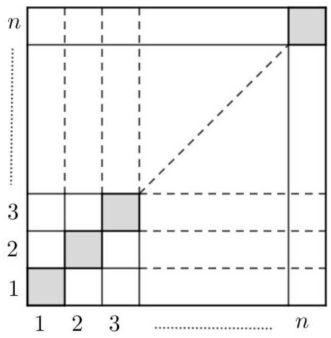
We call the $n \times n$ square *lucky* if the $2n$ sums are, in a certain order, equal to $1, 2, \dots, 2n$.
a) Show that there doesn't exist any $5 \times 5$ lucky square.
b) Determine the largest number that may appear in a $4 \times 4$ lucky square.
We call the $n \times n$ square *lucky* if the $2n$ sums are, in a certain order, equal to $1, 2, \dots, 2n$.
a) Show that there doesn't exist any $5 \times 5$ lucky square.
b) Determine the largest number that may appear in a $4 \times 4$ lucky square.