Question 134
A semicircle is correctly placed in a larger semicircle if their diameters are parallel, the endpoints of the diameter of the smaller semicircle lie on the arc of the larger semicircle, and the arc of the smaller semicircle touches the diameter of the larger semicircle.
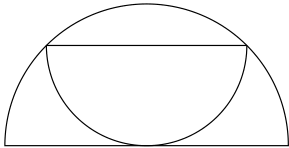
A sequence of semicircles $K_1, K_2, K_3, \dots$ is given, so that the semicircle $K_{n+1}$ is correctly placed in $K_n$ for every positive integer $n$. The area inside $K_n$ that is outside $K_{n+1}$ is coloured in blue for odd $n$, and in yellow for even $n$.
The radius of the semicircle $K_1$ equals $1$. Find the total area that is coloured in blue. (Mea Bombardelli, Matko Ljulj)