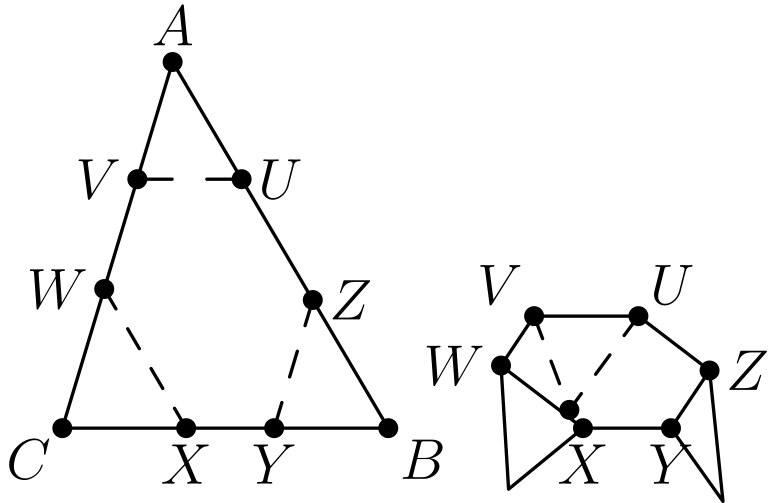
Question 8
In $\triangle ABC,$ $BC = 23,$ $CA = 27,$ and $AB = 30.$ Points $V$ and $W$ are on $\overline{AC}$ with $V$ on $\overline{AW},$ points $X$ and $Y$ are on $\overline{BC}$ with $X$ on $\overline{CY},$ and points $Z$ and $U$ are on $\overline{AB}$ with $Z$ on $\overline{BU}.$ In addition, the points are positioned so that $\overline{UV} \parallel \overline{BC},$ $\overline{WX} \parallel \overline{AB},$ and $\overline{YZ} \parallel \overline{CA}.$ Right angle folds are then made along $\overline{UV},$ $\overline{WX},$ and $\overline{YZ}.$ The resulting figure is placed on a level floor to make a table with triangular legs. Let $h$ be the maximum possible height of a table constructed from $\triangle ABC$ whose top is parallel to the floor. Then $h$ can be written in the form $\frac{k\sqrt{m}}{n},$ where $k$ and $n$ are relatively prime positive integers and $m$ is a positive integer that is not divisible by the square of any prime. Find $k + m + n.$