Question 1
Let $n\ge5$ be an integer. Consider $n$ squares with side lengths $1,2,\ldots,n$, respectively. The squares are arranged in the plane with their sides parallel to the $x$ and $y$ axes. Suppose that no two squares touch, except possibly at their vertices.
Show that it is possible to arrange these squares in a way such that every square touches exactly two other squares.
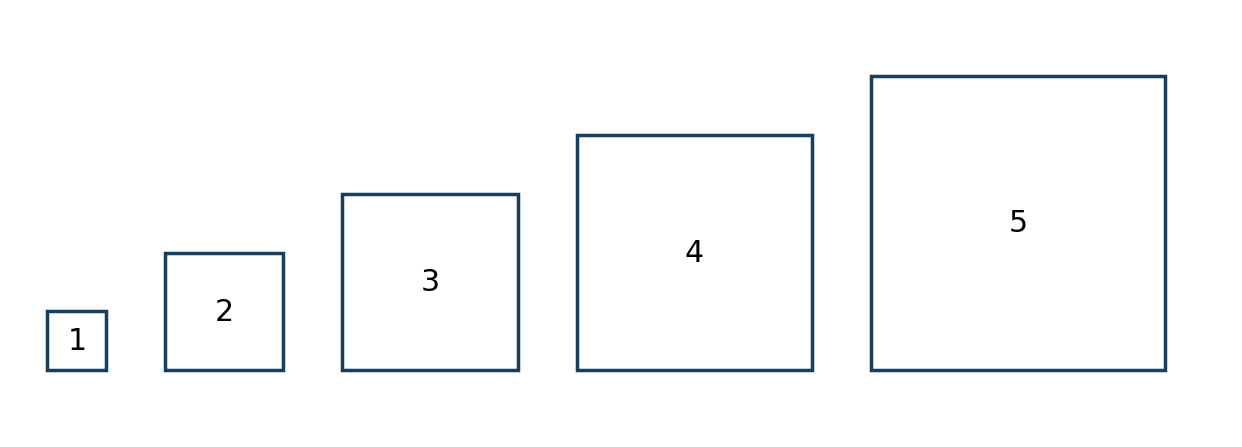
AI illustration of the input squares for $n=5$, before arranging them:
Show that it is possible to arrange these squares in a way such that every square touches exactly two other squares.
AI illustration of the input squares for $n=5$, before arranging them: