Question 144
For each positive integer $n$, we consider a $3n \times 3n$ chessboard, and its squares are colored black and white as follows: Starting from the upper left corner square, every third diagonal is black and all other squares are white, as in the figure.
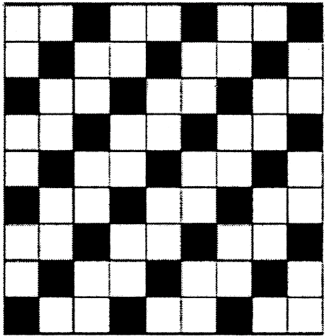
At each move we select a $2 \times 2$ square and we change the color of its squares as follows: The white squares become orange, the orange ones (if there exist any) become black and the black ones become white. Our target is, after a finite number of moves, to obtain a chessboard with all black squares of the initial placement changed to white and all white squares of the initial placement changed to black. Prove that:
a) The target is not feasible for $n = 3$.
b) The target is feasible for $n = 2$.