Question 89
Rectangle $R_{0}$ has sides of lengths $3$ and $4$. Rectangles $R_{1}$, $R_{2}$, and $R_{3}$ are formed such that:
- all four rectangles share a common vertex $P$,
- for each $n=1,2,3$, one side of $R_{n}$ is a diagonal of $R_{n-1}$,
- for each $n=1,2,3$, the opposite side of $R_{n}$ passes through a vertex of $R_{n-1}$ such that the center of $R_{n}$ is located counterclockwise of the center of $R_{n-1}$ with respect to $P$.
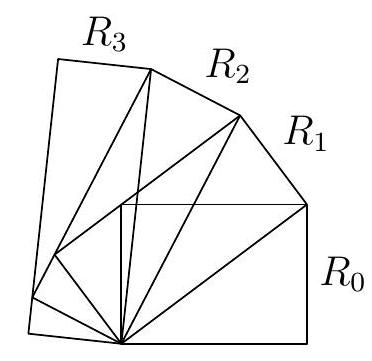
Compute the total area covered by the union of the four rectangles.
- all four rectangles share a common vertex $P$,
- for each $n=1,2,3$, one side of $R_{n}$ is a diagonal of $R_{n-1}$,
- for each $n=1,2,3$, the opposite side of $R_{n}$ passes through a vertex of $R_{n-1}$ such that the center of $R_{n}$ is located counterclockwise of the center of $R_{n-1}$ with respect to $P$.
Compute the total area covered by the union of the four rectangles.