Question 14
On top of a rectangular card with sides of length $1$ and $2 + \sqrt{3}$, an identical card is placed so that two of their diagonals line up, as shown ($AC$, in this case).
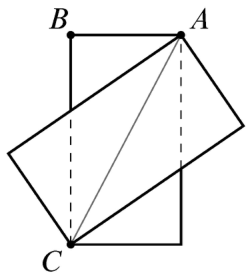
Continue the process, adding a third card to the second, and so on, lining up successive diagonals after rotating clockwise. In total, how many cards must be used until a vertex of a new card lands exactly on the vertex labeled $B$ in the figure?
(A) 6 (B) 8 (C) 10 (D) 12 (E) No new vertex will land on $B$.