Question 75
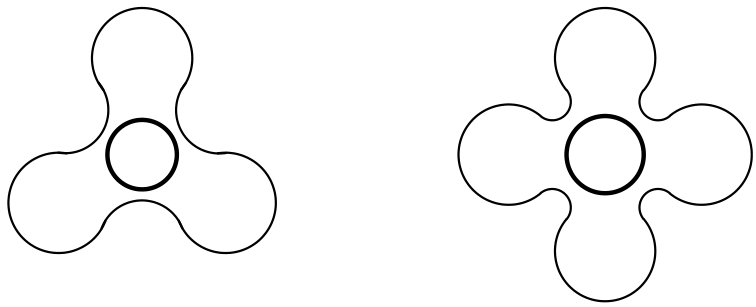
For $n \ge 2$, an *n-spinner* is a “fidget spinner” with $n$ identical arms and an angle of $360/n$ degrees between pairs of adjacent arms. For instance, a $3$-spinner and a $4$-spinner are illustrated below:
We wish to place each of the numbers $1, \ldots, nm$ on the arms of an $n$-spinner, with $m$ numbers placed on each arm, all equally spaced in a row. Some possibilities for $(n, m) = (4, 2)$ are illustrated below.
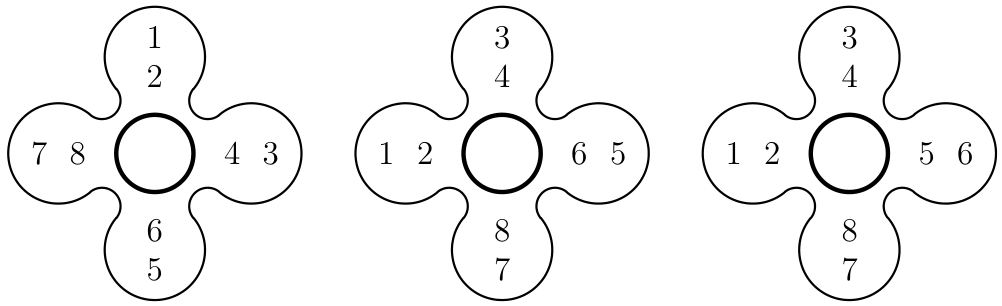
Since the first two can be obtained by rotation from each other, they are considered to be the same, and so we count the above as only two different placements. (The third is genuinely different because the “5” is closer to the middle than it is in the other two.) Counting in this manner, how many different placements do we obtain for given $n \ge 2$ and $m \ge 1$?
We wish to place each of the numbers $1, \ldots, nm$ on the arms of an $n$-spinner, with $m$ numbers placed on each arm, all equally spaced in a row. Some possibilities for $(n, m) = (4, 2)$ are illustrated below.
Since the first two can be obtained by rotation from each other, they are considered to be the same, and so we count the above as only two different placements. (The third is genuinely different because the “5” is closer to the middle than it is in the other two.) Counting in this manner, how many different placements do we obtain for given $n \ge 2$ and $m \ge 1$?