Question 160
(a) A quadrilateral with equal opposite sides is a parallelogram. The following figures show two parallelograms with the same sides, the second being a rectangle. Determine the largest possible area of a parallelogram of sides $b$ and $h$. 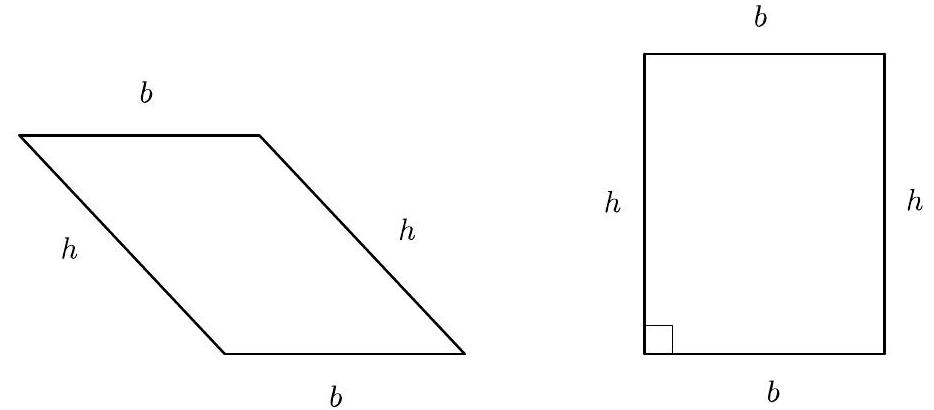
(b) Consider the following two figures, where $a, b, x$ and $y$ are positive real numbers. Show that the second figure has a larger area.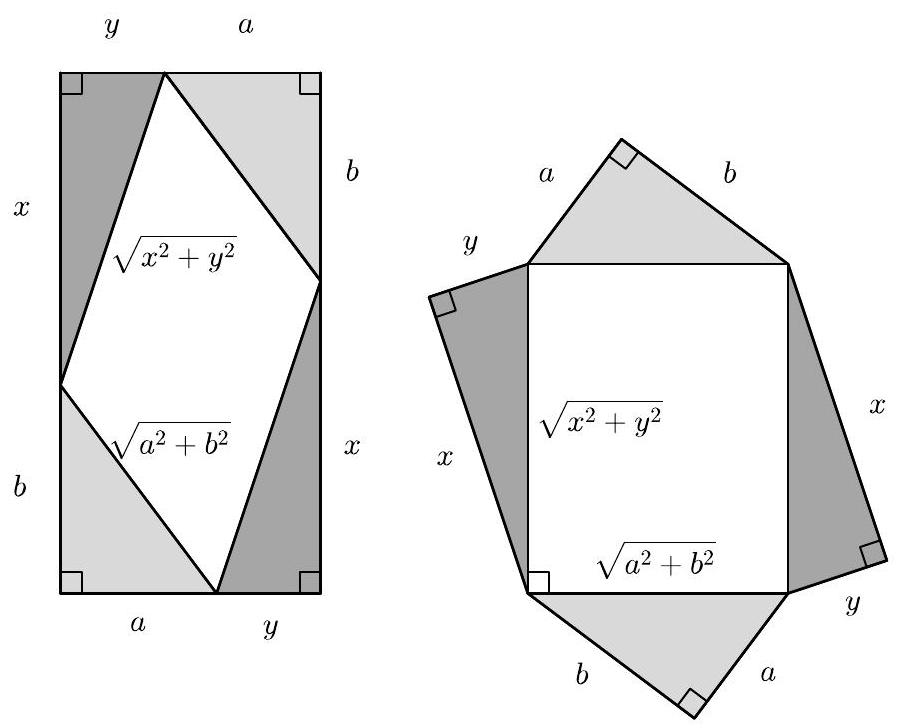
(c) Using the result of the previous item, prove the inequality of Cauchy-Schwarz for two terms, described by the following inequality: $$
a x+b y \leq \sqrt{a^{2}+b^{2}} \cdot \sqrt{x^{2}+y^{2}}
$$
(b) Consider the following two figures, where $a, b, x$ and $y$ are positive real numbers. Show that the second figure has a larger area.
(c) Using the result of the previous item, prove the inequality of Cauchy-Schwarz for two terms, described by the following inequality: $$
a x+b y \leq \sqrt{a^{2}+b^{2}} \cdot \sqrt{x^{2}+y^{2}}
$$