Question 144
Be $ABC$ an acute triangle with $AB \neq AC$. Consider all rectangles with two vertices on the side $BC$, one on the side $AB$ and one on the side $AC$. We will call the center of the rectangle the meeting point of the diagonals. In the following figure, the center of the rectangle $DEFG$ is the point $P$.
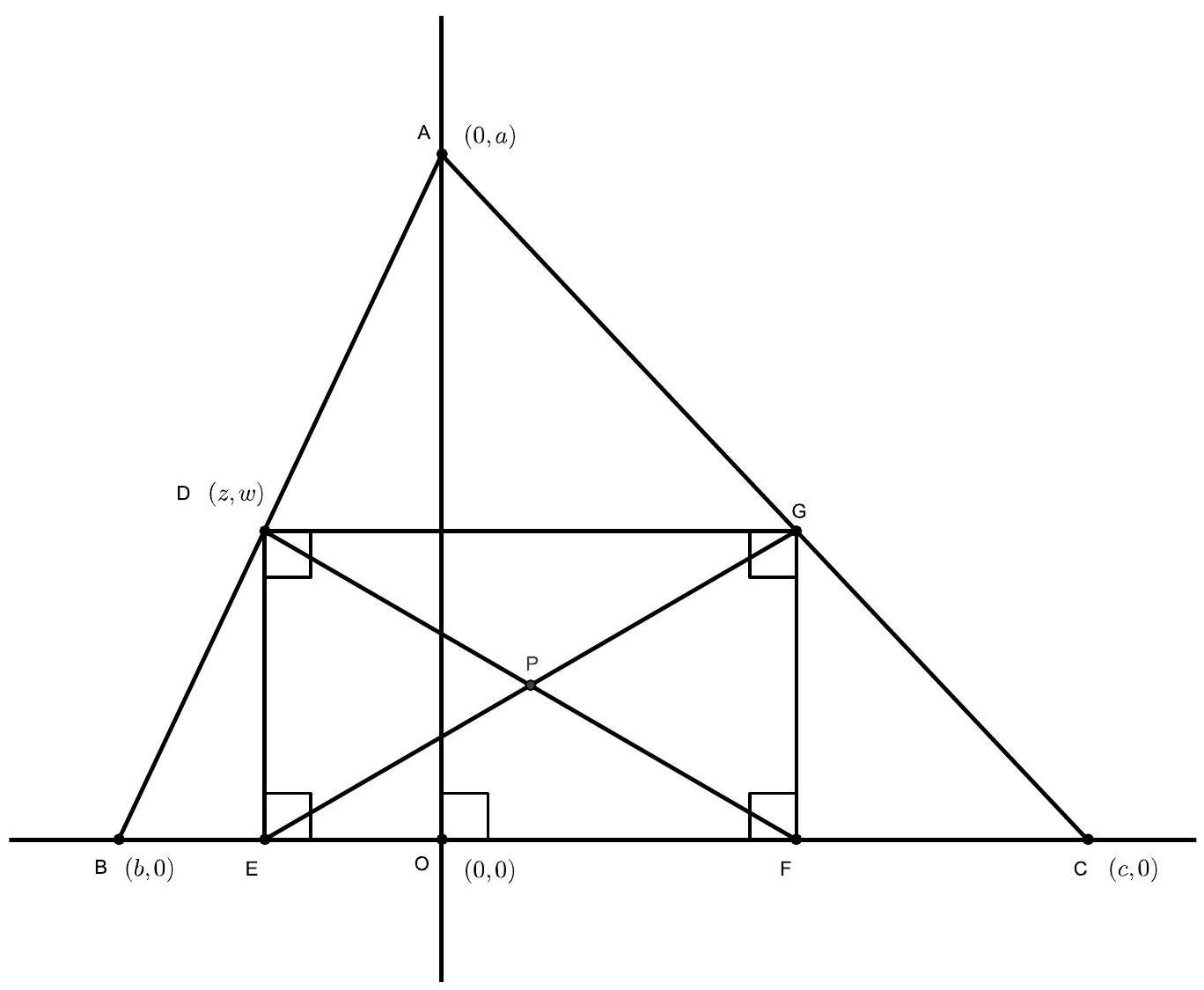
It is intended to determine the geometric place determined by the centers of these rectangles, that is, if all possible centers were marked, which figure would be formed by the union of these points. To solve this problem, we will use analytical geometry. Be $O$ the height of the height for $A$ next to $BC$. Consider the coordinate system with origin in $O$, axis $x$ over the line $BC$ and axis $y$ over the line $OA$. So we can score the points $O=(0,0), A=(0, a)$, $B=(b, 0)$ e $C=(c, 0)$. It is worth mentioning that $AB \neq AC$ We can say that $b \neq -c$, that is, $b+c \neq 0$.
a) Determine the coordinates of the midpoints $M$ e $N$ of the segments $OA$ e $BC$, respectively. Then determine the equation of the line $MN$.
b) If we consider the coordinates of the point $D=(z, w)$, what are the coordinates of the points $E, F$ e $G$?
c) The center of the rectangle is the encounter of the diagonals and, as every rectangle is a parallelogram, it coincides with the midpoint of the diagonal $DF$. Determine the coordinates of this point and conclude that it is on the line $MN$.