M sold some apples for a certain total amount. Selling $10$ more apples for the same total would reduce the price per apple by $2$ baht. Selling $10$ fewer would increase the price per apple by $4$ baht. (a) How many apples did M sell? (b) What was the original price per apple?
Bag A initially has twice as many beads as bag B. Transfer $12\%$ of A and $20\%$ of B to bag C. C then has $488$ beads, $22\%$ more than before. How many beads were originally in A?
Cities P and Q are $625$ km apart. M leaves P for Q at $5{:}30$ a.m., travelling at $100$ km/h. N leaves Q for P $15$ minutes later at $80$ km/h. At what time do they meet?
Alan has $80\%$ more stamps than Billy. Billy has $3/5$ as many as Charlie. If Billy gives Charlie $150$ stamps, Charlie will have three times Billy’s remaining count. Find the original total.
A leaking boat is $50$ km from port. Water enters at $2$ tonnes per $5$ minutes; a pump removes $12$ tonnes per hour. The boat sinks if there are $90$ tonnes of water aboard. What minimum speed in km/h prevents sinking?
A box contains $20$ red, $30$ white and some blue marbles. A randomly drawn marble has probability $9/11$ of being blue. How many blue marbles are there?
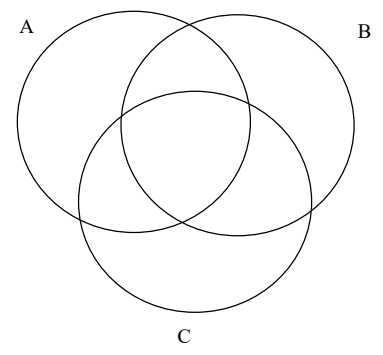
Place $1749,3250,7893,2025,1348,2001,112,102,48,2030,930,207,750,1605$ in the Venn diagram: A contains numbers divisible by $5$, B by $2$, and C by $3$.
Use each digit $1,2,3,4,5,6,7,8,9$ exactly once to form a five-digit number, a three-digit number and a one-digit number whose product is as large as possible. Fill the boxes in the original figure.
Peter donates $144$ books to four schools A, B, C, D. Their pairwise differences satisfy $|A-B|=4$, $|B-C|=3$, $|C-D|=2$. A receives the most books, fewer than $40$. (a) How many valid allocations to B and D are possible? (b) How many books do B and D receive?
Quadrilateral $ABCD$ has area $6174\text{ cm}^2$. E and F are the midpoints of $AB$ and $CD$. G lies on $BC$ with $CG=2GB$, and H lies on $AD$ with $AH=2HD$. Find $[EGFH]$.
Alloy M contains $95\%$ bronze, $4\%$ tin and $1\%$ zinc. Alloy N contains only bronze and tin. The source says M and N are mixed “in equal proportion”; the result contains $86\%$ bronze, $13.6\%$ tin and $0.4\%$ zinc. Find the percentage of bronze in N. (An alloy is a mixture of metals.)