For which positive integers $m$ does there exist an infinite sequence in $\mathbb Z/m\mathbb Z$ which is both an arithmetic progression and a geometric progression, but is nonconstant?
Proposed by Holden Mui. Source: Evan Chen’s third-party compilation; https://aops.com/community/p24774800. One editorial point; manual grading.
Let $a,b$ be positive integers. Every cell of an $(a+b+1)\times(a+b+1)$ grid is amber or bronze, with at least $a^2+ab-b$ amber and at least $b^2+ab-a$ bronze cells. Prove that one can choose $a$ amber and $b$ bronze cells, no two in the same row or column.
Proposed by Ankan Bhattacharya. Source: Evan Chen’s third-party solution notes; https://aops.com/community/p24774812. One point is a nonofficial editorial normalization; this essay requires manual grading.
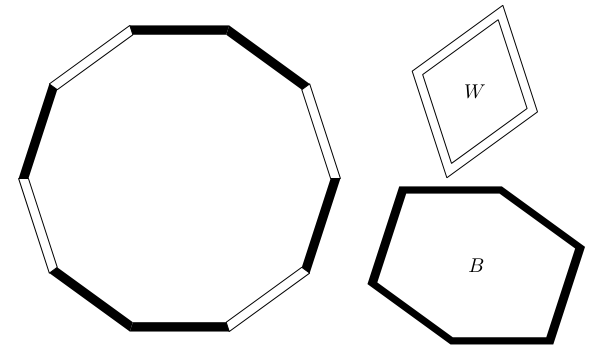
Let $b,w\ge2$ be integers and $n=b+w$. Assemble a regular $2n$-gon from $2b$ black and $2w$ white unit rods so that parallel sides have the same color. Translate the black rods to form a convex $2b$-gon $B$, and the white rods to form a convex $2w$-gon $W$. Prove that $[B]-[W]$ depends only on $b,w$, not the assembly. The source example has $b=3,w=2$.
Proposed by Ankan Bhattacharya. Source: Evan Chen’s third-party solution notes; https://aops.com/community/p24775345. One point is a nonofficial editorial normalization; this essay requires manual grading.
Let $ABCD$ be a rhombus. Points $K,L$ satisfy that $K$ is inside the rhombus, $L$ is outside it, and $KA=KB=LC=LD$. Prove that there are points $X,Y$ on lines $AC,BD$, respectively, such that $KXLY$ is a rhombus.
Proposed by Ankan Bhattacharya. Source: Evan Chen’s third-party compilation; https://aops.com/community/p24774741. One editorial point; manual grading.
Find all pairs of primes $(p,q)$ for which $p-q$ and $pq-q$ are both perfect squares.
Proposed by Holden Mui. Source: Evan Chen’s third-party solution notes; https://aops.com/community/p24774670. One point is a nonofficial editorial normalization; this essay requires manual grading.
Suppose $\max\{|a_n|,|b_n|,|c_n|\}\le2022$ for all $n\ge0$. Prove $|a_0|^2+|b_0|^2+|c_0|^2\le1$.
Proposed by Ankan Bhattacharya. Source: Evan Chen’s third-party compilation; https://aops.com/community/p24775314. One editorial point; manual grading.