In the year $2001,$ the United States will host the International Mathematical Olympiad. Let $I,$ $M,$ and $O$ be distinct positive integers such that the product $I \cdot M \cdot O = 2001.$ What is the largest possible value of the sum $I + M + O?$
Each day, Jenny ate $20\%$ of the jellybeans that were in her jar at the beginning of that day. At the end of the second day, $32$ remained. How many jellybeans were in the jar originally?
The Fibonacci sequence $1,$ $1,$ $2,$ $3,$ $5,$ $8,$ $13,$ $21,$ $\ldots$ starts with two $1$s, and each term afterwards is the sum of its two predecessors. Which one of the ten digits is the last to appear in the units position of a number in the Fibonacci sequence?
Two different prime numbers between $4$ and $18$ are chosen. When their sum is subtracted from their product, which of the following numbers could be obtained?
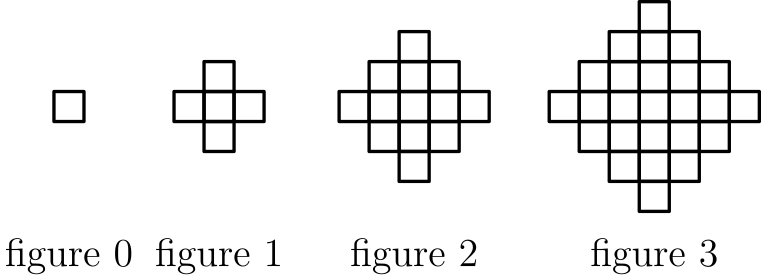
Figures $0,$ $1,$ $2,$ and $3$ consist of $1,$ $5,$ $13,$ and $25$ nonoverlapping unit squares, respectively. If the pattern were continued, how many nonoverlapping unit squares would there be in figure $100?$
Mrs. Walter gave an exam in a mathematics class of five students. She entered the scores in random order into a spreadsheet, which recalculated the class average after each score was entered. Mrs. Walter noticed that after each score was entered, the average was always an integer. The scores (listed in ascending order) were $71,$ $76,$ $80,$ $82,$ and $91.$ What was the last score Mrs. Walter entered?
The point $P = (1, 2, 3)$ is reflected in the $xy$-plane, then its image $Q$ is rotated by $180^\circ$ about the $x$-axis to produce $R,$ and finally, $R$ is translated by $5$ units in the positive $y$ direction to produce $S.$ What are the coordinates of $S?$
Let $A,$ $M,$ and $C$ be nonnegative integers such that $A + M + C = 12.$ What is the maximum value of $$
\begin{aligned} &A \cdot M \cdot C + A \cdot M \\ &\quad {}+ M \cdot C + C \cdot A? \end{aligned}
$$
One morning each member of Angela’s family drank an $8$-ounce mixture of coffee with milk. The amounts of coffee and milk varied from cup to cup, but were never zero. Angela drank a quarter of the total amount of milk and a sixth of the total amount of coffee. How many people are in the family?
A checkerboard of $13$ rows and $17$ columns has a number written in each square, beginning in the upper left corner, so that the first row is numbered $1,$ $2,$ $\ldots,$ $17,$ the second row $18,$ $19,$ $\ldots,$ $34,$ and so on down the board. If the board is renumbered so that the left column, top to bottom, is $1,$ $2,$ $\ldots,$ $13,$ the second column $14,$ $15,$ $\ldots,$ $26$ and so on across the board, some squares have the same numbers in both numbering systems. Find the sum of the numbers in these squares (under either system).
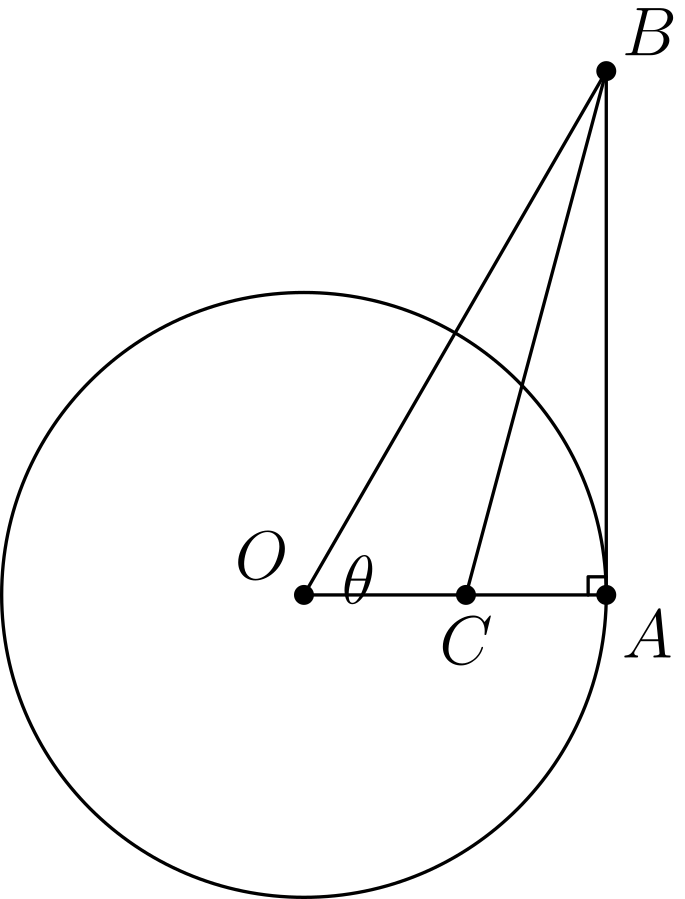
A circle centered at $O$ has radius $1$ and contains the point $A.$ Segment $AB$ is tangent to the circle at $A$ and $\angle AOB = \theta.$ If point $C$ lies on $\overline{OA}$ and $BC$ bisects $\angle ABO,$ then what is $OC?$
In year $N,$ the $300$th day of the year is a Tuesday. In year $N + 1,$ the $200$th day is also a Tuesday. On what day of the week did the $100$th day of year $N - 1$ occur?
In triangle $ABC,$ $AB = 13,$ $BC = 14,$ and $AC = 15.$ Let $D$ denote the midpoint of $\overline{BC}$ and let $E$ denote the intersection of $\overline{BC}$ with the bisector of angle $BAC.$ Which of the following is closest to the area of triangle $ADE?$
If $x,$ $y,$ and $z$ are positive numbers satisfying $$
x + \frac{1}{y} = 4,
$$ $$
y + \frac{1}{z} = 1,
$$ and $$
z + \frac{1}{x} = \frac{7}{3},
$$ then what is $xyz?$