Skip to content / Đến nội dung
ThichHocToan.com

Question bank AMC12 1980

Exam papers

30 questions

Question 1

The largest whole number such that seven times the number is less than $100$ is
  1. $12$
  2. $13$
  3. $14$
  4. $15$
  5. $16$

Question 2

The degree of $(x^2+1)^4(x^3+1)^3$ as a polynomial in $x$ is
  1. $5$
  2. $7$
  3. $12$
  4. $17$
  5. $72$

Question 3

If the ratio of $2x-y$ to $x+y$ is $\frac23,$ what is the ratio of $x$ to $y?$
  1. $\frac15$
  2. $\frac45$
  3. $1$
  4. $\frac65$
  5. $\frac54$

Question 4

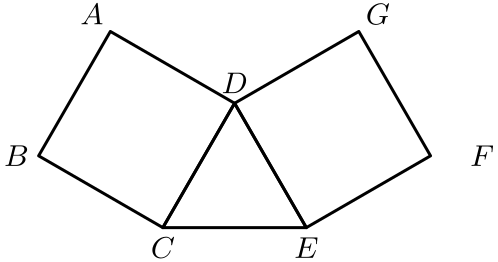
In the adjoining figure, $CDE$ is an equilateral triangle and $ABCD$ and $DEFG$ are squares. The measure of $\angle GDA$ is

Question illustration
  1. $90^\circ$
  2. $105^\circ$
  3. $120^\circ$
  4. $135^\circ$
  5. $150^\circ$

Question 5

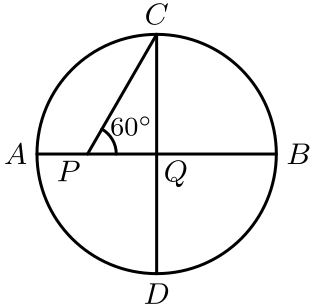
If $AB$ and $CD$ are perpendicular diameters of circle $Q,$ $P$ in $AQ,$ and $\angle QPC=60^\circ,$ then the length of $PQ$ divided by the length of $AQ$ is

Question illustration
  1. $\frac{\sqrt3}{2}$
  2. $\frac{\sqrt3}{3}$
  3. $\frac{\sqrt2}{2}$
  4. $\frac12$
  5. $\frac23$

Question 6

A positive number $x$ satisfies the inequality $\sqrt x\lt2x$ if and only if
  1. $x\gt\frac14$
  2. $x\gt2$
  3. $x\gt4$
  4. $x\lt\frac14$
  5. $x\lt4$

Question 7

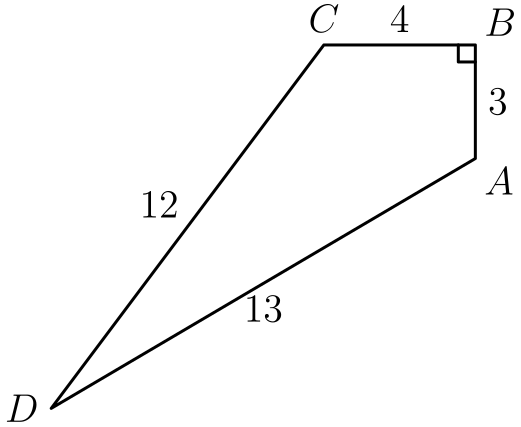
Sides $AB,$ $BC,$ $CD,$ and $DA$ of convex polygon $ABCD$ have lengths $3,$ $4,$ $12,$ and $13,$ respectively; and $\angle CBA$ is a right angle. The area of the quadrilateral is

Question illustration
  1. $32$
  2. $36$
  3. $39$
  4. $42$
  5. $48$

Question 8

How many pairs $(a,b)$ of nonzero real numbers satisfy the equation $$
\frac1a+\frac1b=\frac1{a+b}?
$$
  1. none
  2. $1$
  3. $2$
  4. one pair for each $b\ne0$
  5. two pairs for each $b\ne0$

Question 9

A man walks $x$ miles due west, turns $150^\circ$ to his left and walks $3$ miles in the new direction. If he finishes at a point $\sqrt3$ miles from his starting point, then $x$ is
  1. $\sqrt3$
  2. $2\sqrt3$
  3. $\frac32$
  4. $3$
  5. not uniquely determined by the given
    information

Question 10

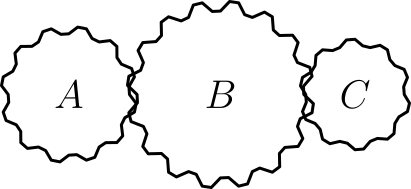
The number of teeth in three meshed circular gears $A,$ $B,$ $C$ are $x,$ $y,$ $z,$ respectively. (The teeth on all gears are the same size and regularly spaced as in the figure.) The angular speeds, in revolutions per minute, of $A,$ $B,$ $C$ are in the proportion

Question illustration
  1. $x:y:z$
  2. $z:y:x$
  3. $y:z:x$
  4. $yz:xz:xy$
  5. $xz:yx:zy$

Question 11

If the sum of the first $10$ terms and the sum of the first $100$ terms of a given arithmetic progression are $100$ and $10,$ respectively, then the sum of the first $110$ terms is
  1. $90$
  2. $-90$
  3. $110$
  4. $-110$
  5. $-100$

Question 12

The equations of $L_1$ and $L_2$ are $y=mx$ and $y=nx,$ respectively. Suppose $L_1$ makes twice as large an angle with the horizontal (measured counterclockwise from the positive $x$-axis) as does $L_2,$ and that $L_1$ has $4$ times the slope of $L_2.$ If $L_1$ is not horizontal, then $mn$ is
  1. $\frac{\sqrt2}{2}$
  2. $-\frac{\sqrt2}{2}$
  3. $2$
  4. $-2$
  5. not uniquely determined by the given information

Question 13

A bug (of negligible size) starts at the origin on the coordinate plane. First it moves $1$ unit right to $(1,0).$ Then it makes a $90^\circ$ turn counterclockwise and travels $\frac12$ a unit to $(1,\frac12).$ If it continues in this fashion, each time making a $90^\circ$ turn counterclockwise and traveling half as far as in the previous move, to which of the following points will it come closest?
  1. $(\frac23,\frac23)$
  2. $(\frac45,\frac25)$
  3. $(\frac23,\frac45)$
  4. $(\frac23,\frac13)$
  5. $(\frac25,\frac45)$

Question 14

If $c$ is a constant and the function $f$ defined by $$
\begin{gathered} f(x)=\frac{cx}{2x+3},\\ x\ne-\frac32, \end{gathered}
$$ satisfies $f(f(x))=x$ for all real numbers $x$ except $-\frac32,$ then $c$ is
  1. $-3$
  2. $-\frac32$
  3. $\frac32$
  4. $3$
  5. not uniquely determined by the given information

Question 15

A store prices an item in dollars and cents so that when $4\%$ sales tax is added no rounding is necessary because the result is exactly $n$ dollars, where $n$ is a positive integer. The smallest value of $n$ is
  1. $1$
  2. $13$
  3. $25$
  4. $26$
  5. $100$

Question 16

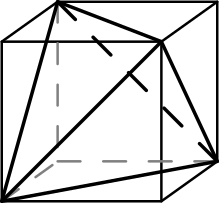
Four of the eight vertices of a cube are vertices of a regular tetrahedron. Find the ratio of the surface area of the cube to the surface area of the tetrahedron.

Question illustration
  1. $\sqrt2$
  2. $\sqrt3$
  3. $\sqrt{\frac32}$
  4. $\frac2{\sqrt3}$
  5. $2$

Question 17

Given that $i^2=-1,$ for how many integers $n$ is $(n+i)^4$ an integer?
  1. none
  2. $1$
  3. $2$
  4. $3$
  5. $4$

Question 18

If $b\gt1,$ $\sin x\gt0,$ $\cos x\gt0$ and $\log_b\sin x=a,$ then $\log_b\cos x$ equals
  1. $2\log_b(1-b^{\frac{a}{2}})$
  2. $\sqrt{1-a^2}$
  3. $b^{a^2}$
  4. $\frac12\log_b(1-b^{2a})$
  5. none of these

Question 19

Let $C_1,$ $C_2,$ and $C_3$ be three parallel chords of a circle on the same side of the center. The distance between $C_1$ and $C_2$ is the same as the distance between $C_2$ and $C_3.$ The lengths of the chords are $20,$ $16,$ and $8.$ The radius of the circle is
  1. $12$
  2. $4\sqrt7$
  3. $\frac{5\sqrt{65}}3$
  4. $\frac{5\sqrt{22}}2$
  5. not uniquely determined by the given information

Question 20

A box contains $2$ pennies, $4$ nickels and $6$ dimes. Six coins are drawn without replacement, with each coin having an equal probability of being chosen. What is the probability that the value of the coins drawn is at least $50$ cents?
  1. $\frac{37}{924}$
  2. $\frac{91}{924}$
  3. $\frac{127}{924}$
  4. $\frac{132}{924}$
  5. none of these