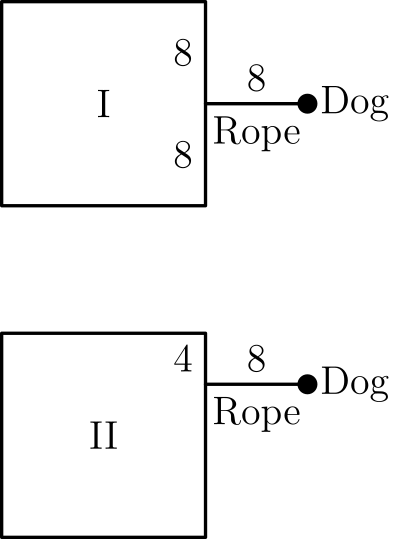
Doug and Dave shared a pizza with $8$ equally-sized slices. Doug wanted a plain pizza, but Dave wanted anchovies on half of the pizza. The cost of a plain pizza was $\$8,$ and there was an additional cost of $\$2$ for putting anchovies on one half. Dave ate all the slices of anchovy pizza and one plain slice. Doug ate the remainder. Each then paid for what he had eaten. How many more dollars did Dave pay than Doug?
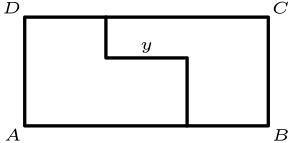
The $8 \times 18$ rectangle $ABCD$ is cut into two congruent hexagons, as shown, in such a way that the two hexagons can be repositioned without overlap to form a square. What is $y?$
A player pays $\$5$ to play a game. A die is rolled. If the number on the die is odd, the game is lost. If the number on the die is even, the die is rolled again. In this case the player wins if the second number matches the first and loses otherwise. How much should the player win if the game is fair? (In a fair game the probability of winning times the amount won is what the player should pay.)
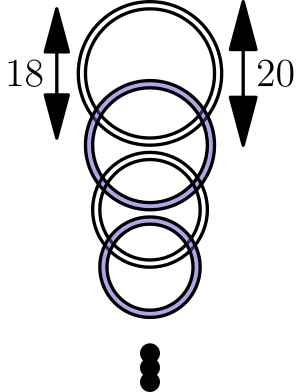
A number of linked rings, each $1$ cm thick, are hanging on a peg. The top ring has an outside diameter of $20$ cm. The outside diameter of each of the other rings is $1$ cm less than that of the ring above it. The bottom ring has an outside diameter of $3$ cm. What is the distance, in cm, from the top of the top ring to the bottom of the bottom ring?
Odell and Kershaw run for $30$ minutes on a circular track. Odell runs clockwise at $250$ m/min and uses the inner lane with a radius of $50$ meters. Kershaw runs counterclockwise at $300$ m/min and uses the outer lane with a radius of $60$ meters, starting on the same radial line as Odell. How many times after the start do they pass each other?
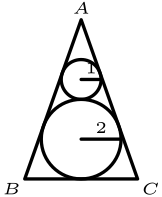
A circle of radius $1$ is tangent to a circle of radius $2.$ The sides of $\triangle ABC$ are tangent to the circles as shown, and the sides $AB$ and $AC$ are congruent. What is the area of $\triangle ABC?$
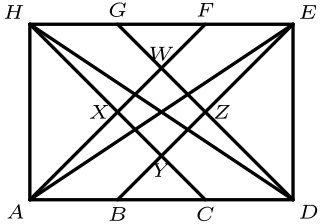
In rectangle $ADEH,$ points $B$ and $C$ trisect $\overline{AD},$ and points $G$ and $F$ trisect $\overline{HE}.$ In addition, $AH = AC = 2.$ What is the area of quadrilateral $WXYZ$ shown in the figure?
A license plate in a certain state consists of $4$ digits, not necessarily distinct, and $2$ letters, also not necessarily distinct. These six characters may appear in any order, except that the two letters must appear next to each other. How many distinct license plates are possible?
Six distinct positive integers are randomly chosen between $1$ and $2006,$ inclusive. What is the probability that some pair of these integers has a difference that is a multiple of $5?$