Assuming $a\neq3,$ $b\neq4,$ and $c\neq5,$ what is the value in simplest form of the following expression? $$
\frac{a-3}{5-c} \cdot \frac{b-4}{3-a} \cdot \frac{c-5}{4-b}
$$
A driver travels for $2$ hours at $60$ miles per hour, during which her car gets $30$ miles per gallon of gasoline. She is paid $\$0.50$ per mile, and her only expense is gasoline at $\$2.00$ per gallon. What is her net rate of pay, in dollars per hour, after this expense?
The $25$ integers from $-10$ to $14,$ inclusive, can be arranged to form a $5$-by-$5$ square in which the sum of the numbers in each row, the sum of the numbers in each column, and the sum of the numbers along each of the main diagonals are all the same. What is the value of this common sum?
A single bench section at a school event can hold either $7$ adults or $11$ children. When $N$ bench sections are connected end to end, an equal number of adults and children seated together will occupy all the bench space. What is the least possible positive integer value of $N?$
Seven cubes, whose volumes are $1,$ $8,$ $27,$ $64,$ $125,$ $216,$ and $343$ cubic units, are stacked vertically to form a tower in which the volumes of the cubes decrease from bottom to top. Except for the bottom cube, the bottom face of each cube lies completely on top of the cube below it. What is the total surface area of the tower (including the bottom) in square units?
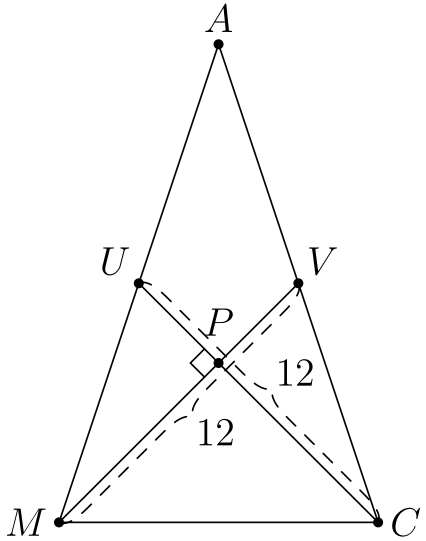
Triangle $AMC$ is isosceles with $AM = AC.$ Medians $\overline{MV}$ and $\overline{CU}$ are perpendicular to each other, and $MV=CU=12.$ What is the area of $\triangle AMC?$
A frog sitting at the point $(1, 2)$ begins a sequence of jumps, where each jump is parallel to one of the coordinate axes and has length $1,$ and the direction of each jump (up, down, right, or left) is chosen independently at random. The sequence ends when the frog reaches a side of the square with vertices $(0, 0),$ $(0, 4),$ $(4, 4),$ and $(4, 0).$ What is the probability that the sequence of jumps ends on a vertical side of the square?
A positive integer divisor of $12!$ is chosen at random. The probability that the divisor chosen is a perfect square can be expressed as $\frac{m}{n},$ where $m$ and $n$ are relatively prime positive integers. What is $m+n?$
A point is chosen at random within the square in the coordinate plane whose vertices are $(0, 0),$ $(2020, 0),$ $(2020, 2020),$ and $(0, 2020).$ The probability that the point is within $d$ units of a lattice point is $\tfrac{1}{2}.$ (A point $(x, y)$ is a lattice point if $x$ and $y$ are both integers.) What is $d$ to the nearest tenth?
Let $(a,b,c,d)$ be an ordered quadruple of not necessarily distinct integers, each one of them in the set $\{0,1,2,3\}.$ For how many such quadruples is it true that $a\cdot d-b\cdot c$ is odd? (For example, $(0,3,1,1)$ is one such quadruple, because $0\cdot 1-3\cdot 1 = -3$ is odd.)
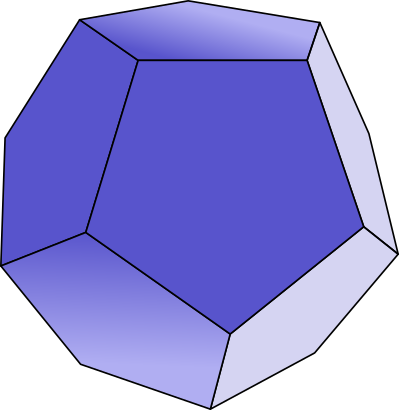
As shown in the figure below, a regular dodecahedron (the polyhedron consisting of $12$ congruent regular pentagonal faces) floats in space with two horizontal faces. Note that there is a ring of five slanted faces adjacent to the top face, and a ring of five slanted faces adjacent to the bottom face. How many ways are there to move from the top face to the bottom face via a sequence of adjacent faces so that each face is visited at most once and moves are not permitted from the bottom ring to the top ring?
Quadrilateral $ABCD$ satisfies $\angle ABC = \angle ACD = 90^{\circ},$ $AC=20,$ and $CD=30.$ Diagonals $\overline{AC}$ and $\overline{BD}$ intersect at point $E,$ and $AE=5.$ What is the area of quadrilateral $ABCD?$