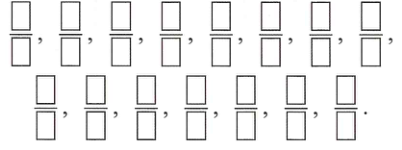
Using each number exactly once, fill in the positive integers $1$ to $30$ into the following boxes to form $15$ fractions, such that as many of these fractions as possible have integer values.
A palindrome is a positive integer which reads the same backward as forward. For example: $909$, $3553$ and $12421$ are all palindromes. Find all $5$-digit palindromes that are divisible by $44$.
A plane is divided into a number of non-overlapping polygons by using $n$ straight lines. Find the largest number of triangles that can be formed
(a) when $n=5$. (1 mark)
(b) when $n=6$. (2 marks)
(c) when $n=7$. (3 marks)
Select as many integers as possible from $1$ to $21$ so that no two disjoint pairs have the same difference. For example $\{1,3,5,13\}$ is such a collection; since the two pairs $3-1=5-3$ are not disjoint. On the other hand, $\{1,2,4,7,10\}$ is not since $4-1=10-7$. What is the maximum number of integers that can be selected?
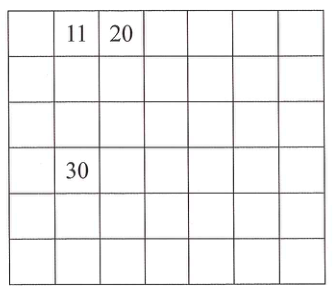
Using each of the numbers exactly once, fill in the numbers from $1$ to $42$ in each of the unit square of the $6\times7$ table so that any two consecutive numbers are in unit squares which share a common side. The numbers $11$, $20$ and $30$ are already placed as shown in the diagram below. Complete the following table.